
UNITED STATES
SECURITIES AND EXCHANGE COMMISSION
WASHINGTON, DC 20549
FORM
(Mark One)
ANNUAL REPORT PURSUANT TO SECTION 13 OR 15(d) OF THE SECURITIES EXCHANGE ACT OF 1934 |
For the fiscal year ended
OR
TRANSITION REPORT PURSUANT TO SECTION 13 OR 15(d) OF THE SECURITIES EXCHANGE ACT OF 1934 |
For the transition period from ____________________ to ____________________
Commission File Number:
(Exact Name of Registrant as Specified in its Charter)
( State or other jurisdiction of incorporation or organization) |
(I.R.S. Employer |
(Address of principal executive offices) |
(Zip Code) |
Registrant’s telephone number, including area code: (
Securities registered pursuant to Section 12(b) of the Act:
Title of each class |
|
Trading Symbol(s) |
|
Name of each exchange on which registered |
|
|
Securities registered pursuant to Section 12(g) of the Act: None
Indicate by check mark if the Registrant is a well-known seasoned issuer, as defined in Rule 405 of the Securities Act. Yes ☐
Indicate by check mark if the Registrant is not required to file reports pursuant to Section 13 or 15(d) of the Act. Yes ☐
Indicate by check mark whether the Registrant: (1) has filed all reports required to be filed by Section 13 or 15(d) of the Securities Exchange Act of 1934 during the preceding 12 months (or for such shorter period that the Registrant was required to file such reports), and (2) has been subject to such filing requirements for the past 90 days.
Indicate by check mark whether the Registrant has submitted electronically every Interactive Data File required to be submitted pursuant to Rule 405 of Regulation S-T (§232.405 of this chapter) during the preceding 12 months (or for such shorter period that the Registrant was required to submit such files).
Indicate by check mark whether the registrant is a large accelerated filer, an accelerated filer, a non-accelerated filer, smaller reporting company, or an emerging growth company. See the definitions of “large accelerated filer,” “accelerated filer,” “smaller reporting company,” and “emerging growth company” in Rule 12b-2 of the Exchange Act.
Large accelerated filer |
|
☐ |
|
|
☒ |
|
|
|
|
|
|||
Non-accelerated filer |
|
☐ |
|
Smaller reporting company |
|
|
|
|
|
|
|
|
|
Emerging growth company |
|
|
|
|
|
|
If an emerging growth company, indicate by check mark if the registrant has elected not to use the extended transition period for complying with any new or revised financial accounting standards provided pursuant to Section 13(a) of the Exchange Act.
Indicate by check mark whether the registrant has filed a report on and attestation to its management’s assessment of the effectiveness of its internal control over financial reporting under Section 404(b) of the Sarbanes-Oxley Act (15 U.S.C. 7262(b)) by the registered public accounting firm that prepared or issued its audit report.
If securities are registered pursuant to Section 12(b) of the Act, indicate by check mark whether the financial statements of the registrant included in the filing reflect the correction of an error to previously issued financial statements.
Indicate by check mark whether any of those error corrections are restatements that required a recovery analysis of incentive-based compensation received by any of the registrant’s executive officers during the relevant recovery period pursuant to §240.10D-1(b). ☐
Indicate by check mark whether the Registrant is a shell company (as defined in Rule 12b-2 of the Exchange Act). Yes ☐ No
The aggregate market value of Class A common stock held by non-affiliates of the Registrant on June 30, 2024, the last business day of the Registrant's most recently completed second fiscal quarter was approximately $
As of February 24, 2025, there were
DOCUMENTS INCORPORATED BY REFERENCE
Portions of the Registrant’s definitive proxy statement relating to its 2025 annual meeting of stockholders (the “2025 Proxy Statement”) are incorporated by reference into Part III of this Annual Report on Form 10-K where indicated. The 2025 Proxy Statement will be filed with the U.S. Securities and Exchange Commission within 120 days after the end of the fiscal year to which this report relates.
Table of Contents
|
|
Page |
|
|
|
Item 1. |
5 |
|
Item 1A. |
22 |
|
Item 1B. |
51 |
|
Item 1C. |
51 |
|
Item 2. |
51 |
|
Item 3. |
52 |
|
Item 4. |
52 |
|
|
|
|
|
|
|
Item 5. |
53 |
|
Item 6. |
54 |
|
Item 7. |
Management’s Discussion and Analysis of Financial Condition and Results of Operations |
55 |
Item 7A. |
70 |
|
Item 8. |
72 |
|
Item 9. |
Changes in and Disagreements With Accountants on Accounting and Financial Disclosure |
113 |
Item 9A. |
113 |
|
Item 9B. |
113 |
|
Item 9C. |
Disclosure Regarding Foreign Jurisdictions that Prevent Inspections |
113 |
|
|
|
|
|
|
Item 10. |
114 |
|
Item 11. |
114 |
|
Item 12. |
Security Ownership of Certain Beneficial Owners and Management and Related Stockholder Matters |
114 |
Item 13. |
Certain Relationships and Related Transactions, and Director Independence |
114 |
Item 14. |
114 |
|
|
|
|
|
|
|
Item 15. |
115 |
|
Item 16. |
117 |
|
|
118 |
This Annual Report on Form 10-K ("Form 10-K") includes certain information regarding the historical performance of our specialized investment vehicles, which include specialized funds and customized separate accounts. An investment in shares of our Class A common stock is not an investment in our specialized investment vehicles. In considering the performance information relating to our specialized investment vehicles contained herein, prospective Class A common stockholders should bear in mind that the performance of our specialized investment vehicles is not indicative of the possible performance of shares of our Class A common stock and is also not necessarily indicative of the future results of our specialized investment vehicles, even if fund investments were in fact liquidated on the dates indicated, and there can be no assurance that our specialized investment vehicles will continue to achieve, or that future specialized investment vehicles will achieve comparable results.
We own or have rights to trademarks, service marks or trade names that we use in connection with the operation of our business. In addition, our names, logos and website names and addresses are owned by us or licensed by us. We also own or have the rights to copyrights that protect the content of our solutions. Solely for convenience, the trademarks, service marks, trade names and copyrights referred to in this Form 10-K are listed without the ©,® and ™ symbols, but we will assert, to the fullest extent under applicable law, our rights or the rights of the applicable licensors to these trademarks, service marks, trade names and copyrights.
This Form 10-K may include trademarks, service marks or tradenames of other companies. Our use or display of other parties’ trademarks, service marks, trade names or products is not intended to, and does not imply a relationship with, or endorsement or sponsorship of us by, the trademark, service mark or tradename owners.
Unless otherwise indicated, information contained in this Form 10-K concerning our industry and the markets in which we operate is based on information from independent industry and research organizations, other third-party sources (including industry publications, surveys and forecasts), and management estimates. Management estimates are derived from publicly available information released by independent industry analysts and third-party sources, as well as data from our internal research, and are based on assumptions made by us upon reviewing such data and our knowledge of such industry and markets that we believe to be reasonable. Although we believe the data from these third-party sources is reliable, we have not independently verified any third-party information. In addition, projections, assumptions and estimates of the future performance of the industry in which we operate and our future performance are necessarily subject to uncertainty and risk due to a variety of factors, including those described in “Risk Factors” and “Forward-Looking Statements.” These and other factors could cause results to differ materially from those expressed in the estimates made by the independent parties and by us.
Our principal operating brands are RCP Advisors 2, LLC (“RCP 2”) and RCP Advisors 3, LLC (“RCP 3”, and collectively with RCP 2, “RCP Advisors”), TrueBridge Capital Partners LLC (“TrueBridge”), Five Points Capital, Inc. (“Five Points”), Reynolda Equity Partners ("Reynolda"), Enhanced Capital Group, LLC (“ECG” or “Enhanced”), Bonaccord Capital Advisors LLC ("Bonaccord"), Hark Capital Advisors, LLC ("Hark"), P10 Advisors, LLC (“P10 Advisors”), and Westech Investment Advisors LLC (“WTI”).
Unless otherwise indicated or the context otherwise requires, all references in this Form 10-K to “we, ”“us,” “our,” the “Company,” “P10”and similar terms refer to P10, Inc. and its subsidiaries and, to the extent applicable, its predecessors. As used in this Form 10-K, (i) the term “P10 Holdings” refers to P10 Holdings, Inc. for all periods and (ii) the term “P10, Inc.” refers solely to P10, Inc., a Delaware corporation, and not to any of its subsidiaries.
FORWARD-LOOKING STATEMENTS
This Form 10-K contains forward-looking statements, which reflect our current views with respect to, among other things, future events and financial performance, our operations, strategies and expectations. The words “believe,” “may,” “will,” “estimate,” “continue,” “anticipate,” “intend,” “expect,” “plan” and similar expressions are intended to identify forward-looking statements. Any forward-looking statements contained in this Form 10-K are based upon our historical performance and on our current plans, estimates and expectations. The inclusion of this or any forward-looking information should not be regarded as a representation by us or any other person that the future plans, estimates or expectations
2
contemplated by us will be achieved. Such forward-looking statements are subject to various risks, uncertainties and assumptions, including but not limited to global and domestic market and business conditions, our successful execution of business and growth strategies and regulatory factors relevant to our business, as well as assumptions relating to our operations, financial results, financial condition, business prospects, growth strategy and liquidity. Accordingly, there are or will be important factors that could cause actual outcomes or results to differ materially from those indicated in these statements. We believe these factors include, but are not limited to, those described under “Risk Factors.” These factors should not be construed as exhaustive and should be read in conjunction with the other cautionary statements that are included in this Form 10-K. We operate in a very competitive and rapidly changing environment. New risks emerge from time to time. It is not possible for our management to predict all risks, nor can we assess the impact of all factors on our business or the extent to which any factor, or combination of factors, may cause actual results to differ materially from those contained in any forward-looking statements we may make. We undertake no obligation to publicly update or review any forward-looking statement, whether as a result of new information, future developments or otherwise.
SUMMARY RISK FACTORS
Investing in our Class A common stock involves numerous risks, including the risks described in “Part I, Item 1A. Risk Factors” of this Annual Report. Below are some of these risks, any one of which could materially adversely affect our business, financial condition, results of operations, and prospects.
3
4
PART I
Item 1. Business.
Our Company
We are a leading multi-asset class private market solutions provider in the alternative asset management industry. Our mission is to provide our investors differentiated access to a broad set of investment solutions that address their diverse investment needs within private markets. We structure, manage and monitor portfolios of private market investments, which include specialized funds and customized separate accounts within primary investment funds, secondary investments, direct investments and co-investments, (collectively, “specialized investment vehicles”) across highly attractive asset classes and geographies in the middle and lower middle markets that generate superior risk-adjusted returns. Our existing portfolio of private solutions include Private Equity, Venture Capital, and Private Credit. Our deep industry relationships, differentiated investment access and structure, proprietary data analytics, and our portfolio monitoring and reporting capabilities provide our investors the ability to navigate the increasingly complex and difficult to access private markets investments.
Our revenue is composed almost entirely of recurring management and advisory fees, with the vast majority of fees earned on committed capital that is typically subject to ten to fifteen year lock up agreements. We have an attractive business model that is underpinned by highly recurring, diversified management and advisory fee revenues, and strong free cash flow. The nature of our solutions and the integral role that our solutions play in our investors’ investment decisions have translated into high revenue visibility and investor retention. As of December 31, 2024, we had FPAUM of $25.7 billion.
We are differentiated by the scale, depth, diversity and investment performance of our solutions, which are bolstered by the investment expertise of our investment team, our long-standing access to leading fund managers, our robust and constantly expanding data capabilities and our disciplined investment process. We market our solutions under well-established brands within the specialized markets in which we operate. These include RCP Advisors, Bonaccord Capital, and P10 Advisors, our Private Equity solutions; TrueBridge, our Venture Capital solution; and Enhanced, Five Points, Hark Capital, and WTI, our Private Credit solutions (of which Five Points also offers certain private equity solutions). In addition, in September 2024, we entered into an agreement to acquire Qualitas Equity Funds SGEIC, S.A. ("Qualitas"). We believe adding new asset class solutions or new geographies will foster deeper manager relationships, enabling managers and portfolio companies alike to benefit from our offering and expect to expand within other asset classes and geographies through additional acquisitions and future planned organic growth by providing additional specialized investment vehicles within our existing investment asset class solutions. We expect the Qualitas acquisition to close in the first quarter of 2025, subject to customary closing conditions and regulatory approvals, and continue to pursue additional acquisitions and other growth opportunities.
Our success and growth have been driven by our long history of strong performance and our position in the private markets ecosystem. We believe our growing scale in the middle and lower-middle market provides us a competitive advantage with investors and fund managers. In addition, our senior investment professionals have developed strong and long-tenured relationships with leading middle and lower middle market private equity and venture capital firms, which we believe provides us with differentiated access to the relationship-driven middle and lower-middle market private equity and venture capital sectors. As we expand our offerings, our investors entrust us with additional capital, which strengthens our relationships with our fund managers, drives additional investment opportunities, sources more data, enables portfolio optimization and enhances returns, and in turn attracts new investors. We believe this powerful feedback process will continue to strengthen our position within the private markets ecosystem. In addition, our multi-asset class solutions are highly synergistic, and coupled with our vast network of general partners and portfolio companies, drive cross-solution sourcing opportunities.
Our global investor base includes some of the world’s largest institutional investors, including pension funds, endowments, foundations, corporate pensions and financial institutions. In addition, we have a strong footprint within some of the most prominent family offices and high net worth individuals. We have a significant presence within the middle and lower middle-market private markets industry in North America, where the majority of our capital is currently being deployed as we leverage our differentiated solutions to serve our global investors.
As of December 31, 2024, we had 267 employees, including 112 investment professionals across 11 offices located in 9 states.
5
We managed $25.7 billion in FPAUM from which we earn management and advisory fees as of December 31, 2024. In addition, our FPAUM has grown at a compound annual growth rate ("CAGR") of 19% from December 31, 2020 to December 31, 2024.
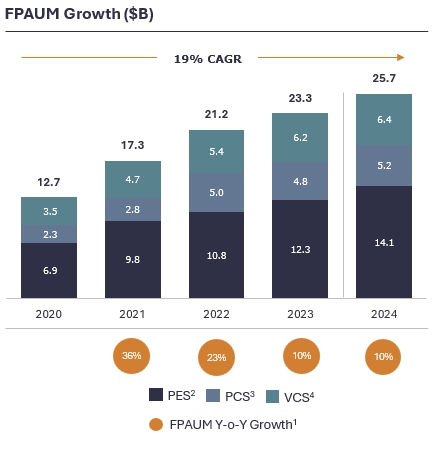
1. Q4'24 FPAUM growth is the FPAUM growth from Q4'23 to Q4'24.
2. Private Equity Solutions ("PES")
3. Private Credit Solutions ("PCS")
4. Venture Capital Solutions ("VCS")
Our Solutions
We operate and invest across private markets through a number of specialized investment solutions. We offer the following solutions to our investors:
Private Equity Solutions "PES"
Under PES, we make direct and indirect investments in middle and lower- middle market private equity primarily across North America and Europe. PES also makes minority equity investments in a diversified portfolio of mid-sized managers across private equity, private credit, real estate and real assets. The PES investment team, which is comprised of 42 investment professionals with an average of 26+ years of experience, has deep and long-standing investor and fund manager relationships in the middle and lower-middle market which it has cultivated over the past 20 years, including over 2,280+ investors, 285+ fund managers, 560+ private market funds and 5,100+ portfolio companies. We have 57 active investment vehicles. PES occupies a differentiated position within the private markets ecosystem helping our investors access, perform due diligence, analyze and invest in what we believe are attractive middle and lower-middle market private equity opportunities. We are further differentiated by the scale, depth, diversity and accuracy of our constantly expanding proprietary private markets database that contains comprehensive information on more than 6,000 investment firms, 11,100 funds, 49,000 individual transactions, 32,600 private companies and 458,000 financial metrics. As of December 31, 2024, PES managed $14.1 billion of FPAUM.
Venture Capital Solutions "VCS"
Under VCS, we make investments in venture capital funds across North America and specialize in targeting high-performing, access-constrained opportunities. The VCS investment team, which is comprised of 16 investment professionals
6
with an average of 24+ years of experience, has deep and long-standing investor and fund manager relationships in the venture market which it has cultivated over the past 14+ years, including over 1,980+ investors, 110+ fund managers, 100+ direct investments, 415+ private market funds and 14,700+ portfolio companies. We have 20 active investment vehicles. VCS is differentiated by our innovative strategic partnerships and our vantage point within the venture capital and technology ecosystems, maximizing advantages for our investors. In addition, since 2011, we have partnered with Forbes to publish the Midas List, a ranking of the top value-creating venture capitalists. As of December 31, 2024, VCS managed $6.4 billion of FPAUM.
Private Credit Solutions "PCS"
Under PCS, we primarily make debt investments across North America, targeting lower middle market companies owned by leading financial sponsors and also offer certain private equity solutions. PCS also provides loans to mid-life, growth equity, venture and other funds backed by the unrealized investments at the fund level and provide financing for companies that would otherwise require equity. The PCS investment team, which is comprised of 54 investment professionals with an average of 25+ years of experience, has deep and long-standing relationships in the private credit market which it has cultivated over the past 22 years, including 440+ investors across 49 active investment vehicles and 1,800+ portfolio companies with $9.8+ billion capital deployed. Our PCS is differentiated by our relationship-driven sourcing approach providing capital solutions for growth-oriented companies. We are further synergistically strengthened by our PES network of fund managers, characterized by more than 630 credit opportunities annually. We currently maintain 80+ active sponsor relationships and have 125+ platform investments. Within PCS, the Company has investments that target renewable energy development and historic building renovation projects, as well as provide capital to small businesses that are woman or minority owned or operated in underserved communities. These investments are differentiated in both the breadth of impact areas served, the type of capital deployed and the duration of the impact investing track record. From the impact investing inception in 1999 through December 31, 2024, inclusive of proprietary assets and assets managed by affiliates, the Company has raised a total of $6.4 billion. Of the total AUM, impact assets represent $4.2 billion invested in over 1,000 projects and businesses across 40 states, Washington DC, and Puerto Rico and does not include investments made by non-impact affiliates. Investments in clean energy have generated an estimate of over 2,900 GWh of renewable energy from inception to December 31, 2024. As of December 31, 2024, PCS managed approximately $5.2 billion of FPAUM.
Our Vehicles
We have a flexible business model whereby our investors engage us across multiple specialized private market solutions through different specialized investment vehicles. Our vehicles have traditional, stable fee structures that generate performance fees, which are generally not accrued to P10 due to our structure. P10’s revenue associated with the funds are from the management fees while employees of P10 receive the vast majority of performance fees directly from the vehicles.
7
Our average annual fee rates remain stable at approximately 1% of average fee paying assets under management. Fees for our funds are often structured such that they step down, or decrease, over the life of the fund.
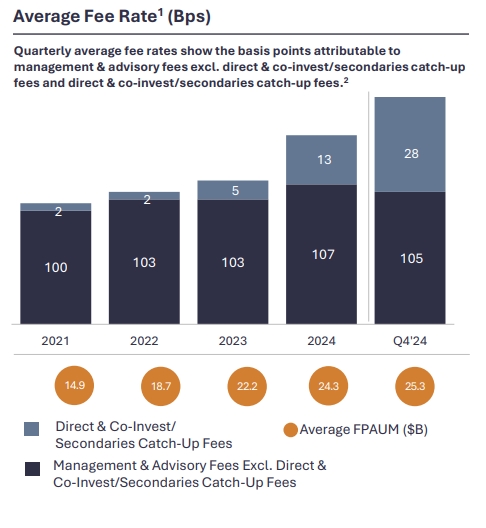
1. The average fee rates shown in the graph are calculated as Management and advisory fees divided by average FPAUM.
2. Catch-up fees are earned from investors that committed during the fundraising period of funds originally launched in prior periods, and as such, the investors are required to pay a catch-up fee as if they had committed to the fund at the first closing. While catch-up fees are not a significant component of our overall revenue stream, they may result in a temporary increase in our revenues in the period in which they are recognized.
8
We offer the following vehicles for our investors:
Primary Investment Funds
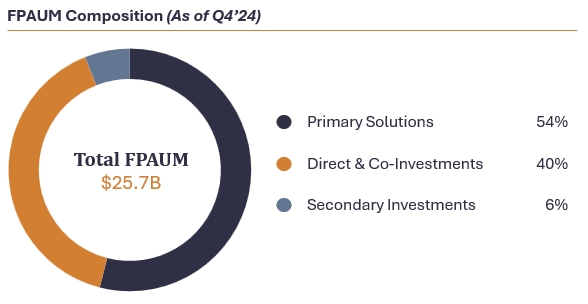
Primary investment funds refer to investment vehicles which target investments in new private markets funds, which in turn invest directly in portfolio companies. P10’s primary investment funds include both commingled investment vehicles with multiple investors, as well as our customized separate accounts, which typically include one investor. Primary investments are made during a fundraising period in the form of capital commitments, which are called upon by the fund manager and utilized to finance its investments in portfolio companies during a predefined investment period. We receive a fee stream that is typically based on our investors’ committed, locked-in capital. Capital commitments typically average ten to fifteen years, though they may vary by fund and strategy. We offer primary investment funds across our private equity and venture capital solutions. Our primary funds comprise approximately $13.9 billion of our FPAUM as of December 31, 2024.
Direct and Co-Investment Funds
Direct and co-investments involve acquiring an equity interest in or making a loan to an operating company, project, property, alternative asset manager, or asset, typically by co-investing alongside an investment by a fund manager or by investing directly in the underlying asset. P10’s direct and co-investment funds include both commingled investment vehicles with multiple investors as well as our customized separate accounts, which typically include one investor. Capital committed to direct investments and co-investments is typically invested immediately, thereby advancing the timing of expected returns on investment. We typically receive fees from investors based upon committed capital, with some funds receiving fees based on invested capital; capital commitments which typically average ten to fifteen years, though they may vary by fund. We offer direct and co-investment funds across our private equity, venture capital, and private credit solutions. Our direct investing platform comprises approximately $10.2 billion of our FPAUM as of December 31, 2024.
Secondaries
Secondaries refer to investments in existing private markets funds through the acquisition of an existing interest in a private markets fund by one investor from another in a negotiated transaction. In so doing, the buyer agrees to take on future funding obligations in exchange for future returns and distributions. Because secondary investments are generally made when a primary investment fund is three to seven years into its investment period and has deployed a significant portion of its capital into portfolio companies, these investments are viewed as more mature. We typically receive fees from investors on committed capital for a decade, the typical life of the fund. We currently offer secondaries funds across our private equity solutions. Our secondary funds comprise approximately $1.6 billion of our FPAUM as of December 31, 2024.
9
Our Investors
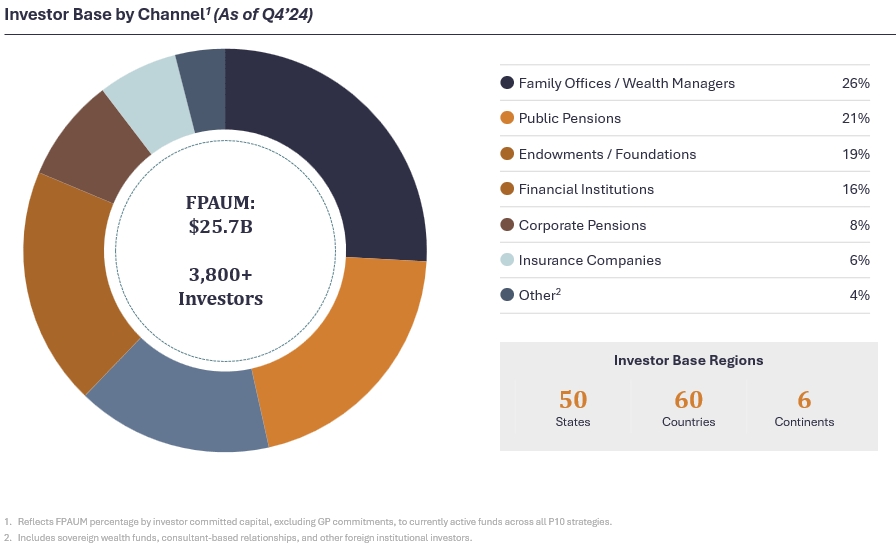
We believe our comprehensive value proposition across our private market solutions, vehicles offering, data analytics, portfolio monitoring and reporting has enabled us to build strong relationships with our existing investors and to attract new high-quality investors. We leverage our differentiated approach to serve a broad set of investors across multiple geographies. As of December 31, 2024, we have a global investor base of over 3,800 investors, across 50 states, 60 countries and 6 continents – including some of the world’s largest pension funds, endowments, foundations, corporate pensions and financial institutions. In addition, we have a strong footprint within some of the most prominent family offices and high net worth individuals.
The following chart illustrates the diversification of our investor base as of December 31, 2024:
Our Distribution and Marketing
We continuously seek to strengthen and expand our relationships with our current and prospective investors. We have a dedicated team of business development and investor relations professionals who maintain an active and transparent dialogue with an expansive list of existing and prospective investors and while we have a significant presence in North America, we have cultivated relationships with a number of international investors.
Our business development and investor relations professionals frequent dialogue with existing and prospective investors, enable us to monitor investor preferences and tailor future product offerings to meet investor demand. Prospective investors that desire to learn more about us often visit our offices to conduct in-depth due diligence. Our business development and investor relations professionals lead this process, coordinate meetings, and continue to be the prospective investor’s principal point of contact throughout their decision-making process. Our business development and investor relations professionals are also responsible for being the principal points of contact for our existing investors, and for our customized separate accounts, we work with each investor to design and implement a specific strategic plan in accordance with the investment guidelines agreed to by us and the investor.
10
Our Investment Performance
We believe the performance of our investment vehicles acts as a key retention mechanism for our existing investors and a primary attribute for prospective investors. We attribute our strong investment performance to several factors, including: our broad private market relationships and access, our diligent and responsible investment process, our tenured investing experience and our premier data capabilities. In concert, these factors enable us to pursue attractive, risk-adjusted investment opportunities to meet our investors’ investment objectives.
Our History
P10’s mission is to be the premier private markets solutions provider focused on the middle and lower middle market. We provide global institutional investors differentiated access to a broad set of solutions and specialized investment vehicles across attractive asset classes and geographies generating competitive risk-adjusted returns. As of December 31, 2024, we have $25.7 billion in fee paying assets under management. We offer a comprehensive set of investment strategies to clients, including both commingled funds and customized separate accounts within our primary investment funds, secondary, direct investment, co-investment vehicles, and advisory solutions. Since October 2017, we have been focused on building best-in-class solutions aimed at growing our fee paying assets under management. Prior to October 2017, the Company took strategic actions designed to lay the foundation for what is now known as P10.
The Company's history began with founding P10 Holdings as a Texas corporation in 1992 and reincorporating in Delaware in 2000. On November 19, 2016, P10 Holdings completed the sale of substantially all of its assets and liabilities and operations and became a non-operating company focused on monetizing our retained intellectual property and acquiring profitable businesses and our business primarily consisted of cash, certain retained intellectual property assets and our net operating losses and other tax benefits. In March 2017, P10 Holdings filed for re-organization under Chapter 11 of the Federal Bankruptcy Code, using a prepackaged plan of reorganization. In connection with the filing, P10 Holdings entered into a Restructuring Support Agreement with 210/P10 Investment LLC, as well as a Restructuring Support Agreement with the 2016 purchaser of our assets. P10 Holdings emerged from bankruptcy on May 3, 2017. A key feature of the Restructuring Support agreement included 210/P10 Investment LLC providing capital and management for the company post-bankruptcy.
Our entry into the alternative asset management industry originated with the acquisitions of RCP Advisors (RCP 2 and RCP 3). RCP Advisors was founded in 2001 and is a leading sponsor of private equity, funds-of-funds, secondary funds and co-investment funds. On October 5, 2017, we closed on the acquisition of RCP 2 and entered into a purchase agreement to acquire RCP 3 on January 2018. On January 3, 2018, we closed on the acquisition of RCP 3. RCP 2 and RCP 3 are registered investment advisors with the United States Securities and Exchange Commission.
On April 1, 2020, we completed the acquisition of Five Points Capital, Inc., a leading lower middle market alternative investment manager focused on providing equity and debt capital to private, growth-oriented companies and limited partner capital to other private equity funds. Five Points is focused exclusively in the U.S. lower middle market. Five Points is a registered investment advisor with the United States Securities and Exchange Commission.
On October 2, 2020, we completed the acquisition of TrueBridge, an investment firm focused on investing in venture capital through fund-of-funds, co-investments, and separate accounts. TrueBridge is a registered investment advisor with the United States Securities and Exchange Commission.
On December 14, 2020, the Company completed the acquisition of 100% of the equity interest in ECG, and a non-controlling interest in Enhanced Capital Partners, LLC (“ECP”, and collectively with ECG, “Enhanced”). Enhanced undertakes and manages equity and debt investments in impact initiatives across North America, targeting underserved areas and other socially responsible end markets including renewable energy, historic building renovations, and affordable housing. ECP is a registered investment advisor with the United States Securities and Exchange Commission.
On September 30, 2021, we completed the acquisitions of Hark Capital and Bonaccord Capital Advisors. Hark provides loans to mid-life private equity, growth equity, venture and other funds. These loans are backed by the unrealized investments at the fund level and provide financing for companies that would otherwise require equity. Bonaccord acquires minority equity investments in a diversified portfolio of alternative markets asset managers with a focus on mid-sized managers across private equity, private credit and real assets.
11
During 2021, the Company began exploring the benefits of going public on a listed exchange and raising additional capital through an equity issuance. On October 18, 2021, the Company announced an Initial Public Offering ("IPO") and corporate reorganization that would make P10 Holdings a wholly-owned subsidiary of P10, Inc. The IPO priced on October 20, 2021, and P10’s Class A common stock began trading on the NYSE on October 21, 2021 under the ticker “PX”. Investors purchased 23,000,000 Class A shares in conjunction with the IPO and the Company gained a top-tier set of institutional investors. The IPO process is described in more detail below.
In June 2022, the Company formed P10 Advisors, a fully consolidated subsidiary, to manage investment opportunities that are sourced across the P10 platform but do not fit within an existing investment mandate.
On October 13, 2022, the Company completed the acquisition of all of the issued and outstanding membership interests of WTI. WTI provides senior secured financing to early-stage and emerging stage life sciences and technology companies. WTI is a registered investment advisor with the United States Securities and Exchange Commission.
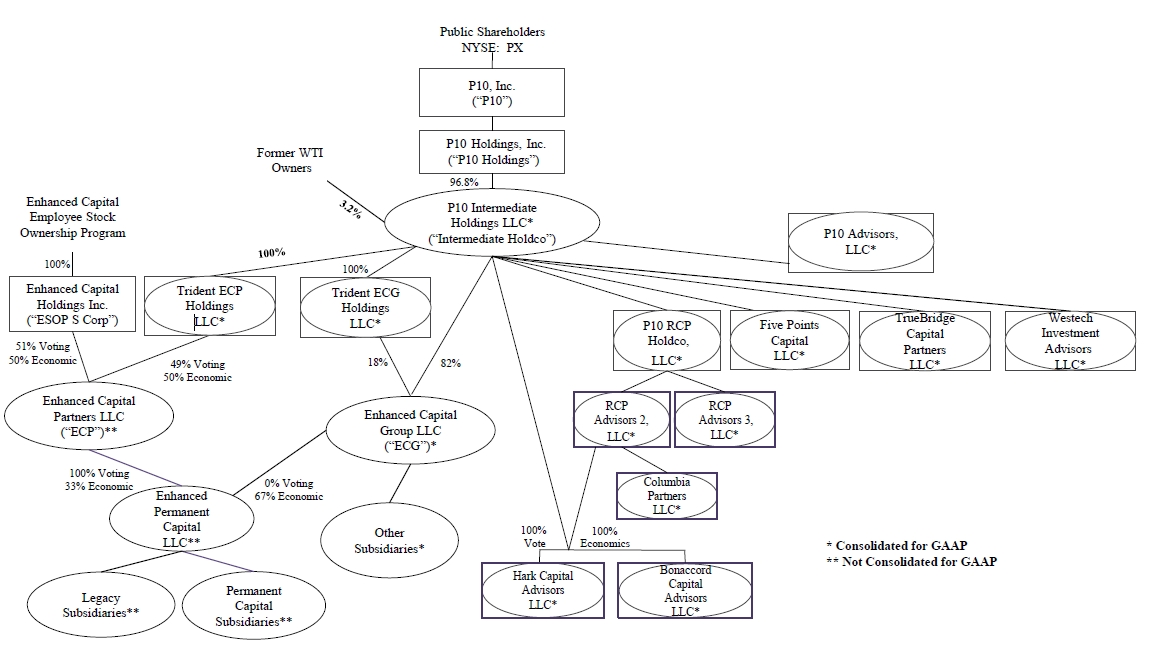
Simultaneously with the acquisition of WTI, the Company completed a restructuring of P10 Intermediate and subsidiaries to LLC entities that are considered disregarded entities for federal income tax purposes. This allowed the WTI sellers to obtain a partnership interest in P10 Intermediate and all of its subsidiaries. As a result of the acquisition, the WTI sellers obtained 3,916,666 membership units of P10 Intermediate, which can be exchanged into 3,916,666 shares of P10 class A common stock, following applicable restrictive periods.
The results of WTI’s operations have been included in the consolidated financial statements effective October 13, 2022. The Company reports noncontrolling interest related to the partnership interests which are owned by the WTI sellers. This is recorded as noncontrolling interest on the Consolidated Balance Sheets and Consolidated Statements of Operations. Noncontrolling interest is allocated a share of income or loss in the respective consolidated subsidiaries in proportion to their relative ownership interest. Additionally, the Company makes periodic distributions to the WTI sellers for tax related and other agreed upon expenses as disclosed in the purchase agreement.
On September 16, 2024, the Company entered into an equity purchase agreement of Qualitas, which is expected to close in the first quarter of 2025. Qualitas is a leading European lower middle market private equity fund-of-funds manager based in Madrid, Spain with roughly $1 billion in fee-paying assets under management. The transaction does not include any carried interest for legacy funds. This acquisition established an European presence and meaningfully grows P10's investor base, positioning the Company as a leading global, multi-strategy private markets firm focused on the middle and lower-middle markets.
ORGANIZATIONAL STRUCTURE
We completed an offering in connection with our IPO and concurrent listing on the New York Stock Exchange. On October 21, 2021, we issued 11,500,000 shares of our Class A common stock to the purchasers in the offering and selling stockholders sold 8,500,000 shares of our Class A common stock. Pursuant to our issuance of Class A common stock, we received net proceeds of approximately $129.4 million after deducting underwriting discounts and commissions but before expenses based on the initial public offering price of $12.00 per share. On November 19, 2021, we announced that the underwriters of the public offering fully exercised their option to acquire an additional 3,000,000 shares of Class A common stock at the public offering price of $12.00 per share, less underwriting discounts and commissions. These shares were sold by certain stockholders of P10 and P10 did not receive any proceeds from the sale.
Simultaneously with the acquisition of WTI, the Company completed a restructuring of P10 Intermediate and subsidiaries to LLC entities that are considered disregarded entities for federal income tax purposes. This allowed the sellers to obtain a partnership interest in P10 Intermediate and all of its subsidiaries. As a result of the acquisition, the WTI sellers obtained 3,916,666 membership units of P10 Intermediate, which can be exchanged into 3,916,666 shares of P10 class A common stock, following applicable restrictive periods.
12
The diagram below illustrates our structure and does not include all unconsolidated entities in which we hold non-controlling equity method investments.
Our Class B Common Stock
We have 43,461,442 outstanding shares of Class B common stock held of record by approximately 2,710 stockholders as of December 31, 2024. Each share of our Class B common stock entitles its holder to ten votes per share until a Sunset ("Sunset") occurs. A Sunset will occur on the earliest of the following: (a) the Sunset Holders cease to maintain direct or indirect beneficial ownership of 10% of the outstanding shares of Class A Common Stock (determined assuming all outstanding shares of Class B Common Stock have been converted into Class A Common Stock) (b) the Sunset Holders collectively cease to maintain direct or indirect beneficial ownership of at least 25% of the aggregate voting power of the outstanding shares of Common Stock and (c) upon the tenth anniversary of the effective date of our amended and restated certificate of incorporation. After a Sunset becomes effective, each share of Class B common stock will automatically convert into Class A common stock. In addition, each share of Class B common stock will automatically convert into Class A common stock upon any transfer except to certain permitted holders.
Because a Sunset may not take place for some time, it is expected that the Class B common stock will continue to entitle its holders to ten votes per share, and the Class B Holders will continue to exercise voting control over the Company, for the near future. The Class B Holders have approximately 87% of the combined voting power of our common stock.
Upon any transfer, Class B common stock converts automatically on a one-for-one basis to shares of Class A common stock, except in the case of transfers to certain permitted transferees. In addition, holders of Class B common stock may elect to convert shares of Class B common stock on a one-for-one basis into Class A common stock at any time.
Our current stockholders believe that the contributions of the current ownership group and management team have been critical in P10’s growth to date. We have a history of employee equity participation and believe that this practice has been instrumental in attracting and retaining a highly experienced team and will continue to be an important factor in maximizing long-term stockholder value. We believe that ensuring that our key decision-makers will continue to guide the direction of P10 results in a high degree of alignment with our stockholders, and voting members of the Class B common stock have ten votes per share which will help maintain this continuity.
13
Our Class A Common Stock
The Class A common stock have one vote per share and share ratably with our Class B common stock in all distributions.
Stockholders Agreement and Registration Rights
P10, Inc. entered into a stockholders agreement (the “Stockholders Agreement”) with certain investors, including employees, pursuant to which the investors were granted piggyback and demand registration rights prior to the IPO.
NYSE Controlled Company Agreement
P10, Inc. entered into a controlled company agreement (the “Controlled Company Agreement”) on October 20, 2021, with principals of 210 Capital, L.L.C. (“210 Capital”) and certain of their affiliates (the “210 Group”), RCP Advisors and certain of their affiliates (the “RCP Group”) and TrueBridge and certain of their affiliates (the “TrueBridge Group”), granting each party certain board designation rights. So long as the RCP Group and any of their permitted transferees who hold shares of common stock as of the applicable time continue to collectively hold a combined voting power of at least 5% of the shares of common stock outstanding immediately following the IPO, P10, Inc. shall include in its slate of nominees one (1) director designated by the RCP Stockholders. So long as TrueBridge and any of its permitted transferees who hold shares of common stock as of the applicable time continue to collectively hold a combined voting power of at least 5% of the shares of common stock outstanding immediately following the IPO, P10, Inc. shall include in its slate of nominees one (1) director designated by the TrueBridge Group.
On December 19, 2024, the Company entered into an amendment (the “Amendment”) to the Controlled Company Agreement to, among other things: (i) remove 210/P10 Acquisition Partners, LLC and certain members of the RCP Group thereunder, and (ii) remove the board nomination and other rights of 210/P10 Acquisition Partners, LLC. In connection with its entry into the Amendment, 210/P10 Acquisition Partners, LLC converted all shares of Class B Common Stock of the Company held by it into shares of Class A Common Stock of the Company.
The RCP Group and TrueBridge Group each have the right to nominate one director. These board designation rights are subject to certain limitations and exceptions.
Our Investment Process
We maintain rigorous investment, monitoring and risk management processes across each of our specialized private market solutions, all unified by a common philosophy and a focus on comprehensive analysis of fund managers and/or portfolio companies.
We believe our investment performance is attributable to a number of factors, including most notably our seasoned, dedicated investment teams and our methodical approach to investing that help us consistently source and analyze opportunities effectively. Our investment professionals are responsible for sourcing, selecting, evaluating, underwriting, diligencing, negotiating, executing, managing and exiting our investments. In addition, our investment professionals regularly develop new investor relationships and networks of industry insiders to proactively source new investments. Our ability to access top-tier, capacity constrained fund managers through a proactive and systematic sourcing process we believe is a significant differentiating factor for our investors.
Our investment committee members across our solutions have significant private markets experience and fully participate in the diligence process, which ensures consistent application of investment strategy, process, diversification and portfolio construction. In addition, the investment committees of our respective solutions review and evaluate investment opportunities through a comprehensive framework that includes both a qualitative and a quantitative assessment of the key risks of investments.
The details of our investment process are outlined below:
Opportunities Tracked
As of December 31, 2024, we track thousands of potential investment opportunities across private markets, spanning primary investment funds, secondaries and direct and co-investments. Our attractive positioning within the private markets
14
ecosystem, coupled with our synergistic network of general partners and extensive database has enabled us to cultivate a comprehensive funnel of what we believe are premier investment opportunities.
Initial Screen
Leveraging our extensive database, investment professionals submit investment opportunities for initial review, subject to delineated exceptions set forth in our funds’ investment committee charters or resolutions. To facilitate the initial review, the investment team summarizes the opportunity in a preliminary evaluation report and the opportunity is subsequently reviewed by senior members of the team for potential further consideration and investment.
Annual Due Diligence
For each potential investment opportunity, the responsible investment team gathers, analyzes and reviews available information on the underlying asset. The due diligence process is augmented further by our extensive database, which enables us to analyze and compare the investment opportunity to what we believe are precedent transactions. As part of the due diligence process, we also conduct operational due diligence and legal diligence, which evaluate the potential risks associated with the investment opportunity’s operational framework and legal standing. More specifically, our operational due diligence team focuses on legal, financial, IT and background checks, while our legal due diligence team focuses on review of legal documents, fund agreements and compliance.
Annual Investments Made
After our due diligence is completed, the responsible investment team works with the relevant Investment Committee to validate that each investment opportunity meets the investment objective of the portfolio at hand. The Investment Committee provides feedback on the general partner (and investment merits in the case of secondaries and direct and co-investments), risks and prospects of each investment opportunity. Provided that the opportunity meets the appropriate criteria, the investment committee issues an indicative approval to proceed with confirmatory due diligence. Upon successful confirmatory due diligence the Investment Committee will reconvene to review the investment for a final vote. Once final approval has been obtained, the investment team may proceed with commitments or funding.
Our Risk Management Process
Our risk management process includes risk identification, measurement, mitigation, monitoring and management/reporting, with particular risk assessments tailored by solution, vehicle and individual client. We apply our risk management framework across three distinct areas of our investment process: (a) the general partner, (b) the investment fund, and (c) the portfolio company. We seek to mitigate risk through prudent portfolio diversification and through comprehensive due diligence on general partners, investment funds and portfolio companies.
General Partner
We perform extensive, upfront due diligence on general partners prior to making an investment and all our current period partners are subject to our ongoing risk management framework. Key components of our ongoing risk management of general partners include monitoring the firm’s historical and current strategy, historical track record and anticipated performance, current team composition and remuneration, decision-making process, ability to add value, deal flow and fund terms. Furthermore, our risk management processes include reviewing information related to the general partners target asset classes, sector/sub-sectors, investment specialties, key personnel, and primary geographical regions in which the general partner invests.
Investment Fund
Investment Funds are also subject to our due diligence and risk management framework. Key components of our ongoing risk management of investment funds include monitoring vintage year, fund size, currency, as well as measures of historical performance (including percent of commitments called, distributions to paid in capital, residual value to paid in capital, net total value multiple of invested capital, net internal rate of return, and the date performance results were last updated), historical investments and benchmarking.
15
Portfolio Company
Key components of our ongoing risk management of portfolio companies include monitoring cash flow details, financial and operating metrics, and other relevant performance measurements. Our investments in our portfolio companies include both debt and equity.
In addition to our distinct ongoing risk management processes we participate in board meetings, investment funds’ annual meetings, maintain membership on limited partnership boards and advisory boards and remain in frequent dialogue with portfolio companies in an effort to remain appraised of relevant developments in the investment funds. We are also recipients of monthly and quarterly performance reporting packages, annual audited financial statements, along with K-1 tax reporting packages and evaluations of the state of the market generally.
Our ongoing monitoring efforts culminate in annual summaries featuring extensive qualitative and quantitative information of each portfolio company. The annual summaries help us benchmark each general partner to ensure each portfolio we invest in to ensure each portfolio is performing as expected.
Our Responsible Investment Philosophy
Responsible investment, which encompasses environmental, social and governance (“ESG”) and impact investing considerations, is important to our operating and investment philosophies. We believe that integration of an ESG framework into both our investment process and internal operations may improve long-term, risk-adjusted returns for our clients. Certain of our subsidiaries have developed a responsible investment policy. In addition, two of our subsidiaries are a signatory to the United Nations Principles for Responsible Investment (“UNPRI”). We aim to continually improve and evolve, and plan to review our policy annually.
Given our scale and position in the private markets ecosystem, we believe we are well positioned to help educate the broader investor and fund manager community on how best to integrate responsible investment considerations in their investment process and programs.
Our Fees and Other Key Contractual Terms
Specialized Investment Vehicles
While the terms of each fund may vary, we have outlined the key terms of the customized separate accounts and commingled funds within our specialized investment vehicles below:
Commingled Investment Vehicles
Capital Commitments
Investors in our investment funds generally make commitments to provide capital at the outset of a fund and deliver capital when called upon by us, as investment opportunities become available and to fund operational expenses and other obligations. The commitments are generally available for investment for 1 to 5 years, during what we call the commitment period. We typically have invested the capital committed to our funds, over a 3 to 5-year period.
Structure
Our investment funds are structured as limited partnerships organized by us accepting commitments or funds from our investors. Our investors become limited partners in our funds and a separate entity that we form and control acts as the general partner. Funds managed by the Company, who act as the general partner, make capital commitments to the limited partnership which are generally 1% of total capital commitments. Contingent upon the solution, each investment fund will have a designated “Manager”, which generally serves as the investment manager of the fund, responsible for all investment diligence, decision making and monitoring.
16
Fees
We earn management and advisory fees based on a percentage of investors’ capital commitments to, in funds or deployed capital. Management and advisory fees during the commitment period are charged on capital commitments and after the commitment period (or a defined anniversary of the fund’s initial closing) is reduced by a percentage of the management and advisory fees for the preceding years or charged on net invested capital or NAV, in select cases.
Duration and Termination
Our primary investment funds, secondaries funds and direct and co-investment funds are typically ten to fifteen years in duration, terminating either on a specific anniversary date, or after a determined number of years after the fund’s final close. Our funds are generally subject to extensions for up to 3 years at the discretion of the general partner and thereafter if consent of the requisite majority of investors, or in some cases, the fund’s advisory committee is obtained.
Separate Accounts
Capital Commitments
Investors in our separate accounts generally make commitments to provide capital at the outset of a fund and deliver capital when called upon by us, as investment opportunities become available and to fund operational expenses and other obligations. The commitments are generally available for investment for 4 to 5 years, during what we call the commitment period. We typically have invested the capital committed to our investment funds over a 5-year period.
Structure
Most of our separate accounts are contractual arrangements involving an investment management agreement between us and our investor. Within agreed-upon investment guidelines, we generally have full discretion to buy, sell or otherwise effect investment transactions involving the assets in the account, in the name and on behalf of our investor, although in some cases certain investors have the right to veto investments. The discretion to invest committed capital generally is subject to investment guidelines established by our investors or by us in conjunction with our investors. In some cases, at the investor’s request, we establish a separate investment vehicle, generally a limited partnership with our investor as the sole limited partner and a wholly owned subsidiary as the general partner. Our capital commitment to the limited partnership is typically 1% of total capital commitments. We manage the limited partnership under an investment management agreement between our investor and us.
Fees
We earn management and advisory fees based on a percentage of investors’ capital commitments to or, in select cases, net invested capital in, or NAV of, our investment funds. These fees often decrease over the life of the contract due to built-in declines in contractual rates and/or as a result of lower net invested capital balances or NAV as capital is returned to investors.
Duration and Termination
Separate account contracts typically can be terminated by our investors for specified reasons, but specific terms vary significantly from investor to investor and certain contracts may be terminated for any reason, typically with 5 to 90 days’ notice.
Our Competition
We compete in all aspects of our business with a large number of asset management firms, commercial banks, broker-dealers, insurance companies and other financial institutions. With respect to our investment strategies, we primarily compete with other private markets solutions providers within North America that specialize in private equity, venture capital, impact investing and private credit. We seek to maintain excellent relationships with general partners and managers of investment funds, including those in which we have previously made investments for our investors and those in which we may invest in the future, as well as sponsors of investments that might provide co-investment opportunities in portfolio companies alongside the sponsoring fund manager. However, because of the number of investors seeking to gain access to investment funds and co-investment opportunities managed or sponsored by the top performing fund managers, there can be no
17
assurance that we will be able to secure the opportunity to invest on behalf of our investors in all or a substantial portion of the investments we select, or that the size of the investment opportunities available to us will be as large as we would desire. Access to secondary investment opportunities is also highly competitive and is often controlled by a limited number of general partners, fund managers and intermediaries. Our ability to continue to compete effectively will depend upon our ability to attract highly qualified investment professionals and retain existing employees.
In order to grow our business, we must maintain our existing investor base and attract new investors. Historically, we have competed principally on the basis of the factors listed below:
The asset management business is intensely competitive, and in addition to the above factors, our ability to continue to compete effectively will depend upon our ability to attract highly qualified investment professionals and retain existing employees.
Regulatory and Compliance Matters
Our business is subject to extensive regulation in the United States at both the federal and state level and, in certain circumstances, outside the United States. Under these laws and regulations, the SEC, relevant state securities authorities and other foreign regulatory agencies have broad administrative powers, including the power to limit, restrict or prohibit an investment advisor from carrying on its business if it fails to comply with such laws and regulations. Possible sanctions that may be imposed include the suspension of individual employees, limitations on engaging in certain lines of business for specified periods of time, revocation of investment advisor and other registrations, censures and fines.
SEC Regulation
Certain subsidiaries of P10 are registered as investment advisers with the SEC. As a registered investment adviser, each is subject to the requirements of the Investment Advisers Act, and the rules promulgated thereunder, as well as to examination by the SEC’s staff. The Investment Advisers Act imposes substantive regulation on virtually all aspects of our business and our relationships with our investors and funds. Applicable requirements relate to, among other things, fiduciary duties to investors, engaging in transactions with investors, maintaining an effective compliance program, political contributions, personal trading, incentive fees, allocation of investments, conflicts of interest, custody, advertising, recordkeeping, reporting and disclosure requirements. The Investment Advisers Act also regulates the assignment of advisory contracts by the investment adviser. The SEC is authorized to institute proceedings and impose sanctions for violations of the Investment Advisers Act, ranging from fines and censures to termination of an investment adviser’s registration. The failure of any Adviser to comply with the requirements of the Investment Advisers Act or the SEC could have a material adverse effect on us.
Our separate accounts and funds are not registered under the Investment Company Act because we generally only form separate accounts for, and offer interests in our funds to, persons who we reasonably believe to be “qualified purchasers” as defined in the Investment Company Act. In addition, certain funds are not registered under the Investment Company Act because we limit such funds to 100 or fewer “persons” as defined in the Investment Company Act. In addition, certain WTI funds are registered under the Investment Company Act and must comply with the reporting and governance requirements of
18
the Investment Company Act. Compliance with the Investment Company Act can be complex and failure to comply can result in significant fines, penalties, loss to reputation and other material adverse effects on us.
ERISA-Related Regulation
Some of our funds are treated as holding “plan assets” as defined under the Employee Retirement Income Security Act of 1974, as amended (“ERISA”), as a result of investments in those funds by benefit plan investors. By virtue of its role as investment manager of these funds, each applicable Adviser is a “fiduciary” under ERISA with respect to such benefit plan investors. ERISA and the Code impose certain duties on persons that are fiduciaries under ERISA, prohibit certain transactions involving benefit plans and “parties in interest” or “disqualified persons” to those plans, and provide for monetary penalties for violations of these prohibitions. With respect to these funds' regulations, each Adviser relies on particular statutory and administrative exemptions from certain ERISA prohibited transactions, which exemptions are highly complex and may in certain circumstances depend on compliance by third parties whom we do not control. The failure of any Adviser or us to comply with these various requirements could have a material adverse effect on our business.
In addition, with respect to other investment funds in which benefit plan investors have invested, but which are not treated as holding “plan assets,” each Adviser relies on certain rules under ERISA in conducting investment management activities. These rules are sometimes highly complex and may in certain circumstances depend on compliance by third parties that we do not control. If for any reason these rules were to become inapplicable, each Adviser could become subject to regulatory action or third-party claims that could have a material adverse effect on our business.
Foreign Regulation
We provide investment advisory and other services and raise funds in a number of countries and jurisdictions outside the United States. In many of these countries and jurisdictions, which include the European Union ("EU"), the European Economic Area ("EEA"), the individual member states of each of the EU and EEA, Central and South America, Australia and other countries in the South Pacific, we and our operations, and in some cases our personnel, are subject to regulatory oversight and requirements. In general, these requirements relate to registration, licenses for our personnel, periodic inspections, the provision and filing of periodic reports, and obtaining certifications and other approvals. Across the EU, we are subject to the Alternative Investment Fund Managers Directive ("AIFMD") requirements regarding, among other things, registration for marketing activities, the structure of remuneration for certain of our personnel and reporting obligations. Individual member states of the EU have imposed additional requirements that may include internal arrangements with respect to risk management, liquidity risks, asset valuations, and the establishment and security of depositary and custodial requirements.
It is expected that additional laws and regulations will come into force in the UK, the EEA, the EU, and other countries in which we operate over the coming years. There have also been significant legislative developments affecting the private equity industry in Europe and there continues to be discussion regarding enhancing governmental scrutiny and/or increasing regulation of the private equity industry.
SBA Regulations
Several of our Advisers provide investment advisory and other services to funds which operate as Small Business Investment Companies ("SBICs") and are licensed by the Small Business Administration ("SBA"). SBICs supply small businesses with financing in both the equity and debt arenas. There are various requirements that apply to SBICs under SBA rules and regulations. These rules and regulations are sometimes highly complex. The SBA is authorized to institute proceedings and impose sanctions for violations of rules and regulations applicable to SIBCs, including forcing the liquidation of an SBIC. The failure of an Adviser to comply with the requirements of the SBA could have a material adverse effect on us.
Privacy and Cybersecurity Regulation
Certain of our businesses are subject to laws and regulations enacted by U.S. federal and state governments, the E.U. or other non-U.S. jurisdictions and/or enacted by various regulatory organizations or exchanges relating to the privacy and data security of the information of clients, employees or others, or to our cybersecurity measures in general, including the U.S. Gramm-Leach-Bliley Act of 1999, the European Union’s General Data Protection Regulation (“EU GDPR”), the U.K.
19
GDPR, China’s Personal Information Protection Law (PIPL), Canada’s Personal Information Protection and Electronic Documents Act (PIPEDA) and territorial Canadian privacy laws, and the Privacy Acts of Australia and New Zealand. In addition, California and at least nineteen other states have enacted comprehensive consumer privacy laws that impose compliance obligations with regard to the collection, use and disclosure of personal data, as well as cybersecurity requirements to protect personal data and our data systems in general. These privacy and cybersecurity laws and regulations have heightened our privacy and cybersecurity compliance obligations, impacted our businesses’ collection, processing and retention of personal data, including how we protect that data, and imposed strict standards for reporting data breaches. Many of these privacy and cybersecurity laws and regulations also provide significant penalties for non-compliance. For more information, see “Risk Factors—Risks Related to Our Industry.”
Future Developments
The SEC and various self-regulatory organizations and state securities regulators have in recent years increased their regulatory activities, including regulation, examination and enforcement in respect of asset management firms.
As described above, certain of our businesses are subject to compliance with laws and regulations of U.S. federal and state governments, non-U.S. governments, their respective agencies and/or various self-regulatory organizations or exchanges, and any failure to comply with these regulations could expose us to liability and/or damage our reputation. Our businesses have operated for many years within a legal framework that requires us to monitor and comply with a broad range of legal and regulatory developments that affect our activities. However, additional legislation, changes in rules promulgated by financial regulatory authorities or self-regulatory organizations or changes in the interpretation or enforcement of existing laws and rules, either in the United States or elsewhere, may directly affect our mode of operation and profitability.
Compliance
Each Adviser has a Chief Compliance Officer. Certain Advisers also maintain in-house legal staff as well as additional compliance staff. Each Adviser generally engages outside counsel to review, analyze and negotiate the terms of the documents relating to impact, primary, secondary and direct/co-investments. Because most of our separate account investors and certain of our advisory investors rely on us to negotiate terms, including terms about which certain investors are particularly sensitive or which are investor-specific, our compliance and legal teams work closely with both the investors and outside counsel. Our compliance and legal teams also work closely with our investment teams during negotiations. Typically, outside counsel negotiates directly with fund managers and deal sponsors and their counsel the terms of all limited partnership agreements, subscription documents, side letters, purchase agreements and other documents relating to primary, secondary and direct co-investments. Our compliance and legal teams review and make recommendations regarding amendments and requests for consents presented by the fund managers from time to time. In addition, our compliance and legal teams work with outside counsel as we deem necessary to prepare, review and negotiate all documents relating to the formation and operation of our funds.
Each Adviser’s compliance team is responsible for overseeing and enforcing our policies and procedures relating to compliance with the laws applicable to our business both U.S. and foreign. This includes our code of ethics and personal trading policies.
We have an outsourced Internal Audit group, which have disclosure controls and procedures and internal controls over financial reporting, which are documented and assessed for design and operating effectiveness in accordance with the U.S. Sarbanes-Oxley Act of 2002. Our Internal Audit group independently reports to an audit committee of our board of directors, operates with a global mandate and is responsible for the examination and evaluation of the adequacy and effectiveness of the organization’s governance and risk management processes and internal controls, as well as the quality of performance in carrying out assigned responsibilities to achieve the organization’s stated goals and objectives.
Human Capital
The Company believes that a strong focus on human capital through the talent we hire and retain is critical to maintaining our competitiveness. As of December 31, 2024, we have 267 full-time equivalent employees, primarily located in the United States, including 112 investment professionals. Our employees are not represented by a collective bargaining group. We consider our employee relations to be strong and have not experienced interruptions of operations due to labor disagreements.
20
Human Capital Objectives
Our business is built on strong, trusted and relationships with stakeholders: employees, limited partners, general partners, and our public stockholders. As such, attracting, recruiting, developing, and retaining diverse talent is vital to our success. The Company is focused on supporting our employees, and we consider talent management to be essential to the ongoing success of our business. Our Board of Directors and Committees provide oversight of our human capital management strategy.
Sustainability
The Company’s executive leadership team and Board recognize that ESG is a strategic and operational imperative and established an internal team that is tasked with driving progress. In partnership with our employees, we are committed to protecting the natural environment and our communities through sustainable practices. We emphasize a culture of accountability and conduct our business in a manner that is fair, ethical, and responsible to earn the trust of our employees.
Employee Attraction, Recruitment, Development and Retention
We are also committed to pay equity and regularly review our compensation model to ensure fair and inclusive pay practices across our business. We offer competitive benefits packages that reflect the needs of our workforce. In the U.S., we provide all full-time employees medical, dental, and vision benefits, life and disability coverage, parental leave, education reimbursement, and paid time off. We provide retirement benefits including a 401(k)-match program. In addition to base salary, our employees participate in incentive plans that support our organizational philosophy of pay and performance. Our executive compensation program is designed to align incentives with achievement of the Company’s strategic plan and both short- and long-term operating objectives.
Health & Safety
We take the health and safety of our employees seriously. We expect each employee to follow our safety standards and protocols. We continue to utilize employee feedback and surveys to gather information to best serve our team members. Members of our human resource department annually review benefits to ensure we can meet the well-being of our employees and their families.
Diversity and Inclusion
Our commitment to Diversity and Inclusion "D&I" starts with our goal of developing a workforce that is diverse in background, knowledge, skill, and experience. We have implemented policies and training focused on non-discrimination and harassment prevention. We embrace diversity and inclusion, which we believe fosters leadership through new ideas and perspectives. In 2024, we continued the evolution of our D&I strategy and objectives and recognize it as an ongoing business imperative.
AVAILABLE INFORMATION
We maintain a website with the address https://ir.p10alts.com/. We are not including the information contained on our website as part of, or incorporating it by reference into, this Form 10-K. Through our website, we make available free of charge our annual reports on Form 10-K, quarterly reports on Form 10-Q, current reports on Form 8-K, and amendments to these reports in a timely manner after we provide them to the Securities and Exchange Commission (“SEC”).
21
Item 1A. Risk Factors.
Risks Related to Our Business
Our revenue in any given period is dependent on the number of fee-paying clients in such period. While most of our revenue is derived from management and advisory fees based on committed capital that is typically subject to multi-year lock up agreements, under certain limited circumstances, the committed capital can be withdrawn early, or we can be removed or terminated as the adviser or general partner to a particular client.
Our revenue is comprised virtually entirely of management and advisory fees from our registered investment adviser subsidiaries (each, an “Adviser”), with the vast majority of fees earned on committed capital that is typically subject to between 10 and 15 year lock up agreements, although in many cases, the contractual fees decline over the period, after the investment period of three to five years ends. Our investors engage us across multiple private markets solutions through different vehicles, including primary investment funds, direct and co-investment funds and secondary funds. Primary investment funds and direct and co-investment funds include both commingled investment vehicles with multiple investors as well as customizable separate accounts, which typically include one customer. Our revenue in any given period is dependent on the number of fee-paying investors in such period. For our specialized, commingled funds, our fees may terminate if we are removed for certain cause events such as a key person event or without cause by a super majority of investors. Our customized separate account and advisory account business operates in a highly competitive environment. While clients of our separate account and advisory account businesses may have multi-year contracts, certain of these contracts only provide for fees to the extent a client elects to make an investment. In addition, the separate accounts and advisory contracts may be terminated by the client for cause or without cause upon advance notice to us. In connection with these terminable contracts, we may lose clients as a result of the sale or merger of a client, a change in a client's senior management, competition from other financial advisors and financial institutions and other causes. Moreover, certain of our contracts with state government-sponsored clients are secured through such government’s request for proposal process, and can be subject to renewal. If multiple clients were to exercise their termination rights or fail to renew their existing contracts or investors removed us from managing a fund and we were unable to secure new clients, our fees would decline. In the case of any such events, the management fees and advisory fees we earn in connection with managing such account or fund would immediately cease, which could result in an adverse effect on our revenues. If we experience a change of control (as defined under the Investment Advisers Act of 1940, as amended (the “Investment Advisers Act”), or as otherwise set forth in the governing documents of our funds), continuation of the investment management agreements with our funds and our separate account clients would be subject to investor or client consent. We cannot assure you that required consents will be obtained if such a change of control occurs.
If the investments we make on behalf of our specialized investment vehicles perform poorly, our ability to raise capital for future specialized investment vehicles may be materially and adversely affected.
Our revenue from our investment management business is derived from fees earned for our management of our specialized investment vehicles and advisory accounts and with respect to certain of our specialized investment vehicles. We have no economic interest, ownership in or beneficiary interest in the performance of the funds (except for a 5% carried interest in RCP FF Small Buyout Co-Investment Fund, LP). Our subsidiaries serve as the advisors of the affiliated private equity funds, funds-of-funds, secondary funds and co-investment funds and receive management and advisory fees for the services performed. In the event that our specialized investment vehicles or individual investments perform poorly, the fund manager’s revenues and earnings derived from incentive fees will decline, which may result in a decrease in our management and advisory fee revenue and make it more difficult for us to raise capital for new specialized funds or gain new customized separate account clients in the future.
The historical performance of our investments should not be considered as indicative of the future results of our investments or our operations.
In considering the performance information contained in this Form 10-K, our stockholders should be aware that past performance of our specialized investment vehicles or the investments that we recommend to our investors is not necessarily indicative of future results or of the performance of our Class A common stock. An investment in our Class A common stock is not an investment in any of our specialized investment vehicles. In addition, the historical and potential future returns of specialized investment vehicles that we manage are not directly linked to returns on our Class A common stock. Therefore, you should not conclude that continued positive performance of our specialized investment vehicles or the investments that we recommend to our investors will necessarily result in positive returns on our Class A common stock. However, poor
22
performance of our specialized investment vehicles or the investments that we recommend to our investors could cause a decline in our ability to raise additional funds, and could therefore have a negative effect on our performance and on returns on our Class A common stock. The historical performance of our funds should not be considered indicative of the future performance of these funds or of any future funds we may raise, in part because:
The success of our business depends on the identification and availability of suitable investment opportunities for our investors.
Our success largely depends on the identification and availability of suitable investment opportunities for our investors, and in particular the success of funds in which our specialized investment vehicles and advisory accounts invest. The availability of investment opportunities will be subject to market conditions and other factors outside of our control and the control of the private markets and fund managers with which and in which we invest.
Past returns of our specialized investment vehicles and advisory accounts have benefited from investment opportunities and general market conditions that may not continue or reoccur, including previously favorable borrowing conditions in the debt markets. There can be no assurance that our specialized investment vehicles, advisory accounts or the underlying funds in which we invest will be able to avail themselves of comparable opportunities and conditions.
Further, there can be no assurance that the managers of the private markets funds we select will be able to identify sufficient attractive investment opportunities to meet their investment objectives.
Competition for access to investment funds and other investments we make for our investors is intense.
We compete in all aspects of our business with a large number of asset management firms, commercial banks, broker-dealers, insurance companies and other financial institutions. With respect to our investment strategies, we primarily compete with other private markets solutions providers within North America and, upon closing of the Qualitas acquisition, Europe, that specialize in private equity, venture capital, impact investing, NAV loans, GP stakes, and private credit. We seek to maintain excellent relationships with general partners and managers of investment funds, including those in which we have previously made investments for our investors and those in which we may invest in the future, as well as sponsors of investments that might provide co-investment opportunities in portfolio companies alongside the sponsoring fund manager. However, because of the number of investors seeking to gain access to investment funds and co-investment opportunities managed or sponsored by the top performing fund managers, there can be no assurance that we will be able to secure the opportunity to invest on behalf of our investors in all or a substantial portion of the investments we select, or that the size of the investment opportunities available to us will be as large as we would desire. Access to secondary investment opportunities is also highly competitive and is often controlled by a limited number of general partners, fund managers and
23
intermediaries. Our ability to continue to compete effectively will depend upon our ability to attract highly qualified investment professionals and retain existing employees.
Our failure to deal appropriately with conflicts of interest could damage our reputation and materially and adversely affect our business.
As we expand the scope of our business, we increasingly confront potential conflicts of interest relating to our advisory and investment management businesses. For example, we may recommend that various of our advisory clients invest in specialized funds managed by our investment management business. It is possible that actual, potential or perceived conflicts could give rise to investor dissatisfaction, litigation or regulatory enforcement actions. Certain of our subsidiaries are investment advisers and they owe their clients a fiduciary duty and are required to provide disinterested advice. Appropriately dealing with conflicts of interest is complex and difficult and our reputation could be damaged if we fail, or appear to fail, to deal appropriately with one or more potential or actual conflicts of interest. Regulatory scrutiny of, or litigation in connection with, conflicts of interest could have a material adverse effect on our reputation, which could materially and adversely affect our business in a number of ways, including an inability to raise additional funds and reluctance of our existing investors to continue to do business with us.
We have obligations to investors and may have obligations to other third parties that may conflict with interests of our stockholders.
Our subsidiaries that serve as the general partners of, or advisers to, our funds, or to our specialized investment vehicles have fiduciary and contractual obligations to the investors in those funds and accounts, and some of our subsidiaries may have contractual duties to other third parties that may conflict with interests of our stockholders. As a result, we may take actions with respect to the allocation of investments among our specialized investment vehicles or funds (including funds and accounts that have different fee structures), the purchase or sale of investments in our specialized investment vehicles or funds, the structuring of investment transactions for those specialized investment vehicles or funds, in order to comply with these fiduciary and contractual obligations.
Our ability to retain our senior leadership team and find, attract, retain and develop human capital in a highly competitive talent market is critical to our success.
Our success depends on our ability to retain our senior leadership team and to find, attract, retain, and develop additional qualified investment, sales and other professionals. However, we may not be successful in our efforts to retain our senior leadership team, as the market for investment professionals is extremely competitive. The individuals that comprise our senior leadership team possess substantial experience and expertise and, in many cases, have significant relationships with certain of our investors. Accordingly, the loss of any one of our senior leadership team could adversely affect certain investor relationships or limit our ability to successfully execute our investment strategies, which, in turn, could have a material adverse effect on our business, financial condition and results of operations.
Competition for qualified, motivated, and highly-skilled executives, professionals and other key personnel in asset management firms is significant. Turnover and associated costs of rehiring, the loss of human capital through attrition, death, or disability and the reduced ability to attract talent could impair our ability to implement our growth strategy and maintain our standards of excellence. Our future success will depend upon our ability to find, attract, retain, develop and motivate highly-skilled and highly-qualified individuals. We seek to provide our personnel with competitive benefits and compensation packages. However, our efforts may not be sufficient to enable us to find, attract, retain, develop and motivate qualified individuals to support our growth. Moreover, if our personnel join competitors or form businesses that compete with ours, that could adversely affect our ability to raise new or successor funds. In addition, certain of our specialized funds have key person provisions that are triggered upon the loss of services of one or more specified employees and could, upon the occurrence of such event, provide the investors in these funds with certain rights such as rights providing for the termination or suspension of our funds’ investment periods and/or wind-down of our funds. Any change to our senior leadership team could materially and adversely affect our business, financial condition and results of operations.
24
We intend to expand our business and may enter into new lines of business or geographic markets, which may result in additional risks and uncertainties in our business.
Most of our revenue is derived from management and advisory fees based on committed capital that is typically subject to multi-year lock up agreements, typically between 10 and 15 years. We continue to grow our business by offering additional products and services, by entering into new lines of business and by entering into, or expanding our presence in, new geographic markets, including Europe and Asia. Introducing new types of investment structures, products and services could increase our operational costs and the complexities involved in managing such investments, including with respect to ensuring compliance with regulatory requirements and the terms of the investment. To the extent we enter into new lines of business, we will face numerous risks and uncertainties, including risks associated with the possibility that we have insufficient expertise to engage in such activities profitably or without incurring inappropriate amounts of risk, the required investment of capital and other resources and the loss of investors due to the perception that we are no longer focusing on our core business. In addition, we continue to explore opportunities to grow our business via acquisitions, partnerships, investments or other strategic transactions. There can be no assurance that we will successfully identify, negotiate or complete such transactions, that any completed transactions will produce favorable financial results or that we will be able to successfully integrate an acquired business with ours.
Entry into certain lines of business or geographic markets or introduction of new types of products or services may subject us to new laws and regulations with which we are not familiar, or from which we are currently exempt, and may lead to increased litigation and regulatory risk. In addition, certain aspects of our cost structure, such as costs for compensation, occupancy and equipment rentals, communication and information technology services, and depreciation and amortization will be largely fixed, and we may not be able to timely adjust these costs to match fluctuations in revenue related to growing our business or entering into new lines of business. If a new business generates insufficient revenue or if we are unable to efficiently manage our expanded operations, our business, financial condition and results of operations could be materially and adversely affected.
Future transactions and recent acquisitions could pose risks.
We frequently evaluate strategic opportunities and acquisitions. We expect from time to time to pursue additional business opportunities and may decide to eliminate or acquire certain businesses, products or services. Such acquisitions or dispositions could be material. There are various risks and uncertainties associated with potential acquisitions and divestitures, including: (1) availability of financing; (2) difficulties related to integrating previously separate businesses into a single unit, including product and service offerings, operational capabilities and business cultures; (3) general business disruption; (4) managing the integration process; (5) diversion of management’s attention from day-to-day operations; (6) assumption of costs and liabilities of an acquired business, including unforeseen or contingent liabilities or liabilities in excess of the amounts estimated; (7) failure to realize anticipated benefits and synergies, such as cost savings and revenue enhancements; (8) potentially substantial costs and expenses associated with acquisitions and dispositions; (9) failure to retain and motivate key employees; and (10) difficulties in applying our internal control over financial reporting and disclosure controls and procedures to an acquired business. Any or all of these risks and uncertainties, individually or collectively, could have a material adverse effect on our business, financial condition and results of operations.
In September 2024, the Company announced the definitive agreement to acquire Qualitas. This acquisition, expected to close in the first quarter of 2025, establishes a European presence and meaningfully grows P10’s investor base, positioning the Company as a leading global, multi-strategy private markets firm focused on the middle and lower-middle markets. However, there can be no assurance that the Qualitas acquisition will be completed on the expected timeframe or at all, or that we will successfully integrate its operations into our business or otherwise realize the anticipated benefits of the acquisition.
Unforeseen liabilities may also arise from prior and future acquisition activity. We have operations in numerous states, and continue to review potential acquisitions in the European Union ("EU") and in states throughout the U.S., each of which has its own regulatory and compliance requirements. Each of our current and future businesses is and will be required to comply with all applicable federal, state and local laws, rules and regulations. From time to time regulators may conduct inquiries or investigations as to compliance with such requirements. Any such inquiry or investigation could be for periods prior to or subsequent to our acquisition. In the event (i) it was determined that an acquisition or subsidiary was found to have violated an applicable law, rule or regulation, or other requirement, (ii) such violation was determined to be material and (iii) to the extent that we were liable for claims for which indemnification under our acquisition agreement or other coverage is not available, our business, financial condition and results of operations could be materially and adversely affected.
25
Our organic growth with selective strategic acquisitions in recent years may be difficult to sustain, as it may place significant demands on our resources and employees and may increase our expenses.
We have grown organically and further evolved by adding complementary solutions and integrating these solutions into our existing offerings to generate cross-selling opportunities across our existing investor base, as demonstrated by the acquisitions of Hark, Bonaccord, and WTI. The substantial growth of our business has placed, and if it continues, will continue to place, significant demands on our infrastructure, our investment team and other employees, and will increase our expenses. In addition, we are required to continuously develop our infrastructure as a result of becoming a public company and in response to the increasingly complex investment management industry and increasing sophistication of investors. Legal and regulatory developments also contribute to the level of our expenses. The future growth of our business will depend, among other things, on our ability to maintain the appropriate infrastructure and staffing levels to sufficiently address our growth and may require us to incur significant additional expenses and commit additional senior management and operational resources. We may face significant challenges in maintaining adequate financial and operational controls as well as implementing new or updated information and financial systems and procedures. Training, managing and appropriately sizing our work force and other components of our business on a timely and cost-effective basis may also pose challenges. In addition, our efforts to retain or attract qualified investment professionals may result in significant additional expenses. There can be no assurance that we will be able to manage our growing business effectively or that we will be able to continue to grow, and any failure to do so could adversely affect our ability to generate revenue and control our expenses.
Acquired businesses may not perform as expected, leading to an adverse effect on our earnings and revenue growth.
Acquisitions involve a number of risks, including the following, any of which could have an adverse effect on our business and our earnings and revenue growth: (i) incurring costs in excess of what we anticipated; (ii) potential loss of key investment professionals or other team members of the predecessor firm; (iii) inability to generate sufficient revenue to offset transaction costs; (iv) inability to retain investors following an acquisition; (v) incurring expenses associated with the amortization or impairment of intangible assets, particularly for goodwill and other intangible assets; and (vi) payment of more than fair market value for the assets of the acquired business.
While we intend that our completed acquisitions will improve profitability, past or future acquisitions may not be accretive to earnings or otherwise meet operational or strategic expectations. The failure of any of our acquired businesses to perform as expected after acquisition may have an adverse effect on our earnings and revenue growth. These risks are present for our past acquisitions as well as acquisitions we may enter into in the future.
The due diligence process that we undertake in connection with investments may not reveal all facts that may be relevant in connection with an investment.
Before making or recommending investments for our investors, we conduct due diligence that we deem reasonable and appropriate based on the facts and circumstances applicable to each investment. When conducting due diligence, we may be required to evaluate important and complex business, financial, tax, accounting, environmental and legal issues. Outside consultants, legal advisors and accountants may be involved in the due diligence process in varying degrees depending on the type of investment and the parties involved. Nevertheless, when conducting due diligence and making an assessment regarding an investment, we rely on the resources available to us, including information provided by the target of the investment and, in some circumstances, third-party investigations. The due diligence investigation that we will carry out with respect to any investment opportunity may not reveal or highlight all relevant facts that are necessary or helpful in evaluating such investment opportunity. Moreover, such an investigation will not necessarily result in the investment ultimately being successful. In addition, a substantial portion of our specialized funds are funds-of-funds, and therefore we are dependent on the due diligence investigation of the general partner or co-investment partner leading such investment. We have little or no control over their due diligence process, and any shortcomings in their due diligence could be reflected in the performance of the investment we make with them on behalf of our investors. Poor investment performance could lead investors to terminate their agreements with us and/or result in negative reputational effects, either of which could materially and adversely affect our business, financial condition and results of operations.
Our indebtedness and our future indebtedness may expose us to substantial risks.
We expect to continue to utilize debt to finance our operations and potential future acquisitions, which will expose us to the typical risks associated with the use of leverage. Significant future borrowings could make it more difficult for us to withstand adverse economic conditions or business plan variances, to take advantage of new business opportunities, or to
26
make necessary capital expenditures. Any portion of our cash flow required for debt service would not be available for our operations, distributions, dividends or other purposes. Any substantial decrease in net operating cash flows or any substantial increase in expenses could make it difficult for us to meet our debt service requirements or force us to modify our operations.
Restrictive covenants in agreements and instruments governing our debt may adversely affect our ability to operate our business and our failure to comply with any of these covenants may put us in default, which could have an adverse effect on our business and prospects.
The terms in our agreements and instruments governing our debt contain various provisions that limit our and our subsidiaries’ ability to, among other things:
The restrictions in the agreements and instruments governing our debt may prevent us from taking actions that we believe would be in the best interests of our business, and may make it difficult for us to successfully execute our business strategy or effectively compete with companies that are not similarly restricted. We may also incur future debt obligations that might subject us to additional restrictive covenants that could affect our financial and operational flexibility. Our ability to comply with these covenants in future periods will largely depend on our ability to successfully implement our overall business strategy. We cannot assure you that we will be granted waivers or amendments to these agreements or instruments if for any reason we are unable to comply with these agreements and instruments. The breach of any of these covenants and restrictions could result in a default under the agreements and instruments governing our debt. An event of default under any of the agreements and instruments relating to our outstanding indebtedness could cause all amounts outstanding with respect to that debt to be due and payable immediately, any future commitments for further credit to be terminated, a foreclosure against our assets comprising the collateral securing or otherwise supporting the debt and the pursuit of other legal remedies by our lenders. Our assets and cash flow may be insufficient to fully repay borrowings under our outstanding debt instruments if the obligations thereunder were accelerated upon an event of default. We may need to conduct asset sales or elect to pursue other alternatives, including proceedings under applicable insolvency laws relating to some or all of our business. Any or all of the above could have a material adverse effect on our business, financing activities, financial conditions and operations.
Dependence on leverage by certain funds and portfolio companies subjects us to volatility and contractions in the debt financing markets and could adversely affect the ability of our specialized investment vehicles to achieve attractive rates of return on those investments.
Certain of the specialized funds we manage, the funds in which we invest and portfolio companies within our funds and customized separate accounts currently rely on leverage or may in the future rely on leverage. If our specialized funds or the companies in which our specialized investment vehicles invest raise capital in the structured credit, leveraged loan and high yield bond markets, the results of their operations may suffer if such markets experience dislocations, contractions or volatility, including as a result of higher interest rates and international conflicts. Any such events could adversely impact the availability of credit to businesses generally, the cost or terms on which lenders are willing to lend, or the strength of the overall economy.
The absence of available sources of sufficient credit and/or debt financing for extended periods of time or an increase in either the general levels of interest rates or in the risk spread demanded by sources of indebtedness would make it more expensive to finance those investments. Certain investments may also be financed through fund-level debt facilities, which may or may not be available for refinancing at the end of their respective terms. Finally, the interest payments on the indebtedness used to finance our specialized funds’ investments are generally deductible expenses for income tax purposes, subject to limitations under applicable tax law and policy. Any change in such tax law or policy to eliminate or substantially
27
limit these income tax deductions, as has been discussed from time to time in various jurisdictions, would reduce the after-tax rates of return on the affected investments, which may have an adverse impact on our business, results of operations and financial condition.
Defaults by investors in certain of our specialized funds could adversely affect that fund’s operations and performance.
Our business is exposed to the risk that investors that owe us money may not pay us. If investors in our specialized investment vehicles default on their obligations to us, there may be adverse consequences on the investment process, and we could incur losses and be unable to meet underlying capital calls. For example, investors in most of our specialized funds make capital commitments to those funds that we are entitled to call from those investors at any time during prescribed periods. We depend on investors fulfilling and honoring their commitments when we call capital from them for those funds to consummate investments and otherwise pay their obligations when due. Any investor that does not fund a capital call would be subject to several possible penalties, including having a meaningful amount of its existing investment forfeited in that fund. However, the impact of the penalty is directly correlated to the amount of capital previously invested by the investor in the fund.
If an investor has invested little or no capital, for instance early in the life of the fund, then the forfeiture penalty may not be as meaningful. Failure to fund capital calls may occur more frequently in the event of an economic slowdown. In addition, changes to asset allocation policies may restrict or prohibit investors from investing in new or successor funds or funding existing commitments. A failure of investors to honor a significant amount of capital calls for any particular fund or funds could have a material adverse effect on the operation and performance of those funds.
Our failure to comply with investment guidelines set by our investors could result in damage awards against us or a reduction in FPAUM, either of which would cause our earnings to decline and adversely affect our business.
When investors retain us to manage assets on their behalf, certain guidelines are agreed to regarding investment allocation and strategy that we are required to observe in the management of their portfolios. Our failure to comply with these guidelines and other limitations could result in investors causing the termination of the investment management agreement with us, as these agreements generally are terminable without cause on generally 90 days’ notice. Investors could also sue us for breach of contract and seek to recover damages from us. In addition, such guidelines may restrict our ability to pursue certain allocations and strategies on behalf of our investors that we believe are economically desirable, which could similarly result in losses to an investor account or termination of the account and a corresponding reduction in FPAUM. Even if we comply with all applicable investment guidelines, an investor may be dissatisfied with its investment performance or our services or fees and may terminate their customized separate accounts or advisory accounts or be unwilling to commit new capital to our specialized investment vehicles or advisory accounts. Any of these events could cause a reduction to FPAUM and consequently cause our earnings to decline and materially and adversely affect our business, financial condition and results of operations.
Misconduct by our employees, advisors or third-party service providers could harm us by impairing our ability to attract and retain investors and subject us to significant legal liability and reputational harm.
There is a risk that our employees, advisors or third-party service providers could engage in misconduct that adversely affects our business. We are subject to a number of obligations and standards arising from our advisory and investment management businesses and our discretionary authority over the assets we manage. The violation of these obligations and standards by any of our employees, advisors or third-party service providers would adversely affect our investors and us. Our business often requires that we deal with confidential matters of great significance to companies and funds in which we may invest for our investors. If our employees, advisors or third-party service providers were to improperly use or disclose confidential information, we could be subject to legal or regulatory action and suffer serious harm to our reputation, financial position and current and future business relationships. It is not always possible to detect or deter employee, advisor or third-party service provider misconduct, and the extensive precautions we take to detect and prevent this activity may not be effective in all cases. If one of our employees, advisors or third-party service providers were to engage in misconduct or were to be accused of such misconduct, our business and our reputation could be materially and adversely affected.
28
Valuation methodologies for certain assets in our specialized investment vehicles can be significantly subjective, and the values of assets established pursuant to such methodologies may never be realized, which could result in significant losses for our specialized investment vehicles.
There are no readily ascertainable market prices for a large number of the investments in our specialized investment vehicles, advisory accounts or the funds in which we invest. The value of the investments of our specialized investment vehicles is determined periodically by us based on the fair value of such investments as reported by the underlying fund managers. Our valuation of the funds in which we invest is largely dependent upon the processes employed by the managers of those funds. The fair value of investments is determined using a number of methodologies described in the particular funds’ valuation policies. These policies are based on a number of factors, including the nature of the investment, the expected cash flows from the investment, the length of time the investment has been held, restrictions on transfer and other recognized valuation methodologies. The methodologies we use in valuing individual investments are based on a variety of estimates and assumptions specific to the particular investments, and actual results related to the investment may vary materially as a result of the inaccuracy of such assumptions or estimates. In addition, because the illiquid investments held by our specialized investment vehicles, advisory accounts and the funds in which we invest may be in industries or sectors that are unstable, in distress, or undergoing some uncertainty, such investments are subject to rapid changes in value caused by sudden company-specific or industry-wide developments.
Because there is significant uncertainty in the valuation of, or in the stability of the value of, illiquid investments, the fair values of such investments as reflected in a fund’s net asset value do not necessarily reflect the prices that would actually be obtained if such investments were sold. Realizations at values significantly lower than the values at which investments have been reflected in fund net asset values could result in losses for the applicable fund and the loss of potential incentive fees by the fund’s manager and us. Also, a situation in which asset values turn out to be materially different from values reflected in fund net asset values could cause investors to lose confidence in us and may, in turn, result in difficulties in our ability to raise additional capital, retain investors or attract new investors.
Further, the SEC has highlighted valuation practices as one of its areas of focus in investment adviser examinations and has continued to institute enforcement actions against investment advisers for misleading investors about valuation and failing to adopt and implement reasonably designed written policies and procedures concerning the valuation of investments.. If the SEC were to investigate and find errors in our policies or procedures, we and/or members of our management could be subject to penalties and fines, which could harm our reputation and have a material adverse effect on our business, financial condition and results of operations.
Our investment management activities may involve investments in relatively illiquid assets, and we and our investors may lose some or all the amounts invested in these activities or fail to realize any profits from these activities for a considerable period of time.
The investments made by our specialized investment vehicles and recommended by our advisory services may include illiquid assets. The private markets funds in which we invest capital generally invest in securities that are not publicly traded. Even if such securities are publicly traded, many of these funds may be prohibited by contract or applicable securities laws from selling such securities for a period. Accordingly, the private markets funds in which we and our investors invest capital may not be able to sell investments when they desire and therefore may not be able to realize the full value of such investments. Particularly in the case of securities, such funds will generally not be able to sell these securities publicly unless their sale is registered under applicable securities laws, or unless an exemption from such registration requirements is available. Accordingly, the private markets funds in which we invest our investors’ capital may not be able to sell securities when they desire and therefore may not be able to realize the full value of such securities. The ability of private markets funds to dispose of investments is dependent in part on the public equity and debt markets, to the extent that the ability to dispose of an investment may depend upon the ability to complete an initial public offering of the portfolio company in which such investment is held or the ability of a prospective buyer of the portfolio company to raise debt financing to fund its purchase. Furthermore, large holdings of publicly traded equity securities can often be disposed of only over a substantial period, exposing the investment returns to risks of downward movement in market prices during the disposition period. Contributing capital to these funds is risky, and we may lose some or the entire amount of our specialized funds’ and our investors’ investments or the investment made by our funds. Poor investment performance could result in negative reputational effects, which could materially and adversely affect our business, financial condition and results of operations.
In addition, our specialized funds directly or indirectly invest in businesses with capital structures that have significant leverage. The leveraged capital structure of such businesses increases the exposure of the funds’ portfolio companies to
29
adverse economic factors such as rising interest rates, downturns in the economy or deterioration in the condition of such business or its industry. If these portfolio companies default on their indebtedness, or otherwise seek or are forced to restructure their obligations or declare bankruptcy, we could lose some or all our investment and suffer reputational harm.
The portfolio companies in which private markets funds have invested or may invest will sometimes involve a high degree of business and financial risk. These companies may be in an early stage of development, may not have a proven operating history, may be operating at a loss or have significant variations in operating results, may be engaged in a rapidly changing business with products subject to a substantial risk of obsolescence, may be subject to extensive regulatory oversight, may require substantial additional capital to support their operations, finance expansion or maintain their competitive position, may have a high level of leverage, or may otherwise have a weak financial condition. In addition, these portfolio companies may face intense competition, including competition from companies with greater financial resources, more extensive development, manufacturing, marketing, and other capabilities, and a larger number of qualified managerial and technical personnel. Portfolio companies in non-U.S. jurisdictions may be subject to additional risks, including changes in currency exchange rates, exchange control regulations, risks associated with different types (and lower quality) of available information, expropriation or confiscatory taxation and adverse political developments.
In addition, during periods of difficult market conditions, or slowdowns in a particular investment category, industry or region, portfolio companies may experience decreased revenues, financial losses, difficulty in obtaining access to financing and increased costs. During these periods, these companies may also have difficulty in expanding their businesses and operations and may be unable to pay their expenses as they become due. A general market downturn or a specific market dislocation may result in lower investment returns for the private markets funds or portfolio companies in which our specialized investment vehicles invest, which consequently would materially and adversely affect investment returns for our specialized investment vehicles.
Our specialized investment vehicles may face risks relating to undiversified investments.
We cannot give assurance as to the degree of diversification that will be achieved in any of our specialized investment vehicles. Difficult market conditions or slowdowns affecting a particular asset class, geographic region or other category of investment could have a significant adverse impact on a given specialized investment vehicle if its investments are concentrated in that area, which would result in lower investment returns. Accordingly, a lack of diversification on the part of a specialized investment vehicle could adversely affect its investment performance and, as a result, our business, financial condition and results of operations.
Our specialized investment vehicles make investments in funds and companies that we do not control.
Investments by most of our specialized investment vehicles will include debt instruments and equity securities of companies that we do not control. Our specialized investment vehicles may invest through co-investment arrangements or acquire minority equity interests and may also dispose of a portion of their equity investments in portfolio companies over time in a manner that results in their retaining a minority investment. Consequently, the performance of our specialized investment vehicles will depend significantly on the investment and other decisions made by third parties, which could have a material adverse effect on the returns achieved by our specialized investment vehicles. Portfolio companies in which the investment is made may make business, financial or management decisions with which we do not agree. In addition, the majority stakeholders or our management may take risks or otherwise act in a manner that does not serve our interests. If any of the foregoing were to occur, the values of our investments and the investments we have made on behalf of investors could decrease and our financial condition, results of operations and cash flow could suffer as a result.
Investments by our specialized investment vehicles or advisory accounts may in many cases rank junior to investments made by other investors.
In many cases, the companies in which our specialized investment vehicles or advisory accounts invest have indebtedness or equity securities or may be permitted to incur indebtedness or to issue equity securities, that rank senior to our investors’ investments in our specialized investment vehicles or advisory accounts. By their terms, these instruments may provide that their holders are entitled to receive payments of dividends, interest or principal on or before the dates on which payments are to be made in respect of our investors’ investments. Also, in the event of insolvency, liquidation, dissolution, reorganization or bankruptcy of a company in which one or more of our specialized investment vehicles or advisory accounts hold an investment, holders of securities ranking senior to our investors’ investments would typically be entitled to receive
30
payment in full before distributions could be made in respect of our investors’ investments. After repaying senior security holders, the company may not have any remaining assets to use for repaying amounts owed in respect of our investors’ investments. To the extent that any assets remain, holders of claims that rank equally with our investors’ investments would be entitled to share on an equal and ratable basis in distributions that are made from those assets. Also, during periods of financial distress or following an insolvency, our ability to influence a company’s affairs and to take actions to protect investments by our specialized investment vehicles or advisory accounts may be substantially less than that of those holding senior interests.
We may not be able to maintain our desired fee structure as a result of industry pressure from private markets investors to reduce fees, which could have a material adverse effect on our profit margins and results of operations.
We may not be able to maintain our current fee structure for our funds as a result of industry pressure from private markets investors to reduce fees. In order to maintain our desired fee structure in a competitive environment, we must be able to continue to provide investors with investment returns and service that incentivize our investors to pay our desired fee rates. While in our acquisitions, we typically do not purchase the incentive fees, or carried interest, from the owners, but rather only acquire the management and advisory fees, which provide a stable source of extended-term revenue, no assurance can be made that we will succeed in providing investment returns and service that will allow us to maintain our desired fee structure. Fee reductions on existing or future new business could have a material adverse effect on our profit margins and results of operations.
Our risk management strategies and procedures may leave us exposed to unidentified or unanticipated risks.
Risk management applies to our investment management operations as well as to the investments we make for our specialized investment vehicles. We have developed and continue to update strategies and procedures specific to our business for managing risks, which include market risk, liquidity risk, operational risk and reputational risk. Management of these risks can be very complex. These strategies and procedures may fail under some circumstances, particularly if we are confronted with risks that we have underestimated or not identified. In addition, some of our methods for managing the risks related to our investors’ investments are based upon our analysis of historical private markets behavior. Statistical techniques are applied to these observations to arrive at quantifications of some of our risk exposures. Historical analysis of private markets returns requires reliance on valuations performed by fund managers, which may not be reliable measures of current valuations. These statistical methods may not accurately quantify our risk exposure if circumstances arise that were not observed in our historical data. In particular, as we enter new lines of business, our historical data may be incomplete. Failure of our risk management techniques could materially and adversely affect our business, financial condition and results of operations, including the fund manager’s right to receive incentive fees, which may result in a decrease in our management and advisory fee revenue.
Restrictions on our ability to collect and analyze data regarding our investors’ investments could adversely affect our business.
Our proprietary database supports our robust and disciplined sourcing criteria, which fuels our highly selective investment process. We rely on our database to provide a highly transparent, versatile and informative platform through which investors can track, monitor and diligence portfolios. We depend on the continuation of our relationships with the fund managers and sponsors of the underlying funds and investments to maintain current data on these investments and private markets activity. The termination of such relationships by a critical mass of such fund managers and sponsors or the imposition of widespread restrictions on our ability to use the data we obtain for our reporting and monitoring services could adversely affect our business, financial condition and results of operations.
Operational risks, data security breaches, AI related cyber events, loss or leakage of data and other interruptions of our information technology systems or those of our third-party service providers may disrupt our business, compromise sensitive information related to our business, or prevent us from accessing critical information, which may result in losses or limit our growth.
We rely heavily on our financial, accounting, compliance, monitoring, reporting and other data processing systems. In the ordinary course of business, we collect, store and transmit confidential information including but not limited to intellectual property, proprietary business information and personal information. It is critical that we do so in a secure manner to maintain the confidentiality and integrity of such confidential information. A failure or interruption of our systems,
31
including the loss of data, whether caused by fire, other natural disaster, power or telecommunications failure, service interruptions, system malfunction, unauthorized access, computer viruses, acts of terrorism or war or otherwise, could result in a disruption of our business, liability to investors, regulatory intervention or reputational damage, and thus materially and adversely affect our business. Although we have back-up systems in place, including back-up data storage, our back-up procedures and capabilities in the event of a failure or interruption may not be adequate. In recent years, we have substantially upgraded and expanded the capabilities of our data processing systems and other operating technology, and we expect that we will need to continue to upgrade and expand these capabilities in the future to avoid disruption of, or constraints on, our operations. We may incur significant costs to further upgrade our data processing systems and other operating technology in the future.
We are dependent on the effectiveness of our information security policies, procedures and capabilities to protect our computer and telecommunications systems and the data such systems contain or transmit. An external information security breach, such as a “hacker attack,” a virus or worm, or an internal problem with information protection, including inadvertent or intentional actions by our employees such as failure to control access to sensitive systems, could materially interrupt our business operations or cause disclosure or modification of sensitive or confidential information. The risk of a security breach or disruption, particularly through cyberattacks or cyber intrusion, including by computer hackers, foreign governments, and cyber terrorists, has generally increased as the number, intensity, and sophistication of attempted attacks and intrusions from around the world have increased. We may not be able to anticipate all types of security threats, and we may not be able to implement preventive measures effective against all such security threats. The techniques used by cyber criminals change frequently, may not be recognized until launched, and can originate from a wide variety of sources, including outside groups such as third-party service providers, organized crime affiliates, terrorist organizations, or hostile foreign governments or agencies. Advancements in emerging technologies, such as artificial intelligence or quantum computing, may also be used by cyber criminals to increase the variety and effectiveness of cyberattack techniques, enhance the pace of such attacks, and increase the severity of the damage they cause. Any such failure or breach could result in material financial loss, regulatory actions, breach of investor contracts, reputational harm or legal liability. The costs related to significant security breaches or disruptions could be material and exceed the limits of the cybersecurity insurance we maintain against such risks.
As cyber threats continue to evolve, we may be required to expend additional resources to comply with new cyber-related regulations, continue to enhance our information security measures or investigate and remediate any information security vulnerabilities. Our remediation efforts may not be successful and could result in interruptions, delays or cessation of service. This could also impact the cost and availability of cyber insurance to us. In the event we incur a cyber breach and it is advisable to disclose, such disclosure could cause harm to our operations.
Furthermore, significant disruptions of our information technology systems or security breaches could result in the loss, misappropriation, and/or unauthorized access, use, or disclosure of, or the prevention of access to, confidential information, which could result in financial, legal, business, and reputational harm to us. For example, any such event that leads to unauthorized access, use, or disclosure of personal information, including personal information regarding our investors or employees, could harm our reputation directly, compel us to comply with federal and/or state breach notification laws and foreign law equivalents, subject us to mandatory corrective action, and otherwise subject us to liability under laws and regulations that protect the privacy and security of personal information, which could result in significant legal and financial exposure and reputational damages that could adversely affect our business, financial condition and results of operations.
Finally, we rely on third-party service providers for certain aspects of our business, including for certain information systems and technology and administration of our specialized funds. If the information technology systems of our third-party service providers become subject to disruptions or security breaches, or if our third-party service providers mishandle personal information that they received from us, we may have insufficient recourse against such third parties and we may have to expend significant resources to mitigate the impact of such an event, and to develop and implement protections to prevent future events of this nature from occurring. Any interruption or deterioration in the performance of these third parties, or failures of their information systems and technology or their data privacy programs, could impair the quality of the funds’ operations and could affect our reputation and hence adversely affect our business, financial condition and results of operations.
32
We may face damage to our professional reputation and legal liability if our services are not regarded as satisfactory or for other reasons.
As a leading provider of private markets solutions, we depend to a large extent on our relationships with our investors and our reputation for integrity and high-caliber professional services to attract and retain investors. As a result, if an investor is not satisfied with our services, such dissatisfaction may be more damaging to our business than to other types of businesses. The importance of our reputation may increase as we seek to expand our investor base and into new private markets.
In recent years, the volume of claims and amount of damages claimed in litigation and regulatory proceedings against investment advisers has been increasing. Our asset management and advisory activities may subject us to the risk of significant legal liabilities to our investors and third parties, including our investors’ stockholders or beneficiaries, under securities or other laws and regulations for materially false or misleading statements made in connection with securities and other transactions. In our investment management business, we make investment decisions on behalf of our investors that could result in substantial losses. Any such losses also may subject us to the risk of legal and regulatory liabilities or actions alleging negligent misconduct, breach of fiduciary duty or breach of contract. These risks often may be difficult to assess or quantify and their existence and magnitude often remain unknown for substantial periods of time. We may incur significant legal expenses in defending litigation. In addition, litigation or regulatory action against us may tarnish our reputation and harm our ability to attract and retain investors. Substantial legal or regulatory liability could materially and adversely affect our business, financial condition or results of operations or cause significant reputational harm to us, which could seriously harm our business.
Our business depends on a strong and trusted brand, and any failure to maintain, protect, and enhance our brand would have an adverse impact on our business.
Investor and institutional recognition of the P10 trademark and related brands and the association of these brands with our products and services are an integral part of our business. The occurrence of any events or rumors that cause investors and/or institutions to no longer associate these brands with our products and services may materially adversely affect the value of our brand names and demand for our products and services.
In addition, trademarks or trade names that we own now or in the future may be challenged, infringed, declared generic, or determined to be infringing on or dilutive of other marks. We may not be able to protect our rights in these trademarks and trade names, which we need to build name recognition with potential investors. Moreover, third parties may file for registration of trademarks similar or identical to our trademarks; if they succeed in registering or developing common law rights in such trademarks, and if we are not successful in challenging such third-party rights, we may not be able to use these trademarks to develop brand recognition of our products and services. Furthermore, there could be potential trade name or trademark infringement claims brought by owners of other registered trademarks or trademarks that incorporate variations of our registered or unregistered trademarks or trade names. If we are unable to establish name recognition based on our trademarks and trade names, we may not be able to compete effectively, which could materially and adversely affect our business, financial condition or results of operations.
International operations are subject to certain risks, which may affect our revenue.
Upon the closing of the acquisition of Qualitas, we will have a European presence and we intend to grow our non-U.S. business, including growth into new regions with which we have less familiarity and experience, and this growth is important to our overall success. While we have a significant presence within the middle and lower middle-market private markets industry in North America, where the majority of our capital is currently being deployed, we intend to leverage our differentiated solutions to serve our global investors. Our international operations, presently in existence or which we may establish in the future, carry special financial and business risks, which could include the following:
33
As part of our day-to-day operations outside the U.S., we are required to create compensation programs, employment policies, compliance policies and procedures and other administrative programs that comply with the laws of multiple countries. We also are required to communicate and monitor standards and directives across our global operations. Our failure to successfully manage and grow our geographically diverse operations could impair our ability to react quickly to changing business and market conditions and to enforce compliance with non-U.S. standards and procedures.
Any payment of distributions, loans or advances to and from our subsidiaries could be subject to restrictions on or taxation of dividends or repatriation of earnings under applicable local law, monetary transfer restrictions, foreign currency exchange regulations in the jurisdictions in which our subsidiaries operate or other restrictions imposed by current or future agreements, including debt instruments, to which our non-U.S. subsidiaries may be a party. Our business, financial condition and results of operations could be adversely impacted, possibly materially, if we are unable to successfully manage these and other risks of international operations in a volatile environment. If our international business increases relative to our total business, these factors could have a more pronounced effect on our operating results or growth prospects.
We are subject to risks in using custodians, counterparties, administrators and other agents.
Many of our funds depend on the services of custodians, counterparties, administrators and other agents to carry out certain securities and derivatives transactions and other administrative services. We are subject to risks of errors and mistakes made by these third parties, which may be attributed to us and subject us or our investors to reputational damage, penalties or losses. The terms of the contracts with these third-party service providers are often customized and complex, and many of these arrangements occur in markets or relate to products that are not subject to regulatory oversight. We may be unsuccessful in seeking reimbursement or indemnification from these third-party service providers.
Our funds are subject to the risk that the counterparty to one or more of these contracts defaults, either voluntarily or involuntarily, on its performance under the contract. Any such default may occur suddenly and without notice to us. Moreover, if a counterparty defaults, we may be unable to take action to cover our exposure, either because we lack contractual recourse or because market conditions make it difficult to take effective action. This inability could occur in times of market stress, which is when defaults are most likely to occur. In addition, our risk-management models may not accurately anticipate the effects of market stress or counterparty financial condition, and as a result, we may not have taken sufficient action to reduce our risks effectively. Default risk may arise from events or circumstances that are difficult to detect, foresee or evaluate. In addition, concerns about, or a default by, one large participant could lead to significant liquidity problems for other participants, which may in turn expose us to significant losses.
In the event of a counterparty default, particularly a default by a major investment bank or a default by a counterparty to a significant number of our contracts, one or more of our funds may have outstanding trades that they cannot settle or are delayed in settling. As a result, these funds could incur material losses and the resulting market impact of a major counterparty default could harm our business, financial condition and results of operation.
In the event of the insolvency of a custodian, counterparty or any other party that is holding assets of our funds as collateral, our funds might not be able to recover equivalent assets in full as they will rank among the custodian’s or counterparty’s unsecured creditors in relation to the assets held as collateral. In addition, our funds’ cash held with a custodian or counterparty generally will not be segregated from the custodian’s or counterparty’s own cash, and our funds may therefore rank as unsecured creditors in relation thereto.
34
Adverse developments affecting the financial services industry, such as actual events or concerns involving liquidity, defaults or non-performance by financial institutions or transactional counterparties, could adversely affect our current and projected business operations and financial condition and results of operations.
Events involving limited liquidity, defaults, non-performance or other adverse developments that affect financial institutions, transactional counterparties or other companies in the financial services industry or the financial services industry generally, or concerns or rumors about any events of these kinds or other similar risks, have in the past and may in the future lead to market-wide liquidity problems. Access to funding sources and other credit arrangements by us, investors in our funds, and our co-investors could be significantly impaired by factors that affect the financial services industry or economy in general. These factors could include, among others, events such as liquidity constraints or failures, the ability to perform obligations under various types of financial, credit or liquidity agreements or arrangements, disruptions or instability in the financial services industry or financial markets, or concerns or negative expectations about the prospects for companies in the financial services industry.
In addition, investor concerns regarding the U.S. or international financial systems could result in less favorable commercial financing terms, including higher interest rates or costs and tighter financial and operating covenants, or systemic limitations on access to credit and liquidity sources, thereby making it more difficult for us, investors in our funds or our co-investors to acquire financing on acceptable terms or at all. Any decline in available funding or access to our cash and liquidity resources could, among other risks, adversely impact our ability to meet our financial or other obligations. Any of these impacts, or any other impacts resulting from the factors described above or other related or similar factors, could have material adverse impacts on our liquidity and our business, financial condition or results of operations.
We may not be able to fully utilize our net operating loss (“NOL”) and other tax carryforwards which may have the effect of devaluing significant deferred tax assets of the company.
As of December 31, 2024, we had $60 million of federal NOL carryforwards, a portion of which will expire each year if not used to reduce taxable income. Our ability to utilize NOLs and other tax carryforwards to reduce taxable income in future years could be limited for various reasons, including if we had one or more ownership changes under Section 382 of the Internal Revenue Code of 1986 (“Section 382”), if future taxable income is insufficient to recognize the full benefit of such NOL carryforwards prior to their expiration and/or if the IRS successfully asserts that a transaction or transactions were concluded with the principal purpose of evasion or avoidance of U.S. federal income tax. There can be no assurance that we will have sufficient taxable income in later years to enable us to use the NOLs before they expire, or that the IRS will not successfully challenge the use of all or any portion of the NOLs.
Section 382 subjects us to limitations in the use of NOLs if we experience an “ownership change.” For the purposes of Section 382, an ownership occurs if the aggregate increases in ownership of our stock by our "5% shareholders" (non-5% shareholders are grouped together into one or more 5% shareholder groups) over a rolling three year period is greater than 50%. We are uncertain if subsequent offerings will increase the owner shift to be greater than 50%.
In order to protect the Company's NOLs, we included a provision in our amended and restated certificate of incorporation (the "Protective Provision"). The Protective Provision generally restricts any direct or indirect transfers of the common stock if the effect would be to increase the direct or indirect ownership of the common stock by any person from less than 4.99% to 4.99% or more of the common stock, or increase the percentage of the common stock owned directly or indirectly by a person owning or deemed to own 4.99% or more of the common stock (with percentage ownership determined under applicable U.S. federal income tax rules). We also had a shareholder rights plan that prohibits anyone becoming a holder of 4.99% or more of our common stock (as determined for tax purposes) without prior board of directors' approval.
However, the Protective Provision lapsed and the shareholders rights plan was redeemed in 2024 and are no longer in effect. Thus, there are no longer provisions in our governing documents designed to prevent an "ownership change."
If an ownership change occurs, we will be limited in our ability to realize a tax benefit from the use of our deferred tax assets, whether or not we are profitable in future years. These consequences include, without limitation, limiting the amount of federal NOLs that can be used to offset taxable income to an annual limitation. Generally, the annual limitation equals the product of (i) the fair market value of all of our outstanding equity immediately prior to the ownership change, multiplied by (ii) the applicable federal long-term, tax-exempt rate.
35
In addition, if we have a net unrealized built-in gain (generally determined by comparing market capitalization plus total liabilities to the adjusted tax basis of assets) at the time of an ownership change, certain built-in gains recognized within five years after the ownership change (the “recognition period”) may increase the amount of the otherwise available annual limitation. Any such recognized built-in gains that are unused may be carried forward to later post-change years. Internal Revenue Service (“IRS”) Notice 2003-65 provides an approach which treats depreciable or amortizable built-in gain assets of our Company as generating recognized built-in gains each year without regard to whether such assets are disposed of at a gain during the recognition period. However, in September 2019 the IRS released proposed regulations that would eliminate this favorable rule set forth in IRS Notice 2003-65. If finalized as proposed, these regulations would limit the increase in the annual limitation for recognized built-in gains to those gains that are actually recognized through the disposition of built-in gain assets. These regulations have not been finalized but provide generally for an effective date of 30 days after the final regulations are published. For transactions that have been announced to the public or for which a binding commitment has been entered into when the final regulations are published, the provisions of IRS Notice 2003-65 should still be available.
The collectability of revenue under the Advisory Services Agreements is dependent on future cash flows of Enhanced PC. While we expect Enhanced PC’s cash flows to be sufficient such that it is probable that we will collect all of the promised consideration to which we will be entitled in exchange for the services that will be transferred to Enhanced PC, we cannot assure you that the cash flows will be sufficient and we may not collect all of the promised consideration.
Upon the closing of P10’s acquisition of ECG and non-controlling interest in Enhanced PC (as defined below), the Advisory Services Agreement between ECG and Enhanced PC immediately became effective. Under this agreement, ECG provides advisory services to Enhanced PC related to the assets and operations of the subsidiaries owned by Enhanced PC, which consists of the entities contributed by both ECG and ECP. In exchange for those services, ECG receives advisory fees from Enhanced PC based on a fixed fee schedule under which annual fees decline between $0.4 million and $4.0 million each year, totaling $115.1 million over 10 years. The services contemplated under the Advisory Services Agreements did not previously generate revenues when the Permanent Capital Subsidiaries (as defined below) were owned by ECG. We have assessed the collectability of these revenues in light of the observed losses associated with the Permanent Capital Subsidiaries which were contributed to Enhanced PC and will represent substantially all of the operations of Enhanced PC. We have evaluated the expected future cash flows of Enhanced PC, which are expected to be sufficient such that it is probable that we will collect all of the promised consideration to which we will be entitled in exchange for the services that will be transferred to Enhanced PC. However, there can be no assurance that Enhanced PC will achieve the expected future cash flows and would result in us not collecting all of the promised consideration to which we will be entitled in exchange for the services that will be transferred to Enhanced PC.
Rising interest rates could have a substantial adverse effect on our business.
Rising interest rates could have a dampening effect on overall economic activity, the financial condition of our investors and the financial condition of the end customers who ultimately create demand for the capital we supply, all of which could negatively affect demand for our capital. Additionally, a continued increase in interest rates could make it difficult for us to obtain financing at attractive rates, impacting our ability to execute on our growth strategies or future acquisitions. Additionally, private markets fund portfolio companies regularly utilize the corporate debt markets to obtain additional financing for their operations. Leverage incurred by a portfolio company may cause the portfolio company to be vulnerable to increases in interest rates and may make it less able to cope with changes in business and economic conditions. Any adverse impact caused by the use of leverage by portfolio companies in which we directly or indirectly invest could in turn adversely affect the returns of our specialized investment vehicles and advisory accounts. If the investment returns achieved by our funds are reduced, it could result in negative reputational effects, which could materially and adversely affect our business, financial condition and results of operations.
Risks Related to Our Industry
The investment management and investment advisory business is intensely competitive.
The investment management and investment advisory business is intensely competitive, with competition based on a variety of factors, including investment performance, the quality of service provided to investors, brand recognition and business reputation. We compete with a variety of traditional and alternative asset management firms, commercial banks, broker-dealers, insurance companies and other financial institutions. Several factors serve to increase our competitive risks:
36
This competitive pressure could adversely affect our ability to make successful investments and restrict our ability to raise future funds, either of which would materially and adversely impact our business, financial condition and results of operations.
Emerging technologies, such as artificial intelligence, may disrupt the market, lead to greater legal and regulatory risks, and adversely affect our ability to compete.
The emergence of disruptive technologies, such as artificial intelligence, may significantly disrupt the markets in which we operate, increase competition for investment opportunities, and lower costs for our competitors. Some of our competitors have significant amounts of capital and access to resources that may allow them to incorporate these emerging technologies into their business. If we are unable to innovate quickly enough to keep pace with these technological developments, it may adversely impact our ability to compete. These technologies, and their current and potential future applications, as well as the legal and regulatory frameworks within which they operate, are rapidly evolving. The full extent of current or future risks related thereto is difficult to predict. These technologies may also subject us to legal and regulatory risks and compliance costs, which could have a material adverse effect on our business, financial conditions and results of operations.
The Company is exploring how artificial intelligence can be used internally by our business teams to increase productivity, assist in cyber security related matters, as well as improve data quality and reporting. Internal technology teams have worked with an array of artificial intelligence technologies to explore use cases and become familiar with offerings within our current technology stack. The Company is working with new and in-place third party vendors and software as a
37
service providers to leverage artificial intelligence and artificial general intelligence technologies being implemented in their products. Data accuracy, collection, and governance is an important part of the data strategy at the Company, this will keep us prepared and ready to take advantage of artificial intelligence and artificial general intelligence in the future as the regulatory environment and industry offerings mature.
Difficult market conditions can adversely affect our business by reducing the market value of the assets we manage or causing our customized separate account investors to reduce their investments in private markets.
The future global market and economic climate may deteriorate because of many factors beyond our control, including rising interest rates or inflation, reduced availability of credit, changes in laws and regulation, international conflicts, terrorism or political uncertainty and severe public health events. In addition, volatility and disruption in the equity and credit markets can adversely affect the portfolio companies in which private markets funds invest and adversely affect the investment performance of our funds and advisory accounts. We may not be able to or may choose not to manage our exposure to these market conditions. Market deterioration could cause us, the specialized investment vehicles we manage or the funds in which they invest to experience tightening of liquidity, reduced earnings and cash flow, and impairment charges, as well as challenges in raising additional capital, obtaining investment financing and making investments on attractive terms. These market conditions can also have an impact on our ability and the ability of funds in which we and our investors invest to liquidate positions in a timely and efficient manner. More costly and restrictive financing also may adversely impact the returns of our co-investments in leveraged buyout transactions and therefore, adversely affect the results of operations and financial condition of our co-investment funds.
Our business could generate lower revenue in a general economic downturn or a tightening of global credit markets. These conditions may result in reduced opportunities to find suitable investments and make it more difficult for us, or for the funds in which we and our investors invest, to exit and realize value from existing investments, potentially resulting in a decline in the value of the investments held in our investors’ portfolios. Such a decline could cause our revenue and net income to decline by causing some of our investors to reduce their investments in private markets in favor of investments they perceive as offering greater opportunity or lower risk, which would result in lower fees being paid to us.
A general economic downturn, prolonged periods of inflation, increased interest rates or a tightening of global credit markets may also reduce the commitments our investors are able to devote to alternative investments generally and make it more difficult for the funds in which we invest to obtain funding for additional investments at attractive rates, which would further reduce our profitability.
While our financial profile features a highly predictable, recurring revenue stream of most management and advisory fees, earned primarily on committed capital from long-term, contractually locked up funds, our profitability may be adversely affected by our fixed costs and the possibility that we would be unable to scale back other costs within a time frame sufficient to match any decreases in revenue relating to changes in market and economic conditions. If our revenue declines without a commensurate reduction in our expenses, our net income will be reduced. Accordingly, difficult market conditions could materially and adversely affect our business, financial condition and results of operations.
Increased government regulation, compliance failures and changes in law or regulation could adversely affect us.
Governmental authorities around the world in recent years have called for or implemented financial system and participant regulatory reform in reaction to volatility and disruption in the global financial markets, financial institution failures and financial frauds. Such reform includes, among other things, additional regulation of investment funds, as well as their managers and activities, including compliance and risk management oversight; restrictions on specific types of investments and the provision and use of leverage; implementation of capital requirements; limitations on compensation to managers; and books and records, reporting and disclosure requirements. We cannot predict with certainty the impact on us, our funds or separate accounts, or on private markets funds generally, of any such reforms. Any of these regulatory reform measures could have an adverse effect on our funds’ and separate accounts’ investment strategies or our business model. We may incur significant expense to comply with such reform measures. Additionally, legislation, including proposed legislation regarding executive compensation and taxation of carried interest, may adversely affect our ability to attract and retain key personnel.
Our advisory and investment management businesses are subject to regulation in the U.S., including by the SEC, the Small Business Administration (“SBA”), the Commodity Futures Trading Commission, the Internal Revenue Service (the
38
“IRS”) and other regulatory agencies, pursuant to, among other laws, the Investment Advisers Act, the Securities Act, the Small Business Investment Act of 1958, the Code, the Commodity Exchange Act, and the Securities Exchange Act of 1934, as amended (the “Exchange Act”). Any change in such regulation or oversight may have a material adverse impact on our operating results. Our failure to comply with applicable laws or regulations could result in fines, suspensions of personnel or other sanctions, including revocation of our registration as an investment adviser. Even if a sanction imposed against us or our personnel is small in monetary amount, the adverse publicity arising from the imposition of sanctions against us by regulators could harm our reputation and cause us to lose existing investors or fail to gain new investors. We also may rely on third-party service providers for certain aspects of compliance. Any failure, interruption or deterioration of the services of such third-party service providers could materially adversely affect our ability to provide services to our clients, harm our reputation, business or results of operations or result in regulatory intervention.
As a result of highly publicized financial scandals, investors have exhibited concerns over the integrity of the U.S. financial markets, and the regulatory environment in which we operate is subject to further regulation in addition to those rules already promulgated. For example, there are a significant number of regulations that may affect our business under the Dodd-Frank Wall Street Reform and Consumer Protection Act of 2010 (the “Dodd- Frank Act”) and other recent SEC proposed or adopted rules. As one example, in 2024 the SEC adopted rules that increase the amount of information certain registered investment advisers must report to the SEC on a regular basis relating to private funds they advise. In addition, in 2023 the SEC adopted rules (the "Private Fund Adviser Rules" that significantly increased disclosure requirements and impose substantive requirements and prohibitions on fund advisory and related contracts, and that, once implemented, promised both to increase our Advisers’ compliance monitoring and reporting obligations, resulting in increased costs of compliance, and to require changes to our Advisers' practices. However, the Private Fund Adviser Rules were vacated by the US Fifth Circuit Court of Appeals in 2024 prior to going into effect, and the SEC proposed a new rule applicable to US registered investment advisers (the "Safeguarding Rule") that would significantly change how investment advisers manage and safeguard client assets by expanding the custody rule to apply to all client assets held in its advisory account, and if adopted as proposed, would have introduced new challenges and costs to our investment advisory business. As of the date hereof, however, the Safeguarding Rule has not been adopted. The SEC has increased its regulation of the asset management and private fund industries in recent years, focusing on the private equity industry’s fees, allocation of expenses to funds, valuation practices, allocation of fund investment opportunities, custody of the fund assets, marketing and advertising, disclosures to fund investors, the allocation of broken-deal expenses and general conflicts of interest disclosures. The SEC has also heightened its focus on the valuation processes employed by investment advisers. The lack of readily ascertainable market prices for many of the investments made by our funds or separate accounts or the funds in which we invest could subject our valuation policies and processes to increased scrutiny by the SEC. We may be adversely affected because of new or revised legislation or regulations imposed by the SEC, other U.S. or foreign governmental regulatory authorities or self-regulatory organizations that supervise the financial markets. Following the exit of the United Kingdom (“UK”) from the EU we can no longer rely on “passporting” privileges that allow issuers approved in the UK to raise capital in EU jurisdictions without restrictions. To the extent we raise capital in any EU jurisdiction, we are subject to new and increased regulations and we may also be adversely affected by changes in the interpretation or enforcement of existing laws and rules by EU state governmental authorities and self-regulatory organizations.
In addition, global climate change and global climate change transitions could lead to new or enhanced regulation, which may be difficult or costly to comply with, or impact assets that we invest in, which may result in realized and unrealized losses in future periods that could have a material adverse impact on our results of operations and/or financial position. It is not possible to foresee the impacts of potential future climate regulation, or which, if any, assets, industries or markets may be materially and adversely affected by global climate change and global climate change transitions, nor is it possible to foresee the magnitude of such effects. In 2023, the SEC proposed rules that would require substantial standardized climate-related disclosure, and if adopted as proposed, could increase our costs for compliance.
To the extent that one or more Advisers is a “fiduciary” under ERISA, with respect to benefit plan investors, it is subject to ERISA, and to regulations promulgated thereunder. ERISA and applicable provisions of the Code impose certain duties on persons who are fiduciaries under ERISA, prohibit certain transactions involving ERISA plan investors and provide monetary penalties for violations of these prohibitions. Our failure to comply with these requirements could have a material adverse effect on our business. In addition, a court could find that one of our co-investment funds has formed a partnership-in-fact conducting a trade or business and would therefore be jointly and severally liable for the portfolio company’s unfunded pension liabilities.
39
Certain funds managed by subsidiaries of P10, including certain WTI funds, are registered as an investment adviser with the SEC and are subject to the requirements and regulations of the Investment Advisers Act, including the reporting and governance requirements of the Investment Company Act. Such requirements relate to, among other things, restrictions on entering transactions with investors, maintaining an effective compliance program, restrictions on the charging of incentive fees, the use of solicitors and the contents of solicitation arrangements, allocation of investments, recordkeeping and reporting requirements, disclosure requirements, limitations on agency cross and principal transactions between an adviser and their advisory clients, as well as general anti-fraud prohibitions. As an investment adviser, each Adviser owes fiduciary duties to its clients. A failure to comply with the obligations imposed by the Investment Advisers Act, including recordkeeping, advertising and operating requirements, disclosure obligations and prohibitions on fraudulent activities, could result in investigations, sanctions and reputational damage, and could materially and adversely affect our business, financial condition and results of operations. Several of the Advisers provide investment advisory and other services to funds which operate as Small Business Investment Companies (“SBICs”) and are licensed by the SBA. SBICs supply small businesses with financing in both the equity and debt arenas. There are various requirements that apply to SBICs under SBA rules and regulations. These rules and regulations are sometimes highly complex. The SBA is authorized to institute proceedings and impose sanctions for violations of rules and regulations applicable to SBICs, including forcing the liquidation of an SBIC. The failure of an Adviser to comply with the requirements of the SBA could have a material adverse effect on us.
Many of our separately managed accounts and funds are not registered under the Investment Company Act because we generally only form separately managed accounts for, and offer interests in our funds to, persons who we reasonably believe to be “qualified purchasers” as defined in the Investment Company Act. In addition, certain funds are not registered under the Investment Company Act because we limit such funds to 100 or fewer “persons” as defined in the Investment Company Act. Compliance with the Investment Company Act can be complex and failure to comply can result in significant fines, penalties, loss to reputation and other material adverse effects on us.
We are subject to stringent and changing obligations related to data privacy and protection. Our actual or perceived failure to comply with such obligations could lead to regulatory investigations and actions; litigation; fines and penalties; disruptions to our business operations; reputational harm; loss of revenue and profits; and other adverse business impacts.
We are subject to numerous data privacy and protection obligations such as various federal, state, local and foreign laws, regulations and guidance; industry standards; external and internal privacy notices and policies; contracts; and other obligations that apply to the collection, transmission, storage, use and other processing of personal information by us and on our behalf. These obligations may change, are subject to differing interpretations and may be inconsistent among relevant jurisdictions in which we operate or from which we collect personal information. The data privacy and protection landscape continues to evolve in jurisdictions worldwide, and there has been an increasing focus on data privacy and protection issues with the potential to impact our business. This evolution may create uncertainty in our business; affect us or our collaborators’, service providers’, and others’ ability to operate in certain jurisdictions or to collect, store, transfer, use, share and otherwise process personal information; necessitate the acceptance of more onerous obligations in our contracts; cause us to modify our business operations; result in liabilities; or otherwise impose additional compliance costs on us. The cost of compliance with these obligations is high and is likely to increase in the future, and includes a series of operational measures such as: preparing data maps or records of our sources, usage, storage and sharing of personal information; maintaining and updating detailed disclosures in our privacy policies; conducting risk assessments for the use of sensitive personal information; ensuring we have adequate data security measures to protect personal information; auditing the data security of our service providers; and establishing mechanisms to respond to consumers’ data access, deletion, portability, and opt-out requests. Although we endeavor to comply with all applicable data privacy and protection obligations, we may at times fail to do so or may be perceived to have failed to do so. Moreover, despite our efforts, we may not be successful in achieving compliance if our personnel or third parties upon whom we rely fail to comply with such obligations. For example, any failure by a service provider to comply with applicable data privacy or protection law, regulations, contractual or other obligations could result in adverse impacts against us. If we fail, or are perceived to have failed, to address or comply with data privacy and protection obligations, we could face significant consequences. These consequences may include, but are not limited to, government enforcement actions (e.g., investigations, fines, penalties, audits, inspections and similar activities); litigation (including class-related claims); additional reporting requirements and/or oversight; bans on processing personal information; orders to destroy or not use personal information; imprisonment of company officials; public censure; damage to our reputation; loss of revenue and profits; loss of goodwill; and other adverse business impacts, any of which could materially and adversely affect our business, financial condition and results of operations.
40
In the U.S., there are numerous federal and state laws and regulations relating to personal information privacy and protection. For example, at a federal level, we may be subject to the Gramm-Leach-Bliley Act (“GLBA”) that applies to financial institutions and requires regulated entities to implement and maintain certain data privacy and security safeguards. In addition, the SEC requires certain disclosures regarding cybersecurity risk management, strategy, governance and incident reporting. These SEC rules require companies to investigate all cybersecurity incidents without unreasonable delay, determine their level of materiality, and report specific details about any material cybersecurity incidents in a separate filing within four business days. These rules also require additional information in annual disclosures regarding companies’ cybersecurity risk management and reporting processes, as well as the cybersecurity expertise of relevant personnel and third-party service providers or auditors. At the state level, certain states have enacted comprehensive laws governing personal information of consumers, employees and business representatives. For example, we may be subject to the California Consumer Privacy Act (“CCPA”), as amended. The CCPA, similar to other state privacy laws, imposes obligations that include, but are not limited to, providing specific disclosures in privacy notices, conducting risk assessments, entering into contracts governing the disclosure of personal data with vendors and service providers, and affording residents certain rights related to their personal information. The CCPA allows for statutory fines for noncompliance, provides a private right of action to consumers, and allows concurrent jurisdiction to enforce the CCPA by both the California Attorney General as well as the newly-created California Privacy Protection Agency, all of which could increase the risk of an enforcement action or civil litigation related to our privacy practices. The following states have also passed comprehensive privacy laws, modeled in part after the CCPA, that are currently in effect: California, Colorado, Connecticut, Delaware, Iowa, Montana, Nebraska, New Hampshire, New Jersey, Oregon, Rhode Island, Tennessee, Texas, Utah, and Virginia. Additionally, Indiana, Kentucky, Maryland, and Minnesota have passed similar privacy laws that will take effect by January 1, 2026. Failure to comply with these privacy laws can result in civil penalties. These state privacy laws have some provisions and requirements similar to the CCPA. However, preparing to comply with the varying requirements of these laws has already subjected us to costs and legal fees and will subject us to additional costs and risks as they take effect. For example, these laws may limit the ways in which we may use certain categories of personal information, may require us to obtain additional permissions from individuals, and may require revision of our contracts with service providers with whom we share personal information. While these state privacy laws may contain limited exceptions for financial institutions subject to, for example, the GLBA, these laws’ implementation standards and enforcement practices are likely to remain uncertain for the foreseeable future. If we are or may become subject to state data privacy laws, the risk of enforcement actions against us could increase because we may be subject to additional obligations, and the number of individuals or entities that can initiate actions against us may increase (including individuals via a private right of action and state actors). Further, certain state laws may be more stringent or broader in scope, or offer greater individual rights, with respect to personal information than federal, foreign or other state laws, and such laws may differ from each other, which may complicate our compliance efforts.
In addition, 50 U.S. states, the District of Columbia and certain other foreign jurisdictions have enacted data breach notification laws that may require us to notify investors, employees, regulators and others in the event of a security breach (for example, unauthorized access to or disclosure of personal information experienced by us or our service providers). These laws may not be consistent, and compliance in the event of a widespread data breach may be difficult and costly. We may also be contractually required or otherwise obligated to notify investors and others of a security breach. Although we may have contractual protections against our service providers should they experience a security breach, any actual or perceived security breach could harm our reputation and brand, expose us to potential liability and require us to expend significant resources on data security as well as in responding to any such actual or perceived breach. Any contractual protections we may have against relevant counterparties may not be sufficient to protect adequately us from any such liabilities and losses, and we may be unable to enforce any such contractual protections.
Internationally, many jurisdictions have established their own data privacy and protection legal frameworks with which we may need to comply. For example, the EU GDPR imposes strict requirements on the processing of personal information. Under the EU GDPR, government regulators may impose temporary or definitive bans on personal information processing. Potential monetary fines for noncompliance with the EU GDPR are significant — up to the greater of €20 million or 4% of global turnover. The EU GDPR provides that EU member states may introduce further conditions, including limitations, to make their own further laws and regulations limiting the processing of personal information which could limit our ability to collect, use and share European personal information, or could cause our compliance costs to increase, ultimately having an adverse impact on our business, and harm our business and financial condition. The United Kingdom adopted its own General Data Protection Regulation that has similar provisions, requirements, and penalties for non-compliance as the EU GDPR. Many other countries and jurisdictions have enacted similar privacy laws. For example, Canada is currently updating its comprehensive privacy law, the Personal Information Protection and Electronic Documents Act, which is modeled in part after the GDPR. The Canadian province of Quebec passed its own privacy law, called Quebec Law 25, which further restricts
41
how companies may process the personal information of resident of those countries and localities. Failure to comply with these international privacy laws can result in civil penalties.
Certain jurisdictions, including the EU, UK and China, have enacted data localization laws and cross-border personal information transfer laws, which may make it more difficult to transfer personal information across jurisdictions (such as transferring or receiving personal information that originates in the EU or in other foreign jurisdictions). Existing mechanisms that facilitate cross-border personal information transfers may change or be invalidated. If we cannot implement and maintain valid compliance mechanisms for cross-border personal information transfers, we may face increased exposure to regulatory actions, substantial fines and injunctions against processing or transferring personal information from Europe or elsewhere. We may have to implement different personal information processing activities to address these data localization and cross-border personal information transfer laws. As we expand into countries and jurisdictions outside the U.S., we may be subject to additional data privacy and protection laws and regulations that may affect how we conduct business.
Evolving laws and government regulations could adversely affect us.
Governmental regulation of the global financial markets and financial institutions is intense and is continually evolving. This includes regulation of investment funds, as well as their managers and activities, through the implementation of compliance, risk management and anti-money laundering procedures; restrictions on specific types of investments and the provision and use of leverage; capital requirements; limitations on compensation to fund managers; and books and records, reporting and disclosure requirements. The effects on us, our funds, or on private markets generally, of future regulation, or of changes in the interpretation and enforcement of existing regulation, could have an adverse effect on our funds’ investment strategies or our business model. Policy changes and regulatory reform by the U.S. federal government may create regulatory uncertainty for our funds’ portfolio companies and our investment strategies and adversely affect the profitability of our funds’ portfolio companies.
Governmental policy changes and regulatory or tax reform could also have a material effect on our funds. For example, regulatory or tax reform in jurisdictions where we may be conducting business and jurisdictions in which our investors in our funds are located may increase administrative costs, increase taxes borne by our funds or our investors, or otherwise adversely affect our funds or our ability to successfully fundraise on behalf of our funds. A prolonged environment of regulatory uncertainty may make the identification of attractive investment opportunities and the deployment of capital more challenging. In addition, our ability to identify business and other risks associated with new investments depends in part on our ability to anticipate and accurately assess regulatory and other changes that may have a material effect on the businesses in which we choose to invest. The failure to accurately predict the possible outcome of policy changes and regulatory reform could have a material adverse effect on the returns generated from our funds’ investments and our revenues.
The United States has recently enacted and proposed to enact significant new tariffs. Additionally, President Trump has directed various federal agencies to further evaluate key aspects of U.S. trade policy and there has been ongoing discussion and commentary regarding potential significant changes to U.S. trade policies, treaties and tariffs. These tariffs have resulted in, and may continue to trigger, retaliatory actions by affected countries, including the imposition of tariffs on the U.S. by other countries. Certain foreign governments have instituted or are considering imposing trade sanctions on certain U.S. goods and denying U.S. companies access to critical raw materials. There continues to exist significant uncertainty about the future relationship between the U.S. and other countries with respect to such trade policies, treaties and tariffs. These developments, or the perception that any of them could occur, may have a material adverse effect on global economic conditions and the stability of global financial markets, and may significantly reduce global trade and, in particular, trade between the impacted nations and the U,S, Additionally, governmental actions related to the imposition of tariffs, including the possibility of future increased tariffs imposed by the Trump administration, or other trade barriers or changes to international trade agreements or policies, could increase costs, decrease margins, reduce the competitiveness of products and services offered by current and future portfolio companies, restrict our current and future portfolio companies' access to suppliers or customers and adversely affect the revenues and profitability of companies whose businesses rely on goods imported from outside of the U.S. In addition, if we fail to monitor and adapt to changes in policy and the regulations to which we are or may become subject, we could be subject to enforcement actions, which may materially and adversely affect our businesses, financial condition and results of operations.
42
The IRS could challenge the amount, timing and/or use of our NOL carryforwards, and new information could also impact the usability of our NOL carryforwards.
The amount of our NOL carryforwards has not been audited or otherwise validated by the IRS. Among other things, the IRS could challenge the amount, the timing and/or our use of our NOLs. Any such challenge, if successful, could significantly limit our ability to utilize a portion or all our NOL carryforwards. In addition, calculating whether an ownership change has occurred within the meaning of Section 382 is subject to inherent uncertainty, both because of the complexity of applying Section 382 and because of limitations on a publicly traded and over-the-counter traded company’s knowledge as to the ownership of, and transactions in, its securities. Moreover, future offerings may result in an ownership change under Section 382, as discussed above, depending on the amount of stock we issue. Therefore, the calculation of the amount of our utilizable NOL carryforwards could be changed as a result of a successful challenge by the IRS or as a result of new information about the ownership of, and transactions in, our securities.
Possible changes in regulations and interpretations of statutes and regulations could negatively affect our ability to use the tax benefits associated with our NOL carryforwards.
The rules relating to U.S. federal income taxation are periodically under review by persons involved in the legislative and administrative rulemaking processes, including the IRS and the U.S. Department of the Treasury, resulting in revisions of regulations and revised interpretations of established concepts as well as statutory changes, including changes in tax rates. Future revisions in the interpretation of U.S. federal tax laws could adversely impact our ability to use some or all of the tax benefits associated with our NOL carryforwards, even if these carryforwards are not otherwise subject to limitation, as described above, or in addition to such other limitations.
Changes in tax laws may adversely affect us, and the IRS or a court may disagree with tax positions taken by us, which may result in adverse effects on our financial condition or the value of our common stock.
The Tax Cuts and Jobs Act, or the TCJA, enacted on December 22, 2017, significantly affected U.S. tax law, including by changing how the U.S. imposes tax on certain types of income of corporations and by reducing the U.S. federal corporate income tax rate to 21%. It also imposed new limitations on several tax benefits, including deductions for business interest, use of NOL carryforwards, taxation of foreign income, and the foreign tax credit, among others. Many of those changes are set to expire at the end of 2025, unless extended through new legislation.
The CARES Act, enacted on March 27, 2020, in response to the COVID-19 pandemic, further amended the U.S. federal tax code, including in respect of certain changes that were made by the TCJA, generally on a temporary basis. There can be no assurance that future tax law changes will not increase the rate of the corporate income tax significantly, impose new limitations on deductions, credits or other tax benefits, or make other changes that may adversely affect our business, cash flows or financial performance. In addition, the IRS has yet to issue guidance on a few important issues regarding the changes made by the TCJA and the CARES Act. In the absence of such guidance, we will take positions with respect to several unsettled issues. There is no assurance that the IRS or a court will agree with the positions taken by us, in which case tax penalties and interest may be imposed that could adversely affect our business, cash flows or financial performance.
Changes in tax laws or regulations, or the interpretation thereof, tax policy initiatives and reforms under consideration and the practices of tax authorities could adversely affect us. Such changes may include (but are not limited to) the tax rate applicable to operating income, investment income, dividends received or (in the specific context of withholding tax) dividends paid, or the taxation of partnerships and other passthrough entities. For example, in August 2022, the U.S. enacted a 1% excise tax on stock buybacks by public companies and a 15% alternative minimum tax on adjusted financial statement income as part of the Inflation Reduction Act of 2022. We are unable to predict what tax reform may be proposed or enacted in the future or what effect such changes would have on our business, but such changes could affect our financial position and overall or effective tax rates in the future, reduce after-tax returns to our stockholders, and increase the complexity, burden and cost of tax compliance. If our effective tax rate increases, our operating results and cash flow could be adversely affected. Our effective income tax rate can vary significantly between periods due to a few complex factors including, but not limited to, projected levels of taxable income, tax audits conducted and settled by tax authorities, and adjustments to income taxes upon finalization of income tax returns.
43
Federal, state and foreign anti-corruption and sanctions laws create the potential for significant liabilities and penalties and reputational harm.
We are also subject to several laws and regulations governing payments and contributions to political persons or other third parties, including restrictions imposed by the Foreign Corrupt Practices Act (“FCPA”) as well as trade sanctions and export control laws administered by the Office of Foreign Assets Control (“OFAC”), the U.S. Department of Commerce and the U.S. Department of State. The FCPA is intended to prohibit bribery of foreign governments and their officials and political parties and requires public companies and investment advisers in the U.S. to keep books and records that accurately and fairly reflect those companies’ transactions. OFAC, the U.S. Department of Commerce and the U.S. Department of State administer and enforce various export control laws and regulations, including economic and trade sanctions based on U.S. foreign policy and national security goals against targeted foreign states, organizations and individuals. These laws and regulations relate to a few aspects of our business, including servicing existing fund investors, finding new fund investors, and sourcing new investments, as well as activities by the portfolio companies in our investment portfolio or other controlled investments.
Similar laws in non-U.S. jurisdictions, such as EU sanctions or the U.K. Bribery Act, as well as other applicable anti-bribery, anti-corruption, anti-money laundering, or sanction or other export control laws in the U.S. and abroad, may also impose stricter or more onerous requirements than the FCPA, OFAC, the U.S. Department of Commerce and the U.S. Department of State, and implementing them may disrupt our business or cause us to incur significantly more costs to comply with those laws. Different laws may also contain conflicting provisions, making compliance with all laws more difficult. If we fail to comply with these laws and regulations, we could be exposed to claims for damages, civil or criminal financial penalties, reputational harm, incarceration of our employees, restrictions on our operations and other liabilities, which could negatively affect our business, operating results and financial condition. In addition, we may be subject to successor liability for FCPA violations or other acts of bribery, or violations of applicable sanctions or other export control laws committed by companies in which we or our funds invest or which we or our funds acquire. While we have developed and implemented policies and procedures designed to ensure strict compliance by us and our personnel with the FCPA and other anti-corruption, sanctions and export control laws in jurisdictions in which we operate, such policies and procedures may not be effective in all instances to prevent violations. Any determination that we have violated the FCPA or other applicable anti-corruption, sanctions or export control laws could subject us to, among other things, civil and criminal penalties, material fines, profit disgorgement, injunctions on future conduct, securities litigation and a general loss of investor confidence, any one of which could adversely affect our business prospects, financial condition, results of operations or the market value of our Class A common stock.
Regulation of investment advisers outside the U.S. could adversely affect our ability to operate our business.
While the majority of our capital deployment is in the U.S., we provide investment advisory and other services and raise funds in a number of countries and jurisdictions outside the U.S. In many of these countries and jurisdictions, which include the European Union and the Cayman Islands, we and our operations, and in some cases our personnel, are subject to regulatory oversight and requirements. In general, these requirements relate to registration, licenses for our personnel, periodic inspections, the provision and filing of periodic reports, and obtaining certifications and other approvals. Across the EU, we are subject to the European Union Alternative Investment Fund Managers Directive (“AIFMD”), under which we are subject to regulatory requirements regarding, among other things, registration for marketing activities, the structure of remuneration for certain of our personnel and reporting obligations. Individual member states of the EU have imposed additional requirements that may include internal arrangements with respect to risk management, liquidity risks, asset valuations, and the establishment and security of depository and custodial requirements. Because some EEA countries have not yet incorporated the AIFMD into their agreement with the EU, we may undertake marketing activities and provide services in those EEA countries only in compliance with applicable local laws. Outside the EEA, the regulations to which we are subject primarily to registration and reporting obligations.
It is expected that additional laws and regulations will come into force in the EEA, the EU and other countries in which we operate over the coming years. These laws and regulations may affect our costs and manner of conducting business in one or more markets, the risks of doing business, the assets that we manage or advise, and our ability to raise capital from investors. Any failure by us to comply with either existing or new laws or regulations could have a material adverse effect on our business, financial condition and results of operations.
44
We have been, and may continue to be, subject to increasing scrutiny from institutional investors with respect to ESG costs of investments made by our funds, which could constrain investment opportunities for our funds and adversely affect our ability to raise capital from such investors.
In recent years, certain institutional investors have placed importance on environmental, social and governance (“ESG”) implications of investments made by private equity and other funds to which they commit capital. Certain investors have also demonstrated increased activism with respect to existing investments, including by urging asset managers to take certain actions that could adversely affect the value of an investment, or refrain from taking certain actions that could improve the value of an investment. At times, investors have conditioned future capital commitments on the taking or refraining from taking of such actions. Investors’ increased focus and activism related to ESG and similar matters may constrain our investment opportunities. In addition, institutional investors may decide to not commit capital to future fundraises as a result of their assessment of our approach to and consideration of the ESG cost of investments made by us. To the extent our access to capital from such investors is impaired, we may not be able to maintain or increase the size of our funds or raise sufficient capital for new funds, which may adversely affect our revenues.
The effect of global climate change may impact the operations of our products’ investments.
There is evidence of global climate change. Climate change creates physical and financial risk and some of our products and their investments may be adversely affected by climate change. For example, the needs of customers of energy companies vary with weather conditions, primarily temperature and humidity. To the extent weather conditions are affected by climate change, energy use could increase or decrease depending on the duration and magnitude of any changes. Increases in the cost of energy could adversely affect the cost of operations of our investments if the use of energy products or services is material to their business. A decrease in energy use due to weather changes may affect some of our investments’ financial condition through, for example, decreased revenues. Extreme weather conditions in general require more system backup, adding to costs, and can contribute to increased system stresses, including service interruptions.
Volatile market, political and economic conditions can adversely affect investments made by our specialized investment vehicles and advisory accounts.
Since 2008, there has been continued volatility and disruption in the global financial markets. Volatility and disruption in the equity and credit markets could adversely affect the portfolio companies in which the private markets funds invest, which, in turn, would adversely affect the performance of our specialized investment vehicles and advisory accounts. For example, the lack of available credit or the increased cost of credit may materially and adversely affect the performance of funds that rely heavily on leverage such as leveraged buyout funds. Disruptions in the debt and equity markets may make it more difficult for funds to exit and realize value from their investments, because potential buyers of portfolio companies may not be able to finance acquisitions and the equity markets may become unfavorable for initial public offerings. In addition, the volatility will directly affect the market prices of securities issued by many companies for reasons unrelated to their operating performance and may adversely affect the valuation of the investments of our specialized investment vehicles and advisory accounts. Any or all of these factors may result in lower investment returns. Governmental authorities have undertaken, and may continue to undertake, a variety of initiatives designed to strengthen and stabilize the economy and the financial markets. However, there can be no assurance that these initiatives will be successful, and there is no way to predict the ultimate impact of the disruption or the effect that these initiatives will have on the performance of our specialized investment vehicles or advisory accounts.
Investments in many industries have experienced significant volatility over the last several years. The ability to realize investments depends not only on our investments and the investments made by the private markets funds and portfolio companies in which we invest and their respective results and prospects, but also on political and economic conditions, which are out of our control. Continued volatility in political or economic conditions, including an outbreak or escalation of major hostilities, declarations of war, terrorist actions or other substantial national or international calamities or emergencies, could have a material adverse effect on our business, financial condition and results of operations.
Risks Related to Our Organizational Structure
A change of control of our company, including the occurrence of a “Sunset,” could result in an assignment of our investment advisory agreements.
Under the Investment Advisers Act, each of the investment advisory agreements for the funds and other accounts we manage must provide that it may not be assigned without the consent of the particular fund or other client. An assignment
45
may occur under the Investment Advisers Act if, among other things, an Adviser undergoes a change of control. After a “Sunset” becomes effective, the Class B common stock will convert into Class A common stock that is one vote per share instead of ten votes per share, and the Controlled Company Agreement will expire, meaning that the Class B Holders party thereto will no longer control the appointment of directors or be able to direct the vote on all matters that are submitted to our stockholders for a vote. These events could be deemed a change of control of an Adviser, and thus an assignment of an Adviser's advisory agreements. If such a deemed assignment occurs, we cannot be certain that each Adviser will be able to obtain the necessary consents from its funds and other investors, which could cause us to lose the management fees and advisory fees we earn from such funds and other investors.
If we were deemed an “investment company” under the Investment Company Act as a result of our ownership of our subsidiaries, applicable restrictions could make it impractical for us to continue our business as contemplated and could have a material adverse effect on our business.
An issuer will generally be deemed to be an “investment company” for purposes of the Investment Company Act if:
We believe that we are engaged, through our subsidiaries, primarily in the business of providing alternative asset management investment services and not in the business of investing, reinvesting or trading in securities. We also believe that the primary source of income from each of our businesses is properly characterized as income earned in exchange for the provision of services. We hold ourselves out as an alternative asset management investment firm and do not propose to engage primarily in the business of investing, reinvesting or trading in securities. Accordingly, we do not believe that either P10 or any subsidiary is or will be, an “orthodox” investment company as defined in section 3(a)(1)(A) of the Investment Company Act and described in the first bullet point above. Further, P10 does not have significant assets other than its equity interests in certain wholly owned subsidiaries and voting interests of certain general partner entities for our sponsored funds. The general partner entities hold no underlying assets other than being parties to the investment management agreements with our Advisers for their respective funds and serve to allocate carried interest to employees of the Advisers. We do not believe the equity interests of P10 in its wholly owned subsidiaries or the voting interests in the general partners of these subsidiaries are investment securities. As a result, we believe that less than 40% of P10’s total assets (exclusive of U.S. government securities and cash items) on an unconsolidated basis comprises assets that could be considered investment securities. Accordingly, we do not believe P10 is an inadvertent investment company by virtue of the 40% test in section 3(a)(1)(C) of the Investment Company Act as described in the second bullet point above. In addition, we believe P10 is not an investment company under section 3(b)(1) of the Investment Company Act because it is primarily engaged in a non-investment company business.
The Investment Company Act and the rules thereunder contain detailed parameters for the organization and operations of investment companies. Among other things, the Investment Company Act and the rules thereunder limit or prohibit transactions with affiliates, impose limitations on the issuance of debt and equity securities, prohibit the issuance of stock options, and impose certain governance requirements. We intend to conduct our operations so that P10 will not be deemed to be an investment company under the Investment Company Act. However, if anything were to happen that would cause P10 to be deemed to be an investment company under the Investment Company Act, requirements imposed by the Investment Company Act, including limitations on our capital structure, ability to transact business with affiliates (including us) and ability to compensate key employees, could make it impractical for us to continue our business as currently conducted, impair the agreements and arrangements between and among the Advisers, the general partners, the funds, us or our senior leadership team, or any combination thereof and materially and adversely affect our business, financial condition and results of operations.
46
Our amended and restated certificate of incorporation designates the Court of Chancery of the State of Delaware as the sole and exclusive forum for certain types of actions and proceedings that may be initiated by our stockholders, and the federal district courts as the exclusive forum for Securities Act claims, which could limit our stockholders’ ability to obtain what such stockholders believe to be a favorable judicial forum for disputes with us or our directors, officers, other employees, or agents.
Our amended and restated certificate of incorporation provides that, unless we, in writing, select or consent to the selection of an alternative forum, all complaints asserting any internal corporate claims (defined as claims, including claims in the right of our company: (i) that are based upon a violation of a duty by a current or former director, officer, employee, or stockholder in such capacity; or (ii) as to which the Delaware General Corporation Law (the "DGCL") confers jurisdiction upon the Court of Chancery), to the fullest extent permitted by law, and subject to applicable jurisdictional requirements, shall be the Court of Chancery of the State of Delaware (or, if the Court of Chancery does not have, or declines to accept, subject matter jurisdiction, another state court or a federal court located within the State of Delaware). Further, unless we select or consent in writing to the selection of an alternative forum, the federal district courts of the U.S. shall be the exclusive forum for the resolution of any complaint asserting a cause of action arising under the Securities Act. Our choice-of-forum provision will not apply to suits brought to enforce any liability or duty created by the Exchange Act, and investors cannot waive compliance with the federal securities laws and the rules and regulations thereunder. These choice-of-forum provisions may limit a stockholder’s ability to bring a claim in a judicial forum that it finds favorable for disputes with us or our directors, officers or other employees, which may discourage such lawsuits against us and such persons. It is possible that a court may find these provisions of our certificate of incorporation inapplicable to, or unenforceable in respect of, one or more of the specified types of actions or proceedings, in which case we may incur additional costs associated with resolving such matters in other jurisdictions, which could materially adversely affect our business, financial condition, or results of operations and result in a diversion of the time and resources of our management and board of directors.
General Risk Factors
Fulfilling our public company financial reporting and other regulatory obligations is expensive and time consuming.
As a public company, we are subject to the reporting, accounting and corporate governance requirements of the NYSE, the Exchange Act, the Sarbanes-Oxley Act of 2002 (the "Sarbanes-Oxley Act") and Section 619 of the Dodd-Frank Act that apply to issuers of listed equity, which impose certain significant compliance requirements, costs and obligations upon us.
As a public company, we incur significant legal, accounting and other expenses to comply with the reporting requirements of the Exchange Act and the applicable requirements of the Sarbanes-Oxley Act and the Dodd-Frank Act, as well as rules and regulations implemented by the SEC and the NYSE, including the establishment and maintenance of effective disclosure controls and internal controls over financial reporting and implementation of public company corporate governance practices. The requirements of being a public company and ongoing compliance with these rules and regulations require a significant commitment of additional resources and management oversight, which increases our operating costs and could divert the attention of our management and personnel from other business concerns.
Changing laws, regulations and standards relating to corporate governance and public disclosure are creating uncertainty for public companies, increasing legal and financial compliance costs and making some activities more time consuming. These laws, regulations and standards are subject to varying interpretations, in many cases due to their lack of specificity, and as a result, their application in practice may evolve over time as regulatory and governing bodies provide new guidance. This could result in continuing uncertainty regarding compliance matters and higher costs necessitated by ongoing revisions to disclosure and governance practices. We will continue to invest resources to comply with evolving laws, regulations and standards, and this investment may result in increased general and administrative expenses and a diversion of management’s time and attention from revenue-generating activities to compliance activities. If our efforts to comply with new laws, regulations and standards differ from the activities intended by regulatory or governing bodies due to ambiguities related to their application and practice, regulatory authorities may initiate legal proceedings against us, and our business, financial condition and results of operations could be materially and adversely affected.
As a result of disclosure of information as a public company, our business and financial condition becomes more visible, which may result in threatened or actual litigation, including by competitors and other third parties. If the claims are successful, our business, financial condition and results of operations could be materially and adversely affected. Even if the claims do not result in litigation or are resolved in our favor, these claims, and the time and resources necessary to resolve them, could divert the resources of our management and adversely affect our business operations and financial results. These
47
factors could also make it more difficult for us to attract and retain qualified colleagues, executive officers and members of our board of directors.
We are a “controlled company” within the meaning of the NYSE listing standards and, as a result, we qualify for, and may rely on, exemptions from certain corporate governance requirements.
So long as no Sunset has occurred, the Class B stockholders who are party to the Controlled Company Agreement hold more than 50% of the Company’s outstanding voting power and thereby control the outcome of matters submitted to a stockholder vote. As a result of the voting power held by those Class B stockholders who are party to the Controlled Company Agreement, we qualify as a “controlled company” within the meaning of the corporate governance standards of the NYSE. Under these rules, a listed company of which more than 50% of the voting power is held by an individual, group or another company is a “controlled company” and may elect not to comply with certain corporate governance requirements, including the requirement that (i) a majority of our board of directors consist of independent directors, (ii) director nominees be selected or recommended to the board by independent directors and (iii) we have a compensation committee that is composed entirely of independent directors.
Our internal controls over financial reporting do not currently meet all of the standards contemplated by Section 404 of the Sarbanes-Oxley Act (“Section 404”) that we will eventually be required to meet as a public company.
Section 404 defines the requirements for attestation of internal controls over financial reporting. Section 404(a) requires management to provide an annual attestation of the adequacy of design and operating effectiveness of internal control over financial reporting. Section 404(b) adds the requirement to obtain an opinion over the design and effectiveness of controls from a company’s independent registered public accounting firm. Emerging growth companies are exempt from this requirement for a period of five years, or until it no longer qualifies as an emerging growth company, whichever occurs first. We maintain internal control procedures to satisfy the requirements of Section 404(a), which requires annual management assessments of the effectiveness of our internal control over financial reporting. At such time as we are to acquire an attestation, confidence in the reliability of our financial statements is likely to suffer if our independent registered public accounting firm reports a material weakness or significant deficiency in our internal control over financial reporting. This could materially and adversely affect us and lead to a decline in the price of our Class A common stock. In addition, we will incur incremental costs in order to improve our internal control over financial reporting and comply with Section 404, including increased auditing and legal fees and costs associated with hiring additional accounting, operational and administrative staff. We may need to hire additional personnel to design and apply controls to areas of significant complex transactions and technical accounting matters once we are a public company.
As an emerging growth company, our independent registered public accounting firm is not required to formally attest to the effectiveness of our internal controls over financial reporting pursuant to Section 404(b) until the later of either the year following our first annual report required to be filed with the SEC or the date we no longer qualify as an emerging growth company. At such time, our independent registered public accounting firm may issue a report that is adverse in the event it is not satisfied with the level at which our controls are documented, designed or operating.
The disparity in the voting rights among the classes of our common stock and inability of the holders of our Class A common stock to influence decisions submitted to a vote of our stockholders may have an adverse effect on the price of our Class A common stock.
Holders of our Class A common stock and Class B common stock will vote together as a single class on almost all matters submitted to a vote of our stockholders. Shares of our Class A common stock and Class B common stock entitle the respective holders to identical non-economic rights, except that each share of our Class A common stock will entitle its holder to one vote on all matters to be voted on by stockholders generally, while each share of our Class B common stock will entitle its holder to ten votes until a Sunset becomes effective. After a Sunset becomes effective, each share of our Class B common stock will convert into Class A common stock. As of December 31, 2024, the Class B Holders have approximately 87% of the combined voting power of our common stock. Because this concentrated control could discourage others from initiating any potential merger, takeover or other change of control transaction that may otherwise be beneficial to our businesses, the market price of our Class A common stock could be adversely affected. The difference in voting rights could adversely affect the value of our Class A common stock to the extent that investors view, or any potential future purchaser of our company views, the superior voting rights and implicit control of the Class B common stock to have value.
48
Our dual class structure may depress the trading price of our Class A common stock.
Our dual class structure may result in a lower or more volatile market price of our Class A common stock or in adverse publicity or other adverse consequences. For example, certain index providers restrict inclusion of companies with dual or multiple class share structures in certain of their indexes, including the S&P 500. In addition, several stockholder advisory firms have announced their opposition to the use of dual or multiple class structures. As a result, the dual class structure of our common stock may prevent the inclusion of our Class A common stock in certain indices and may cause stockholder advisory firms to publish negative commentary about our corporate governance practices or otherwise seek to cause us to change our capital structure. Any such exclusion from indices could result in a less active trading market for our Class A common stock. Any actions or publications by stockholder advisory firms critical of our corporate governance practices or capital structure could also adversely affect the value of our Class A common stock.
We are an emerging growth company, and reduced reporting and disclosure requirements applicable to emerging growth companies could make our Class A common stock less attractive to investors.
We are an emerging growth company and, for as long as we continue to be an emerging growth company, we may choose to continue to take advantage of exemptions from various reporting requirements applicable to other public companies but not to “emerging growth companies,” including, but not limited to, not being required to have our independent registered public accounting firm audit our internal control over financial reporting under Section 404, reduced disclosure obligations regarding executive compensation in our periodic reports and proxy statements, and exemptions from the requirements of holding a nonbinding advisory vote on executive compensation and stockholder approval of any golden parachute payments not previously approved. We could be an emerging growth company for up to five years following the completion of our initial public offering. We will cease to be an emerging growth company upon the earliest of: (i) the end of the fiscal year following the fifth anniversary of our initial public offering, (ii) the first fiscal year after our annual gross revenues are $1.07 billion or more, (iii) the date on which we have, during the previous three-year period, issued more than $1.0 billion in non-convertible debt securities or (iv) the end of any fiscal year in which the market value of our Class A common stock held by non-affiliates exceeded $700 million as of the end of the second quarter of that fiscal year. We cannot predict if investors will find our Class A common stock less attractive if we choose to rely on these exemptions. If some investors find our Class A common stock less attractive as a result of any choices to reduce future disclosure, there may be a less active trading market for our Class A common stock, and the price of our Class A common stock may be more volatile.
We cannot assure you that we will continue to pay dividends to our stockholders, and our ability to do so is subject to the discretion of our board of directors and may be limited by our holding company structure and applicable provisions of Delaware law.
Although, we currently pay cash dividends to our stockholders, our board of directors may, in its discretion, decrease the level of dividends or discontinue the payment of dividends entirely. Our ability to declare and pay dividends to our stockholders is subject to Delaware law (which may limit the amount of funds available for dividends) and we are not obligated under any applicable laws, our governing documents or any contractual agreements or otherwise to declare or pay any dividends. In addition, because we are a holding company with no material assets (other than the equity interests of our direct subsidiaries), our cash flow and ability to pay dividends is dependent upon the financial results and cash flows of our direct and indirect subsidiaries and the distribution or other payment of cash to us in the form of dividends or otherwise. If, as a consequence of these various limitations and restrictions, we are unable to generate sufficient distributions from our business, we may not be able to make, or may be required to reduce or eliminate, the payment of dividends on our Class A common stock, and you may not receive any return on an investment in our Class A common stock unless you sell your shares for a price greater than that which you paid for such shares.
Anti-takeover provisions in our charter documents and under Delaware law could make an acquisition of us more difficult, limit attempts by our stockholders to replace or remove our current management and may negatively affect the market price of our Class A common stock.
Provisions in our amended and restated certificate of incorporation and bylaws may have the effect of delaying or preventing a change of control or changes in our management. Our amended and restated certificate of incorporation and bylaws include provisions that:
49
These and other provisions may frustrate or prevent any attempts by our stockholders to replace or remove our current management by making it more difficult for stockholders to replace members of our board of directors, which is responsible for appointing the members of our management. In addition, we are a Delaware corporation and governed by the DGCL. Section 203 of the DGCL generally prohibits a Delaware corporation from engaging in any of a broad range of business combinations with any “interested” stockholder, in particular those owning 15% or more of our outstanding voting stock, for a period of three years following the date on which the stockholder became an “interested” stockholder. While we have elected in our amended and restated certificate of incorporation not to be subject to Section 203 of the DGCL, our amended and restated certificate of incorporation contains provisions that have similar effects as Section 203 of the DGCL, except that they provide that the Sunset Holders, their affiliates, groups that include the Sunset Holders and certain of their direct and indirect transferees will not be deemed to be “interested stockholders,” regardless of the percentage of our voting stock owned by them, and accordingly will not be subject to such restrictions.
50
Item 1B. Unresolved Staff Comments.
Not applicable.
Item 1C. Cybersecurity.
We maintain an information security program and governance framework that is designed to protect our information systems against operational risks related to cybersecurity.
Cybersecurity Risk Management and Strategy
We utilize third party cybersecurity consultancy firms to manage and execute our cybersecurity programs. These third party firms are led and supervised by our Chief Information Officer (“CIO”).
Cybersecurity Governance
Board Oversight
Management's Role
Item 2. Properties.
We lease our corporate headquarters and principal offices, which are located at 4514 Cole Avenue, Suite 500, Dallas, Texas 75205. We also lease additional office space in Illinois, California, North Carolina, New York, Louisiana, Missouri,
51
Maryland, and Colorado. We do not own any real property. We believe our current facilities are adequate for our current needs and that suitable additional space will be available as and when needed.
Item 3. Legal Proceedings.
In the ordinary course of business, we may be subject to various legal, regulatory and/or administrative proceedings from time to time. Although there can be no assurance of the outcome of such proceedings, our management does not believe it is probable that any pending or, to our knowledge, threatened legal proceeding or claim would individually or in the aggregate materially affect our consolidated financial statements.
Item 4. Mine Safety Disclosures.
Not applicable.
52
PART II
Item 5. Market for Registrant's Common Equity, Related Stockholder Matters and Issuer Purchase of Equity Securities.
Market Information for Common Stock
Our Class A common stock is traded on the New York Stock Exchange under the symbol "PX". There is no established public trading market for our Class B common stock.
Holders of Record
As of February 13, 2025, there were approximately 6,750 stockholders of record of our Class A common stock and there were approximately 2,710 stockholders of record of our Class B common stock. The actual number of stockholders is greater than this number of record holders and includes stockholders who are beneficial owners but whose shares are held in street name by brokers and other nominees.
Dividend Policy
We declared a quarterly dividend of $0.035 per share of our common stock to record holders in each fiscal quarter of 2024.
The declaration and payment by us of any future dividends to holders of our common stock is at the sole discretion of our board of directors. Our board intends to cause us to continue to pay a comparable cash dividend on a quarterly basis. Subject to funds being legally available, we intend to cause P10 Intermediate to make pro rata distributions to its members, including us, in an amount at least sufficient to allow us to pay all applicable taxes and to pay our corporate and other overhead expenses, including dividend payments to our stockholders. For more information regarding risk factors that could materially and adversely affect us and our ability to continue to pay a comparable cash dividend on a quarterly basis, refer to "Item 1A. Risk Factors" in this Form 10-K.
Issuer Purchases of Equity Securities
The following table provides information about our repurchase activity with respect to shares of our common stock for the quarter ended December 31, 2024:
Period |
Total Number of Shares Purchased |
|
Weighted Average Price Paid per Share |
|
Total Number of Shares Purchased as Part of Publicly Announced Plan or Program (1) |
|
Maximum Approximate Dollar Value of Shares that May Yet Be Purchased Under the Plans or Programs (1) |
|
||||
October 1 - 31, 2024 |
|
— |
|
$ |
- |
|
|
- |
|
$ |
13,872,482 |
|
November 1 - 30, 2024 |
|
361,721 |
|
$ |
12.06 |
|
|
361,721 |
|
$ |
9,508,865 |
|
December 1 - 31, 2024 |
|
453,606 |
|
$ |
13.24 |
|
|
453,606 |
|
$ |
3,496,192 |
|
Total |
|
815,327 |
|
$ |
12.72 |
|
|
815,327 |
|
|
|
|
(1) On May 12, 2022, we announced that our Board of Directors authorized a program to repurchase outstanding shares of our Class A and Class B common stock as of the date of authorization (the "Stock Repurchase Program"). As of December 31, 2024, the Board has approved $92.0 million, of which $52.0 million was approved during the year ending December 31, 2024, for repurchase under the Share Repurchase Program. On February 11, 2025, the Board of Directors authorized an additional $40.0 million for repurchases under the Stock Repurchase Program. The authorization provides us the flexibility to repurchase shares in the open market, in block trades, in accordance with Rule 10b5-1 trading plans, and/or through other legally permissible means, in privately negotiated transactions, from time to time, based on market conditions and other factors. The Stock Repurchase Program does not obligate P10 to acquire any particular amount of common stock and it may be terminated or amended by the Board of Directors at any time.
Recent Sales of Unregistered Securities
We did not sell any unregistered equity securities during the year ended December 31, 2024.
53
Stock Performance Graph
The following graph and table depict the total return to stockholders from the closing price on October 21, 2021 (the date our Class A common stock began trading on NYSE) through December 31, 2024, relative to the performance of the S&P 500 Index, Dow Jones U.S. Asset Managers Index, and Russell 2000 Index. The Company was admitted to the Russell 2000 Index in 2023. The graph and table assume $100 invested on October 21, 2021, and dividends reinvested in the security or index.
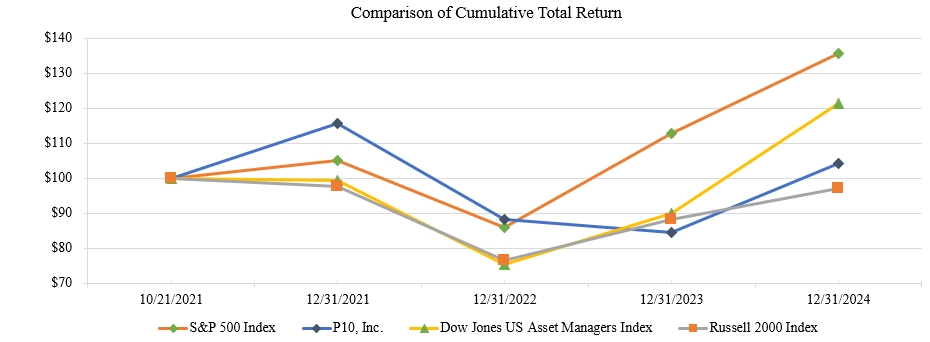

The performance graph and table are not intended to be indicative of future performance. The performance graph and table shall not be deemed "soliciting material" or to be "filed" with the SEC for purposes of Section 18 of the Exchange Act, or otherwise subject to the liabilities under that Section, and shall not be deemed to be incorporated by reference into any of the Company's filings under the Securities Act or the Exchange Act.
Item 6. [Reserved].
54
Item 7. Management's Discussion and Analysis of Financial Condition and Results of Operations.
The following discussion and analysis relates to the activities and operations of P10. As used in this section, “P10,” the “Company”, “we” or “our” includes P10 and only its consolidated subsidiaries. The following information should be read in conjunction with our selected financial and operating data and the accompanying consolidated financial statements and related notes contained elsewhere in this annual report on Form 10-K. Our historical results discussed below, and the way we evaluate our results, may differ significantly from the descriptions of our business and key metrics used elsewhere in this annual report on Form 10-K. The following discussion may contain forward-looking statements that reflects our plans, estimates and beliefs. Our actual results could differ materially from those discussed in these forward-looking statements. Factors that could cause or contribute to these differences include, but are not limited to, those discussed below and elsewhere in this Form 10-K, particularly in "Risk Factors", the "Summary of Risk Factors" and the "Forward-Looking Information." Unless otherwise indicated, references in this Annual Report on Form 10-K to fiscal 2024, fiscal 2023 and fiscal 2022 are to our fiscal years ended December 31, 2024, 2023 and 2022, respectively.
Business Overview
We are a leading multi-asset class private market solutions provider in the alternative asset management industry. Our mission is to provide our investors differentiated access to a broad set of solutions and investment vehicles across highly attractive asset classes and geographies that generate superior risk-adjusted returns. Our success and growth have been driven by our position in the private markets’ ecosystem, providing investors with specialized private market solutions across a comprehensive set of investment strategies, including primary investment funds, secondary investment, direct investment and co-investments and advisory solutions. As investors entrust us with additional capital, our relationships with our fund managers are strengthened, which drives additional investment opportunities, sources more data, enables portfolio optimization and enhances returns, and in turn attracts new investors.
As of December 31, 2024, our private market solutions were comprised of the following:
55
On October 20, 2023, the Company entered into an executive transition agreement with each of Mr. Alpert and Mr. Webb (each, a "Transition Agreement"). Pursuant to the Transition Agreements, Mr. Alpert and Mr. Webb ceased to serve as Co-Chief Executive Officer, and Mr. Alpert and Mr. Webb were appointed as Executive Chairman and Executive Vice Chairman, respectively, for a one-year period. Additionally, Mr. Webb's Transition Agreement provided a one year transition period to continue servicing the Company in a mergers and acquisitions capacity. Effective October 23, 2023, the board of the Company appointed Luke A. Sarsfield III as Chief Executive Officer ("CEO") of the Company. In connection with his appointment as CEO, the Company entered into an employment agreement with Mr. Sarsfield (the "Employment Agreement") setting forth the terms of his employment and compensation. In connection with both the Transition Agreements and the Employment Agreement, provisions were made for severance and sign-on compensation, respectively. Effective June 14, 2024, Mr. Alpert resigned as Executive Chairman, and the Board of the Company appointed CEO, Mr. Sarsfield, as Chairman of the Board. In connection with Mr. Alpert's resignation as Executive Chairman, the Company and Mr. Alpert agreed to the early termination of Mr. Alpert's Transition Agreement. Mr. Webb's Transition Agreement terminated in accordance with its terms on October 23, 2024. Effective November 7, 2024, each of Mr. Alpert and Mr. Webb resigned as members of the board of the Company. The associated expenses were recorded in compensation and benefits on the Consolidated Statements of Operations.
The Board approved a program to repurchase shares of our Class A and Class B common stock. As of December 31, 2024, the Board has approved $92.0 million, of which $52.0 million was approved during the year ending December 31, 2024, for repurchase under the Share Repurchase Program. These shares may be repurchased from time to time in the open market at prevailing market prices, in privately negotiated transactions, in block trades, in accordance with Rule 10b5-1 trading plans and/or through other legally permissible means. The timing and amount of any repurchases pursuant to the program will depend on various factors including, the market price of our Class A Common Stock, trading volume, ongoing assessment of our working capital needs, general market conditions, and other factors. As of December 31, 2024, $88.5 million has been spent to buy back shares and there was $3.5 million remaining for authorized repurchases under this program. On February 11, 2025, the Board of Directors authorized an additional $40.0 million for repurchases under the Stock Repurchase Program.
Sources of Revenue
Our sources of revenue currently include fund management fee contracts, advisory service fee contracts, consulting agreements, referral fees, subscriptions and other services. The majority of our revenues are generated through long-term, fixed fee management and advisory contracts with our investors for providing investment solutions in the following vehicles for our investors:
56
Operating Segments
We operate our business as a single operating segment, which is how our chief operating decision maker evaluates financial performance and makes decisions regarding the allocation of resources.
Trends Affecting Our Business
Our business is affected by a variety of factors, including conditions in the financial markets and economic and political conditions in the North American markets in which we operate, as well as changes in global economic conditions, and regulatory or other governmental policies or actions, which can materially affect the values of the funds our platforms manage, as well as our ability to effectively manage investments and attract capital. Despite higher interest rates and the global economy outlook remaining uncertain, we continue to see investors turning towards alternative investments to achieve asset class diversification, superior investment returns, and participation in access constrained investment opportunities.
The continued growth of our business may be influenced by several factors, including the following market trends:
57
58
Key Financial & Operating Metrics
Revenues
We generate revenues primarily from management fees and advisory contracts, and to a lesser extent, other consulting arrangements and services. See Significant Accounting Policies in Note 2 of our Consolidated Financial Statements for additional information regarding the way revenues are recognized.
We earn management and advisory fees based on a percentage of investors’ capital commitments, in or, in select cases, capital deployed to our investment funds. Management and advisory fees during the commitment period are charged on capital commitments and after the commitment period (or a defined anniversary of the fund’s initial closing) is reduced by a percentage of the management and advisory fees for the preceding years or charged on net invested capital or NAV, in select cases. Fee schedules are generally fixed and set for the expected life of the funds, which typically are between ten to fifteen years. These fees are typically staged to decrease over the life of the contract due to built-in declines in contractual rates and/or as a result of lower net invested capital balances as capital is returned to investors. We also earn revenues through catch-up fees on the funds we manage. Catch-up fees are earned from investors that make commitments to the fund after the first fund closing occurs during the fundraising period of funds originally launched in prior periods, and as such the investors are required to pay a catch-up fee as if they had committed to the fund at the first closing. While catch-up fees are not a significant component of our overall revenue stream, they may result in a temporary increase in our revenues in the period in which they are recognized.
Other revenue consists of subscription and consulting agreements and referral fees that we offer in certain cases. Subscription and consulting agreements provide advisory and/or reporting services to our investors such as monitoring and reporting on an investor’s existing private markets investments. The subscription and consulting agreements typically have renewable one-year lives, and revenue is recognized ratably over the current term of the subscription or the agreement. If subscriptions or fees have been paid in advance, these fees are recorded as deferred revenue on our Consolidated Balance Sheets. Referral fee revenue is recognized upon closing of opportunities where we have referred credit opportunities that do not match our investment criteria. Incentive fees consists of carried interest income from an uncommon pre-acquisition legacy managed fund and incremental incentive revenues earned as a part of an advisory agreement between ECG and Crossroads Impact Corp.
The Company recognizes an accrued contingent liability and contingent payments to customers in our Consolidated Balance Sheets for agreements between ECG and third parties. The agreements require ECG to share in certain revenues earned with the third parties and also includes an option for the third parties to sell back the revenue share to ECG at a set multiple. Additionally, ECG holds the option to buy back 50% of the revenue share at a set multiple. The options are exercisable starting in July 2025. The Company believes it is probable that the third parties will exercise their options to sell back the revenue share and has recognized liabilities on the Consolidated Balance Sheets. The Company has also recognized contingent payments to customers assets associated with the agreements and will amortize the assets against revenue over the estimated length of the management contracts. The amortization is reported in management and advisory fees on the Consolidated Statements of Operations.
Operating Expenses
Compensation and benefits are our largest expense and consists of salaries, bonuses, severance, stock-based compensation, earnout and bonus payments related to the acquisition of WTI, employee benefits and employer-related payroll taxes. Despite our general operating leverage that exists, we expect to continue to experience an incremental rise in compensation and benefits expense commensurate with expected growth in headcount and with the need to maintain
59
competitive compensation levels as we expand into new markets to create new products and services. In substantially all instances, the Company does not hold carried interests in the funds that we manage. Carried interest is typically structured to stay with the investment professionals. It allows our investment professionals to receive additional benefit and provides economic incentive for them to outperform on behalf of our investors. This structure differs from that of most of our competitors, which we believe better aligns the objectives of our stockholders, investors and investment professionals.
Professional fees primarily consist of legal, advisory, accounting and tax fees which may include services related to our strategic development opportunities such as due diligence performed in connection with potential acquisitions. As our Company is an SEC registrant, our professional fees will fluctuate commensurate with our strategic objectives and potential acquisitions, and certain recurring accounting advisory, audit and tax expenses will increase to comply with additional regulatory requirements.
General, administrative and other includes rent, travel and entertainment, technology, insurance and other general costs associated with operating our business.
Strategic alliance expense is included in operating expenses. This expense is driven by the Strategic Alliance Agreement that Bonaccord entered into with an investor at the time Bonaccord was acquired in exchange for a portion of net management fee earnings.
Other (Expense)/Income
Interest expense, net includes interest paid and accrued on our outstanding debt, along with the amortization of deferred financing costs. Other income (loss) includes any income from unconsolidated subsidiaries, interest income earned from bank accounts across management companies, and any accrued expenses related to litigation and regulatory activity as necessary, which would be discussed in Note 13 of our Consolidated Financial Statements.
Income Tax Benefit/(Expense)
Income tax benefit/(expense) is comprised of current and deferred tax benefit/(expense). Current income tax benefit/(expense) represents our estimated taxes to be paid or refunded for the current period. In accordance with ASC 740, Income Taxes (“ASC 740”), we recognize deferred tax assets and liabilities for the expected future tax consequences of temporary differences between the financial reporting and tax basis of assets and liabilities, as well as for operating loss and tax credit carryforwards. Deferred tax assets and liabilities are measured using enacted tax rates in effect for the year in which the differences are expected to reverse. Valuation allowances are recorded to reduce deferred tax assets to the amount we believe is more likely than not to be realized.
Fee-Paying Assets Under Management, or FPAUM
FPAUM reflects the assets from which we earn management and advisory fees. Our vehicles typically earn management and advisory fees based on committed capital, and in certain cases, net invested capital, depending on the fee terms. Management and advisory fees based on committed capital or deployed capital are not affected by market appreciation or depreciation.
60
Results of Operations
For the years ended December 31, 2024, December 31, 2023, and December 31, 2022.
|
|
|
For the year |
||||||||||||
|
|
|
|
||||||||||||
|
|
|
2024 |
|
|
2023 |
|
|
$ Change |
|
|
% Change |
|||
REVENUES |
|
|
(in thousands) |
|
|
|
|
|
|
||||||
Management and advisory fees |
|
|
$ |
290,218 |
|
|
$ |
238,729 |
|
|
$ |
51,489 |
|
|
22% |
Other revenue |
|
|
|
6,230 |
|
|
|
3,005 |
|
|
|
3,225 |
|
|
107% |
Total revenues |
|
|
|
296,448 |
|
|
|
241,734 |
|
|
|
54,714 |
|
|
23% |
OPERATING EXPENSES |
|
|
|
|
|
|
|
|
|
|
|
|
|||
Compensation and benefits |
|
|
|
155,316 |
|
|
|
154,286 |
|
|
|
1,030 |
|
|
1% |
Professional fees |
|
|
|
21,464 |
|
|
|
12,668 |
|
|
|
8,796 |
|
|
69% |
General, administrative and other |
|
|
|
28,780 |
|
|
|
22,584 |
|
|
|
6,196 |
|
|
27% |
Contingent consideration expense |
|
|
|
160 |
|
|
|
560 |
|
|
|
(400 |
) |
|
(71)% |
Amortization of intangibles |
|
|
|
25,612 |
|
|
|
29,221 |
|
|
|
(3,609 |
) |
|
(12)% |
Strategic alliance expense |
|
|
|
4,496 |
|
|
|
1,494 |
|
|
|
3,002 |
|
|
201% |
Total operating expenses |
|
|
|
235,828 |
|
|
|
220,813 |
|
|
|
15,015 |
|
|
7% |
|
|
|
|
|
|
|
|
|
|
|
|
|
|||
INCOME FROM OPERATIONS |
|
|
|
60,620 |
|
|
|
20,921 |
|
|
|
39,699 |
|
|
190% |
|
|
|
|
|
|
|
|
|
|
|
|
|
|||
OTHER (EXPENSE)/ INCOME |
|
|
|
|
|
|
|
|
|
|
|
|
|||
|
|
|
|
|
|
|
|
|
|
|
|
|
|||
Interest expense, net |
|
|
|
(25,510 |
) |
|
|
(21,872 |
) |
|
|
(3,638 |
) |
|
17% |
Other (losses)/income |
|
|
|
(6,747 |
) |
|
|
(2,189 |
) |
|
|
(4,558 |
) |
|
208% |
Total other (expense) |
|
|
|
(32,257 |
) |
|
|
(24,061 |
) |
|
|
(8,196 |
) |
|
34% |
Net income/(losses) before income taxes |
|
|
|
28,363 |
|
|
|
(3,140 |
) |
|
|
31,503 |
|
|
N/A |
Income tax (expense) |
|
|
|
(8,696 |
) |
|
|
(4,632 |
) |
|
|
(4,064 |
) |
|
88% |
NET INCOME/(LOSS) |
|
|
$ |
19,667 |
|
|
$ |
(7,772 |
) |
|
$ |
27,439 |
|
|
N/A |
Revenues
Years Ended December 31, 2024 and December 31, 2023
Our revenue is composed almost entirely of recurring management and advisory fees, with the vast majority of fees earned on committed capital that is typically subject to ten to fifteen year lock up agreements, therefore our average fee rates have remained stable at approximately 1% of average FPAUM for the years ended December 31, 2024 and December 31, 2023. For the year ended December 31, 2024 compared to the year ended December 31, 2023, revenues increased $54.7 million or 23% due to higher management and advisory fees as well as an increase in catch up fees due to fund closings across the Company.
Management and advisory fees increased $51.5 million, or 22%, to $290.2 million for the year ended December 31, 2024 as compared to the year ended December 31, 2023 due to continued fundraising and deployed capital throughout 2024 and 10% growth in average FPAUM across the Company. Catch up fees for the year ended December 31, 2024 were $38.9 million. Catch up fees are associated with the fund closings at Bonaccord, TrueBridge and RCP.
Management fees are non-refundable, however, a certain fund was raised in 2022 with the objective of investing in all funds raised with an undisclosed manager across its global platform, most likely across two vintages – 2022 and 2024/2025. The fund closed with $275.0 million of external LP capital. Management fees were charged on $250 million, as the fund manager was unsure how much of the $275.0 million raised would be deployed. The management rate is 1% based on LP commitment. The fund deployed just under 40% of its total fund size in the 2022 vintages, with the remaining 60% reserved for future vintages. In late 2023, the undisclosed manager announced that it would be separating its global platform into three separate geo-specific entities, spinning its India and China operations off into their own independent firms. The fund mandate does not allow investments in these new independent firms. As a result, the fund manager recommended that LPs vote to release all fund LPs from their uninvested capital which was approximately 60% of the original commitment. The fund manager distributed a consent election to that effect. The management fee from inception will be revised based on this new, smaller fund size which is approximately 40%. In addition, to preserve goodwill with limited partners, the fund waived 50% of the recalculated management fee from inception at June 2022 to December 2023. In accordance with ASC 606, this price concession was treated as a contract modification thus reducing revenue in the period in which it was identified which was the fourth quarter of 2023. In the fourth quarter of 2023, revenue was reduced by $3.0 million.
Other revenues, which represent ancillary elements of our business, increased by $3.2 million or 107% to $6.2 million for the year ended December 31, 2024 as compared to the year ended December 31, 2023 driven by $2.1 million of
61
recognized carried interest income from an uncommon pre-acquisition legacy managed fund, an increase of $0.6 million in ancillary services provided to clients, an increase of $0.4 million of interest income, and an increase of $0.1 million of subscription fee revenues.
|
|
|
For the year |
|
||||||||||||
|
|
|
2024 |
|
|
2023 |
|
$ Change |
|
|
% Change |
|
||||
OPERATING EXPENSES |
|
|
(in thousands) |
|
|
|
|
|
|
|||||||
Compensation and benefits |
|
|
$ |
155,316 |
|
|
$ |
154,286 |
|
$ |
1,030 |
|
|
|
1 |
% |
Professional fees |
|
|
|
21,464 |
|
|
|
12,668 |
|
|
8,796 |
|
|
|
69 |
% |
General, administrative, and other |
|
|
|
28,780 |
|
|
|
22,584 |
|
|
6,196 |
|
|
|
27 |
% |
Contingent consideration expense |
|
|
|
160 |
|
|
|
560 |
|
|
(400 |
) |
|
|
(71 |
)% |
Amortization of intangibles |
|
|
|
25,612 |
|
|
|
29,221 |
|
|
(3,609 |
) |
|
|
(12 |
)% |
Strategic alliance expense |
|
|
|
4,496 |
|
|
|
1,494 |
|
|
3,002 |
|
|
|
201 |
% |
Total operating expenses |
|
|
$ |
235,828 |
|
|
$ |
220,813 |
|
$ |
15,015 |
|
|
|
7 |
% |
Operating Expenses
Years Ended December 31, 2024 and December 31, 2023
Total operating expenses increased by $15.0 million, or 7%, to $235.8 million for the year ended December 31, 2024 compared to the year ended December 31, 2023. This increase was primarily due to increases in professional fees and general, administrative, and other expenses.
Compensation and benefits expense increased by $1.0 million, or 1%, to $155.3 million, for the year ended December 31, 2024 compared to the year ended December 31, 2023. The increase was driven by $21.6 million of increases in headcount and associated benefits across the Company as well as merit-based salary raises to retain and motivate talent across the Company. The increase was offset by a change of estimate for timing of achieving the earnout payment related to the acquisition of WTI. While the Company still expects the first two hurdles to be met, the period in which the hurdles are expected to be satisfied is anticipated to be later than previously projected, which prospectively adjusted recognition of the expense and resulted in $8.7 million decrease for the year ended December 31, 2024 compared to the year ended December 31, 2023. Additionally, there was a decrease in severance expense of $5.4 million and a decrease in stock compensation of $6.5 million, of which $1.0 million decrease relates to remeasurement for the fair value of the Bonaccord Units and Hark Units related to the acquisition of Bonaccord and Hark and a decrease of $3.9 million related to management stock award accelerations due to management turnover and the Executive Transition in October 2023. In 2023, the Hark Units were fully earned and recognized, therefore, there was no correlating expense in 2024 associated with the Hark Units. Moreover, the Bonaccord Units, which are recognized using the tranche method, had a decrease in expense for the year ended December 31, 2024 compared to the year ended December 31, 2024. In 2024, the Bonaccord Units were fully earned and recognized. For further discussion on the Bonaccord Units and Hark Units, please see Note 15 of the Consolidated Financial Statements.
Professional fees increased by $8.8 million, or 69%, to $21.5 million primarily driven by a $3.2 million increase in professional and legal fees associated with the Company's debt refinancing and the remaining increase attributable to the Company's transitions related to build out of management team, office locations, policies as well as normal course of business such as contract modifications, filings, and due diligence for acquisitions.
General, administrative and other increased by $6.2 million, or 27% to $28.8 million, due to $2.2 million of additional placement agent fees and other expenses associated with increased revenues, $1.4 million increase in marketing efforts, as well as $2.4 million of ongoing enhancements to infrastructure, technology, premises, and security across the Company.
Contingent consideration expense decreased $0.4 million, to $0.2 million, for the year ended December 31, 2024 as compared to the year ended December 31, 2023. This was driven by remeasurement of contingent consideration payable in connection with the acquisitions of both Hark and Bonaccord included in 2023, compared to remeasurement of contingent consideration payable in connection with only the acquisition of Bonaccord. The Hark contingent consideration was fully earned and paid in 2023 and the Bonaccord contingent consideration is fully earned as of December 31, 2024 with the final payment of $2.3 million made on January 24, 2025.
62
Amortization of intangibles decreased by $3.6 million, or 12%, to $25.6 million, for the year ended December 31, 2024 as compared to the year ended December 31, 2023. This is due to decreases at ECG and RCP. The decrease at ECG is driven by syndicate contracts' amortization schedule, which is based on projected revenues at the time of acquisition. The decrease at RCP is driven by asset management fee contracts' amortization schedule, which is based on projected revenues at the time of acquisition.
Strategic alliance expense increased by $3.0 million, or 201%, to $4.5 million for the year ended December 31, 2024 as compared to the year ended December 31, 2023. This is due to an increase in net management fee earnings that was driven by additional fundraising and management fee revenue in 2024.
Other (Expense)/Income
Years Ended December 31, 2024 and December 31, 2023
Other expenses increased by $8.2 million, or 34%, to $32.3 million for the year ended December 31, 2024 compared to the year ended December 31, 2023. This increase was driven by $10.1 million in other (losses)/income related to the measurement expense of contra-revenue put option related to incentive fees. Additionally, an increase in interest expense of $3.6 million due to a higher average of SOFR rates and a larger average outstanding debt balance for the year ended December 31, 2024 compared to the year ended December 31, 2023. This was offset slightly by $2.4 million in other (losses)/income related to legal settlement expenses incurred in the year ended December 31, 2023 compared to a $1.2 million legal settlement gain recognized in the year ended December 31, 2024. The legal settlements in both 2023 and 2024 were primarily related to a matter with the Oregon Department of Justice. The increase was also slightly offset by $2.0 million increase in other (losses)/income related to interest earned for money market accounts and income from unconsolidated subsidiaries.
Income Tax Expense
Years Ended December 31, 2024 and December 31, 2023
Income tax expense increased by $4.1 million to an expense of $8.7 million for the year ended December 31, 2024 compared to an expense of $4.6 million for the year ended December 31, 2023. The increase in income tax expense from 2023 to 2024 was due to an increase in overall net operating income and flow-through income from underlying investments in 2024.
63
FPAUM
The following table provides a period-to-period roll-forward of our fee paying assets under management on an actual basis.
|
|
|
|
|
|
|
||
|
|
For the year |
|
|||||
|
|
2024 |
|
|
2023 |
|
||
|
|
(in millions) |
|
|
(in millions) |
|
||
Balance, Beginning of Period |
|
$ |
23,259 |
|
|
$ |
21,206 |
|
Add: |
|
|
|
|
|
|
||
Acquisitions |
|
|
— |
|
|
|
— |
|
Capital raised (1) |
|
|
3,154 |
|
|
|
2,793 |
|
Capital deployed (2) |
|
|
636 |
|
|
|
949 |
|
Net Asset Value Change (3) |
|
|
(4 |
) |
|
|
(121 |
) |
Less: |
|
|
|
|
|
|
||
Scheduled fee base stepdowns |
|
|
(578 |
) |
|
|
(601 |
) |
Expiration of fee period |
|
|
(790 |
) |
|
|
(967 |
) |
Balance, End of period |
|
$ |
25,677 |
|
|
$ |
23,259 |
|
FPAUM as of December 31, 2024
FPAUM increased by $2.4 billion or 10% to $25.7 billion for the year ended December 31, 2024, due primarily to an increase in capital raised and capital deployed from our private equity and venture capital solutions, which was offset by a decline of fees related to scheduled fee stepdowns and expiration of fees. Our FPAUM growth and concentration across solutions and vehicles has been relatively consistent over time but can vary in particular periods due to the systematic fundraising cycles of new funds, which typically lasts 12-24 months. We expect to continue to expand our fundraising efforts and grow FPAUM with the launch of new specialized investment vehicles and asset class solutions.
Results of Operations for Years Ended December 31, 2023 and 2022
For a comparison of our results of operations for fiscal years ended December 31, 2023 and 2022 see "Part II, Item 7. Management's Discussion and Analysis of Financial Condition and Results of Operations" of our annual report Form 10-K for the fiscal year ended December 31, 2023, filed with the SEC on March 13, 2024 and incorporated by reference herein.
Non-GAAP Financial Measures
Below is a description of our unaudited non-GAAP financial measures. These are not measures of financial performance under GAAP and should not be construed as a substitute for the most directly comparable GAAP measures, which are reconciled below. These measures have limitations as analytical tools, and when assessing our operating performance, you should not consider these measures in isolation or as a substitute for GAAP measures. Other companies may calculate these measures differently than we do, limiting their usefulness as a comparative measure.
We use Fee-Related Revenue ("FRR"), Fee-Related Earnings ("FRE"), Adjusted Net Income ("ANI"), as well as Adjusted EBITDA (Earnings Before Interest, Taxes, Depreciation and Amortization) to provide additional measures of profitability. We use the measures to assess our performance relative to our intended strategies, expected patterns of profitability, and budgets, and use the results of that assessment to adjust our future activities to the extent we deem necessary. FRR is calculated as Total Revenues less any incentive fees. FRE is a non-GAAP performance measure used to monitor our baseline earnings less any incentive fee revenue and excluding any incentive fee-related expenses. ANI reflects our actual cash flows generated by our core operations. ANI is calculated as Adjusted EBITDA, less actual cash paid for interest and federal and state income taxes.
64
In order to compute Adjusted EBITDA, we adjust our GAAP net income/(loss) for the following items:
The cash income taxes paid during the 2024 and 2023 periods differ significantly from the net income tax expense, which is primarily comprised of deferred tax expense as described in the results of operations.
|
|
For the Year |
|
|||||||||
|
|
2024 |
|
|
2023 |
|
|
2022 |
|
|||
|
|
(in thousands) |
|
|
|
|
||||||
Net Income/(Loss) |
|
$ |
19,667 |
|
|
$ |
(7,772 |
) |
|
$ |
29,399 |
|
Adjustments: |
|
|
|
|
|
|
|
|
|
|||
Depreciation & amortization |
|
|
28,314 |
|
|
|
31,472 |
|
|
|
28,028 |
|
Interest expense, net |
|
|
25,510 |
|
|
|
21,872 |
|
|
|
9,505 |
|
Income tax expense |
|
|
8,698 |
|
|
|
4,632 |
|
|
|
6,064 |
|
Non-recurring expenses |
|
|
17,520 |
|
|
|
13,874 |
|
|
|
9,587 |
|
Non-cash stock based compensation |
|
|
22,480 |
|
|
|
21,519 |
|
|
|
9,587 |
|
Non-cash stock based compensation - acquisitions |
|
|
7,971 |
|
|
|
8,674 |
|
|
|
9,029 |
|
Non-cash stock based compensation - CEO transition |
|
|
— |
|
|
|
6,331 |
|
|
|
— |
|
Earn out related compensation |
|
|
14,312 |
|
|
|
22,992 |
|
|
|
5,612 |
|
|
|
|
|
|
|
|
|
|
|
|||
Adjusted EBITDA |
|
$ |
144,472 |
|
|
$ |
123,594 |
|
|
$ |
106,811 |
|
Less: |
|
|
|
|
|
|
|
|
|
|||
Cash interest expense, net |
|
|
(21,727 |
) |
|
|
(20,100 |
) |
|
|
(6,784 |
) |
Cash income taxes, net of taxes related to acquisitions |
|
|
(2,538 |
) |
|
|
(1,539 |
) |
|
|
(2,114 |
) |
Adjusted Net Income |
|
$ |
120,208 |
|
|
$ |
101,955 |
|
|
$ |
97,913 |
|
|
|
|
|
|
|
|
|
|
|
|||
Total Revenues |
|
$ |
296,448 |
|
|
$ |
241,734 |
|
|
$ |
198,360 |
|
Adjustments: |
|
|
|
|
|
|
|
|
|
|||
Non-Fee Related Revenue |
|
|
(5,179 |
) |
|
|
(4,730 |
) |
|
|
(2,751 |
) |
Fee-Related Revenue |
|
$ |
291,269 |
|
|
$ |
237,004 |
|
|
$ |
195,609 |
|
|
|
|
|
|
|
|
|
|
|
|||
Adjusted EBITDA |
|
$ |
144,472 |
|
|
$ |
123,594 |
|
|
$ |
106,811 |
|
Less: |
|
|
|
|
|
|
|
|
|
|||
Non-Fee Related Income |
|
|
(2,354 |
) |
|
|
(497 |
) |
|
|
(334 |
) |
Fee-Related Earnings |
|
$ |
142,118 |
|
|
$ |
123,097 |
|
|
$ |
106,477 |
|
65
Financial Position, Liquidity and Capital Resources
Selected Statements of Financial Position
|
|
As of |
|
|
As of |
|
|
|
|
|
|
|||
|
|
December 31, |
|
|
December 31, |
|
|
|
|
|
|
|||
|
|
2024 |
|
|
2023 |
|
|
$ Change |
|
|
% Change |
|||
|
|
(in thousands) |
|
|
|
|
|
|
||||||
Cash and cash equivalents (including restricted cash) |
|
$ |
68,115 |
|
|
$ |
32,057 |
|
|
$ |
36,058 |
|
|
112% |
Goodwill and other intangibles |
|
|
603,627 |
|
|
|
629,233 |
|
|
|
(25,606 |
) |
|
(4)% |
Total assets |
|
|
869,275 |
|
|
|
834,074 |
|
|
|
35,201 |
|
|
4% |
Accrued compensation and benefits |
|
|
69,544 |
|
|
|
45,081 |
|
|
|
24,463 |
|
|
54% |
Debt obligations |
|
|
319,783 |
|
|
|
289,844 |
|
|
|
29,939 |
|
|
10% |
Equity |
|
|
386,890 |
|
|
|
425,162 |
|
|
|
(38,272 |
) |
|
(9)% |
There was an increase in cash and cash equivalents from $32.1 million as of December 31, 2023 to $68.1 million as of December 31, 2024 due to operating cash flows offset by cash used for open market repurchases for the Company's stock. There was a decrease in goodwill and intangible assets of $25.6 million driven by amortization of intangible assets during the year ended December 31, 2024. Remaining total assets also increased in the same period by $24.7 million due to $35.9 million increase in due from related parties and accounts receivable offset by a $9.9 million decrease in prepaid expenses and other assets. The increase in due from related parties is driven by the Advisory Agreements with Enhanced Permanent Capital and the increase in accounts receivable is driven by an increase in revenues across the Company. The decrease in prepaid expenses and other assets was related to the sale of inventory assets for tax credit programs at Enhanced.
Liquidity and Capital Resources
We have continued to support our ongoing operations through the receipt of management and advisory fee revenues. However, to fund our continued growth, we have utilized capital obtained through debt and equity raises. Our ability to continue to raise funds or issue new shares as consideration will be critical as we pursue additional business development opportunities and new acquisitions.
On December 22, 2021, P10, Inc. entered into a Term Loan and Revolving Credit Facility with JP Morgan Chase Bank, N.A.. The term loan and revolving credit facility provides financing for acquisition activity. The term loan provides for a $125.0 million facility and the revolving credit facility provides for an additional $125.0 million. There is also a $125 million accordion feature available in the credit agreement, which we exercised in September 2022. The accordion was not drawn until October 2022, at which point it was divided to $87.5 million of term loan and $37.5 million of revolver. On August 1, 2024, the Company entered into the Amended and Restated Credit Agreement, which provides for a new senior secured revolving credit facility in the amount of $175.0 million with a $10.0 million sublimit for the issuance of letters of credit, and a new senior secured loan facility in the amount of $325.0 million. The New Credit Facilities are to be used to refinance and replace the credit facilities under the Credit Agreement and for general corporate purposes, including acquisitions.
The New Credit Facilities are Term SOFR Loans meaning loans bearing interest based upon the "Adjusted Term SOFR Rate". The Adjusted Term SOFR Rate is the Secured Overnight Financing Rate ("SOFR") at the date of election, plus 2.60%.The Company can elect one or three months for the Revolver Facility and one, three, or six months for the Term Loan. Principal is contractually repaid at a rate of 1.25% on the term loan quarterly effective December 31, 2025. The New Revolving Facility has no contractual principal repayments until maturity, which is August 1, 2028 for both facilities.
As of December 31, 2024, the Term Loan with a balance of $325.0 million is incurring interest at a weighted average Adjusted Term SOFR Rate of 7.68%. As of December 31, 2024, there is no outstanding balance for the Revolver Facility. Refer to Note 11 of the Consolidated Financial Statements for further details provided on the debt and associated interest periods.
The Amended and Restated Credit Agreement contains affirmative and negative covenants typical of such financing transactions, and specific financial covenants which require P10 to maintain a minimum FPAUM of the sum of $16.7 million plus 70% of the aggregate amount of FPAUM acquired or not constituted as organic growth as well as a minimum leverage ratio of less than or equal to 3.50. As of December 31, 2024, P10 was in compliance with its financial and other covenants required under the facility. The Company has incurred $24.1 million in interest expense for the year ended December 31, 2024.
66
Cash Flows
Year Ended December 31, 2024 Compared to the Years Ended December 31, 2023 and December 31, 2022
The following table reflects our cash flows for the years ended December 31, 2024, 2023 and 2022:
|
|
For the Year |
|
|
|
|
|
||||||
|
|
|
|
|
|
|
|
||||||
|
|
2024 |
|
|
2023 |
|
$ Change |
|
|
% Change |
|||
|
|
(in thousands) |
|
|
|
|
|
||||||
Net cash provided by operating activities |
|
$ |
100,970 |
|
|
$ |
47,685 |
|
$ |
53,285 |
|
|
112% |
Net cash (used in) investing activities |
|
|
(5,804 |
) |
|
|
(2,250 |
) |
|
(3,554 |
) |
|
158% |
Net cash (used in) financing activities |
|
|
(59,108 |
) |
|
|
(42,870 |
) |
|
(16,238 |
) |
|
38% |
Increase in cash, cash equivalents and |
|
$ |
36,058 |
|
|
$ |
2,565 |
|
$ |
33,493 |
|
|
1,306% |
Operating Activities
Years Ended December 31, 2024 and December 31, 2023
The Company's operating activities generally reflect the Company's earnings in the respective periods after adjusting for significant non-cash activity, including income of unconsolidated subsidiaries, stock-based compensation, depreciation, amortization, and deferred tax expense, all of which are included in net income/(loss). Cash from operating activities increased $53.3 million or 112%, to $101.0 million for the year ended December 31, 2024 compared to the year ended December 31, 2023. For the years ended December 31, 2024 and 2023, our net cash provided by operating activities was driven primarily by receipts of management fees and advisory fees, partially offset by payment of operating expenses, which includes professional fees, compensation and benefits, as well as general, administrative and other expenses.
Investing Activities
Years Ended December 31, 2024 and December 31, 2023
The cash used in investing activities increased by $3.6 million, or 158% to $5.8 million, for the year ended December 31, 2024 as compared to the year ended December 31, 2023. This increase in cash used in investing activities was due to purchases of leasehold improvements, included in property and equipment during the year ended December 31, 2024.
Financing Activities
Years Ended December 31, 2024 and December 31, 2023
We used a net $59.1 million in cash for financing activities for the year ended December 31, 2024, as compared to cash used in financing activities of $42.9 million for the year ended December 31, 2023. The change is driven by the increase in open market repurchases of the Company's stock in the year ended December 31, 2024 compared to the year ended December 31, 2023 offset by the cash provided by debt refinancing during 2024.
Future Sources and Uses of Liquidity
We generate significant cash flows from operating activities. We believe that we will be able to continue to meet our current and long-term liquidity and capital requirements through our cash flows from operating activities, existing cash and cash equivalents, and our external financing activities which may include refinancing of existing indebtedness or the pay down of debt using proceeds of equity offerings.
Off Balance Sheet Arrangements
We do not invest in any off-balance sheet vehicles that provide liquidity, capital resources, market or credit risk support, or engage in any activities that expose us to any liability that is not reflected in our consolidated financial statements.
67
Critical Accounting Policies and Estimates
We prepare our consolidated financial statements in accordance with accounting principles generally accepted in the United States of America (“U.S. GAAP”) and include the accounts of the Company and its consolidated subsidiaries. The preparation of the Consolidated Financial Statements in conformity with U.S. GAAP requires management to make estimates and assumptions that affect the reported amounts of assets and liabilities and disclosure of contingent assets and liabilities at the dates of the Consolidated Financial Statements and the reported amounts of revenues and expenses during the reporting periods. Actual results could differ from those estimates. We believe the following critical accounting policies could potentially produce materially different results if we were to change the underlying assumptions, estimates, or judgments. See Note 2 of our consolidated financial statements for a summary of our significant accounting policies.
Basis of Presentation
The accompanying Consolidated Financial Statements are prepared in accordance with GAAP. Management believes it has made all necessary adjustments so that the Consolidated Financial Statements are presented fairly and that estimates made in preparing the Consolidated Financial Statements are reasonable and prudent. The Consolidated Financial Statements include the accounts of the Company, its wholly owned or majority-owned subsidiaries and entities in which the Company is deemed to have a direct or indirect controlling financial interest based on either a variable interest model or voting interest model. All intercompany transactions and balances have been eliminated upon consolidation. Certain entities in which the Company holds an interest are investment companies that follow specialized accounting rules under GAAP and reflect their investments at estimated fair value. Accordingly, the carrying value of the Company’s equity method investments in such entities retains the specialized accounting treatment.
Current Expected Credit Losses for Due from Related Parties
The Company evaluates accounts receivable, due from related parties, and notes receivable using the current expected credit loss model. The Company determines a current estimate of all expected credit losses over the life of each financial instrument, which may result in recognition of credit losses on loans and receivables before an actual event of default. The Company establishes reserves for any estimated credit losses with a corresponding charge in the Consolidated Statements of Operations. If accounts are subsequently determined to be uncollectible, they will be expensed in the period that determination is made. Due from related parties represents receivables from the Funds for reimbursable expenses, and management fees collected by a related party of RCP 2 that are owed to RCP 2. Additionally, fees owed to the Company for the advisory agreement entered into upon the closing of the acquisitions of ECG and ECP and any supplemental agreements entered into after acquisition ("Advisory Agreements"), where ECG provides advisory services to Enhanced Permanent Capital, LLC ("Enhanced PC") are reflected in due from related parties on the Consolidated Balance Sheets.
The Company estimates that accounts receivable, due from related parties, and notes receivable are fully collectible based on historical events, current conditions, and reasonable and supportable forecasts. The estimate for the Enhanced PC Advisory Agreements require more judgment than other receivables due to the size of the outstanding receivable and the Company's reliance on reasonable and supportable forecasts on this particular receivable bucket.
Revenue Recognition of Management and Advisory Fees
The Company earns management fees for asset management services provided to the Funds where the Company has discretion over investment decisions. The Company primarily earns fees for advisory services provided to clients where the Company does not have discretion over investment decisions. Management and advisory fees received in advance reflects the amount of fees that have been received prior to the period the fees are earned. These fees are recorded as deferred revenues on the Consolidated Balance Sheets due to the performance obligations not being satisfied at the time of collection.
For asset management and advisory services, the Company typically satisfies its performance obligations over time as the services are provided as a distinct series of daily performance obligations that the customer simultaneously benefits from as they are performed. Asset management fees are based on the contractual terms of each contract which differ, such as fees calculated based on committed capital or deployed capital, fees initially calculated based on committed capital during the investment period and on net invested capital through the remainder of the fund’s term, fees that step down during specified periods of the fund's term, or in limited instances, fees based on assets under management. At contract inception, no revenue is estimated as the fees are dependent variable amounts which are susceptible to factors outside of our control. Fees are recognized for services provided during the period, which are distinct from services provided in other periods. In certain asset
68
management and advisory agreements progress is measured using the practical expedient under the output method resulting in the recognition of revenue in the amount for which the Company has a right to invoice.
Advisory service fees are determined using fixed-rate fees and are recognized over time as the related services are delivered. Other advisory services include transaction and management fees associated with managing the origination and ongoing compliance of certain investments.
The Company allocates a portion of consideration received under an arrangement to a financing component when it determines that a significant financing component exists. The Company does not adjust the promised amount of consideration for the effects of a significant financing component if, at each contract inception the Company expects that the period between services being provided and cash collection would be less than one year. To the extent the Company determines that there is a significant financing component in a contract with a customer, it determines the impact of the time value of money in adjusting the transaction price to account for the income associated with the financing component by estimating the discount rate that would be reflected in a separate financing transaction between the customer and the Company at contract inception, based upon the credit characteristics of the customer receiving financing in the contract.
The Company is applying the optional disclosure exemption for variable consideration for unsatisfied performance obligations, as the variable consideration relates to these unsatisfied performance obligations being fulfilled as a series. The performance obligations related to these contracts are expected to be satisfied over the next 1-10 years as services are provided to the customer.
Catch-up fees are earned from investors that make commitments to previously launched fund after the first fund closing occurs, but during the fundraising period. Contractual terms require the investors to pay a catch-up fee as if they had committed to the fund at the first closing. Catch-up fees are recorded as revenue when such commitments are made as variable consideration in which the constraint is relieved at the time of the commitment.
Stock-Based Compensation Expense
Stock-based compensation relates to grants for shares of P10 awarded to our employees through stock options as well as RSUs awarded to employees and RSAs issued to non-employee directors as compensation for service on the Company's board. Stock compensation expense for awards that cliff-vest after a service period is recorded ratably over the vesting period at the fair market value on the grant date. For awards with graded vesting, and vesting only requires a service condition, the Company elected, in accordance with ASC 718, to treat these awards as single awards for recognition purposes and recognize compensation on a straight-line basis over the requisite service period of the entire award. For awards with graded vesting and require a market condition to vest, the Company treats each expected vesting tranche as an individual award and recognizes expense ratably over the vesting period at the fair market value of the grant date. Certain acquisition-related RSUs vest after meeting certain performance metrics. For these, the Company uses the tranche method and recognizes expense for each tranche of RSUs deemed probable of vesting on a straight-line basis over the expected vesting period. The Company evaluates the probability of vesting at each reporting period. Unvested RSUs are remeasured quarterly against performance metrics as a liability on the Consolidated Balance Sheets. Refer to Note 15 to the Consolidated Financial Statements for further discussion. Forfeitures are recognized as they occur.
Accrued Compensation and Benefits
Accrued compensation and benefits consists of employee salaries, bonuses, benefits, severance, and acquisition-related earnouts (contingent on employment) that has not yet been paid. The estimate for the acquisition-related earnouts require more judgment than the other components in accrued compensation and benefits. The acquisition-related earnout for WTI is an earnout payment of up to $70.0 million of cash and common stock may be earned upon meeting certain performance metrics. Upon the achievement of $20.0 million, $22.5 million, and $25.0 million of EBTIDA, $35.0 million, $17.5 million, and $17.5 million are earned, respectively. Of the total amount, $50.0 million can be earned by the sellers and the remaining $20.0 million would be allocated to employees of the Company at the time the earnout is earned. Payment to both sellers and employees is contingent on continued employment and, therefore, these earnout payments are recorded as compensation and benefits expense on the Consolidated Statements of Operations. Payments will be made in cash, with the option to pay up to 50.0% in units of P10 Intermediate, no later than 90 days following the last day of the calendar quarter in which a milestone payment is achieved. Total payments will not exceed $70.0 million and any amounts paid will be paid by October 2027. The Company will evaluate whether each earn-out hurdle is probable of occurring and recognize an expense over the period the hurdle is expected to be achieved. As of December 31, 2024, the Company has determined that only the first two EBITDA hurdles are probable of being achieved. Additionally in connection with the acquisition of WTI, certain
69
employees entered into employment agreements. As part of these employment agreements, certain employees may receive a one-time bonus payment if the employee is employed by the Company as of the fifth anniversary of the effective date and the trailing-twelve month EBITDA of WTI at that time is equal to or greater than $20.0 million. Payment can be made in cash or stock of P10, provided that no more than $5.0 million will be payable in cash. Total payment will not exceed $10.0 million and any amounts will be paid in October 2027, the fifth anniversary of the effective date.
Revenue Share and Repurchase Agreement
The Company recognizes accrued contingent liabilities and contingent payments to customers asset in our Consolidated Balance Sheets for an agreement between ECG and various third parties. The agreement requires ECG to share in certain revenues earned with the third parties and also includes an option for the third parties to sell back the revenue share to ECG at a set multiple. Additionally, ECG holds the option to buy back 50% of the revenue share at a set multiple. The options to repurchase the revenue share are exercisable starting in July 2025. The Company believes it is probable that the third parties will exercise its option to sell back the revenue share and has recognized a liability on the Consolidated Balance Sheets. The Company has also recognized a contingent payment to customers associated with the agreement and will amortize the asset against revenue over the estimated term of the management contract. The amortization is reported in management and advisory fees on the Consolidated Statements of Operations. The Company will reassess at each reporting period and recognize all changes.
On December 23, 2024, the Company became a guarantor for a related party on a related put option and call option with the same third party customers and terms. The Company would be required to settle either the put or call options if either are exercised and the related party does not have the means to settle themselves. The Company’s accrued contingent liabilities are recognized once determined that it is probable the Company would need to settle as guarantor and estimable and would record a loss at the same time. The Company will reassess at each reporting period and recognize all changes. Refer to Note 13 to the Consolidated Financial Statements for further discussion.
Item 7A. Qualitative and Quantitative Disclosures about Market Risk.
In the normal course of business, we are exposed to a broad range of risks inherent in the financial markets in which we participate, including price risk, interest-rate risk, access to and cost of financing risk, liquidity risk, and counterparty risk. Potentially negative effects of these risks may be mitigated to a certain extent by those aspects of our investment approach, investment strategies or other business activities that are designed to benefit, either in relative or absolute terms, from periods of economic weakness, tighter credit or financial market dislocations.
Our predominant exposure to market risk is related to our role as general partner or investment manager for our specialized investment vehicles and the sensitivities to movements in the fair value of their investments and overall returns for our investors. Since our management fees are generally based on commitments or net invested capital, our management fee and advisory fee revenue is not significantly impacted by changes in investment values, but unfavorable changes in the value of the assets we manage could adversely impact our ability to attract and retain our investors.
Fair value of the financial assets and liabilities of our specialized investment vehicles may fluctuate in response to changes in the value of underlying assets, and interest rates.
Interest Rate Risk
As of December 31, 2024, we had $325.0 million in outstanding principal in Term Loans under our Term Loan and $0 under our Revolving Credit Facility. The annual interest rate on the Term Loan is based on SOFR, subject to a floor of 0.10%, plus 2.50%. On December 31, 2024, the interest rate on these borrowings was 2.6% + SOFR. The Company remains exposed to interest rate risk if there is a shift in the environment. We estimate that a 100-basis point increase in the interest rate would result in an approximately $3.4 million increase in interest expense related to the loan over the next 12 months.
Credit Risk
We are party to agreements providing for various financial services and transactions that contain an element of risk in the event that the counterparties are unable to meet the terms of such agreements. In such agreements, we depend on the respective counterparty to make payment or otherwise perform. We generally endeavor to minimize our risk of exposure by limiting the counterparties with which we enter into financial transactions to reputable financial institutions. In other circumstances, availability of financing from financial institutions may be uncertain due to market events, and we may not be able to access these financing markets.
70
71
Item 8. Financial Statements and Supplementary Data
72
Report of Independent Registered Public Accounting Firm
To the Stockholders and the Board of Directors
P10, Inc.:
Opinion on the Consolidated Financial Statements
We have audited the accompanying consolidated balance sheets of P10, Inc. and subsidiaries (the Company) as of December 31, 2024 and 2023, the related consolidated statements of operations, changes in equity, and cash flows for each of the years in the three-year period ended December 31, 2024, and the related notes (collectively, the consolidated financial statements). In our opinion, the consolidated financial statements present fairly, in all material respects, the financial position of the Company as of December 31, 2024 and 2023, and the results of its operations and its cash flows for each of the years in the three-year period ended December 31, 2024, in conformity with U.S. generally accepted accounting principles.
Basis for Opinion
These consolidated financial statements are the responsibility of the Company’s management. Our responsibility is to express an opinion on these consolidated financial statements based on our audits. We are a public accounting firm registered with the Public Company Accounting Oversight Board (United States) (PCAOB) and are required to be independent with respect to the Company in accordance with the U.S. federal securities laws and the applicable rules and regulations of the Securities and Exchange Commission and the PCAOB.
We conducted our audits in accordance with the standards of the PCAOB. Those standards require that we plan and perform the audit to obtain reasonable assurance about whether the consolidated financial statements are free of material misstatement, whether due to error or fraud. The Company is not required to have, nor were we engaged to perform, an audit of its internal control over financial reporting. As part of our audits, we are required to obtain an understanding of internal control over financial reporting but not for the purpose of expressing an opinion on the effectiveness of the Company’s internal control over financial reporting. Accordingly, we express no such opinion.
Our audits included performing procedures to assess the risks of material misstatement of the consolidated financial statements, whether due to error or fraud, and performing procedures that respond to those risks. Such procedures included examining, on a test basis, evidence regarding the amounts and disclosures in the consolidated financial statements. Our audits also included evaluating the accounting principles used and significant estimates made by management, as well as evaluating the overall presentation of the consolidated financial statements. We believe that our audits provide a reasonable basis for our opinion.
/s/
We have served as the Company’s auditor since 2017.
February 28, 2025
73
P10, Inc.
Consolidated Balance Sheets
(in thousands, except share amounts)
|
|
As of |
|
|
As of |
|
||
|
|
December 31, |
|
|
December 31, |
|
||
|
|
2024 |
|
|
2023 |
|
||
|
|
|
|
|
|
|||
ASSETS |
|
|
|
|
|
|||
Cash and cash equivalents |
|
$ |
|
|
$ |
|
||
Restricted cash |
|
|
|
|
|
|
||
Accounts receivable |
|
|
|
|
|
|
||
Notes receivable |
|
|
|
|
|
|
||
Due from related parties |
|
|
|
|
|
|
||
Investment in unconsolidated subsidiaries |
|
|
|
|
|
|
||
Prepaid expenses and other assets |
|
|
|
|
|
|
||
Property and equipment, net |
|
|
|
|
|
|
||
Right-of-use assets |
|
|
|
|
|
|
||
Contingent payments to customers |
|
|
|
|
|
|
||
Deferred tax assets, net |
|
|
|
|
|
|
||
Intangibles, net |
|
|
|
|
|
|
||
Goodwill |
|
|
|
|
|
|
||
Total assets |
|
$ |
|
|
$ |
|
||
LIABILITIES AND EQUITY |
|
|
|
|
|
|||
LIABILITIES: |
|
|
|
|
|
|
||
Accounts payable and accrued expenses |
|
$ |
|
|
$ |
|
||
Accrued compensation and benefits |
|
|
|
|
|
|
||
Due to related parties |
|
|
|
|
|
|
||
Other liabilities |
|
|
|
|
|
|
||
Contingent consideration |
|
|
|
|
|
|
||
Accrued contingent liabilities |
|
|
|
|
|
|
||
Deferred revenues |
|
|
|
|
|
|
||
Lease liabilities |
|
|
|
|
|
|
||
Debt obligations |
|
|
|
|
|
|
||
Total liabilities |
|
|
|
|
|
|
||
|
|
|
|
|
|
|||
EQUITY: |
|
|
|
|
|
|
||
Class A common stock, $ |
|
|
|
|
|
|
||
Class B common stock, $ |
|
|
|
|
|
|
||
Treasury stock |
|
|
( |
) |
|
|
( |
) |
Additional paid-in-capital |
|
|
|
|
|
|
||
Accumulated deficit |
|
|
( |
) |
|
|
( |
) |
Noncontrolling interests |
|
|
|
|
|
|
||
Total equity |
|
|
|
|
|
|
||
TOTAL LIABILITIES AND EQUITY |
|
$ |
|
|
$ |
|
||
74
The Notes to Consolidated Financial Statements are an integral part of these statements.
P10, Inc.
Consolidated VIE Balance Sheets
(in thousands, except per share amounts)
|
|
As of |
|
|
As of |
|
||
|
|
December 31, |
|
|
December 31, |
|
||
|
|
2024 |
|
|
2023 |
|
||
|
|
|
|
|
|
|
||
ASSETS |
|
|
|
|
|
|||
Cash and cash equivalents |
|
$ |
|
|
$ |
|
||
Restricted cash |
|
|
|
|
|
|
||
Accounts receivable |
|
|
|
|
|
|
||
Notes receivable |
|
|
|
|
|
|
||
Due from related parties |
|
|
|
|
|
|
||
Investment in unconsolidated subsidiaries |
|
|
|
|
|
|
||
Prepaid expenses and other assets |
|
|
|
|
|
|
||
Property and equipment, net |
|
|
|
|
|
|
||
Right-of-use assets |
|
|
|
|
|
|
||
Contingent payments to customers |
|
|
|
|
|
|
||
Intangibles, net |
|
|
|
|
|
|
||
Goodwill |
|
|
|
|
|
|
||
Total assets |
|
$ |
|
|
$ |
|
||
LIABILITIES |
|
|
|
|
|
|
||
Accounts payable and accrued expenses |
|
$ |
|
|
$ |
|
||
Accrued compensation and benefits |
|
|
|
|
|
|
||
Other liabilities |
|
|
|
|
|
|
||
Contingent consideration |
|
|
|
|
|
|
||
Accrued contingent liabilities |
|
|
|
|
|
|
||
Deferred revenues |
|
|
|
|
|
|
||
Lease liabilities |
|
|
|
|
|
|
||
Debt obligations |
|
|
|
|
|
|
||
Total liabilities |
|
$ |
|
|
$ |
|
||
75
The Notes to Consolidated Financial Statements are an integral part of these statements.
P10, Inc.
Consolidated Statements of Operations
(in thousands, except per share amounts)
|
|
For the Year |
|
|||||||||
|
|
|
|
|||||||||
|
|
2024 |
|
|
2023 |
|
|
2022 |
|
|||
REVENUES |
|
|
|
|
|
|
|
|
|
|||
Management and advisory fees |
|
$ |
|
|
$ |
|
|
$ |
|
|||
Other revenue |
|
|
|
|
|
|
|
|
|
|||
Total revenues |
|
|
|
|
|
|
|
|
|
|||
OPERATING EXPENSES |
|
|
|
|
|
|
|
|
|
|||
Compensation and benefits |
|
|
|
|
|
|
|
|
|
|||
Professional fees |
|
|
|
|
|
|
|
|
|
|||
General, administrative and other |
|
|
|
|
|
|
|
|
|
|||
Contingent consideration expense |
|
|
|
|
|
|
|
|
|
|||
Amortization of intangibles |
|
|
|
|
|
|
|
|
|
|||
Strategic alliance expense |
|
|
|
|
|
|
|
|
|
|||
Total operating expenses |
|
|
|
|
|
|
|
|
|
|||
INCOME FROM OPERATIONS |
|
|
|
|
|
|
|
|
|
|||
OTHER (EXPENSE)/ INCOME |
|
|
|
|
|
|
|
|
|
|||
Interest expense, net |
|
|
( |
) |
|
|
( |
) |
|
|
( |
) |
Other (losses)/income |
|
|
( |
) |
|
|
( |
) |
|
|
|
|
Total other (expense) |
|
|
( |
) |
|
|
( |
) |
|
|
( |
) |
Net income/(loss) before income taxes |
|
|
|
|
|
( |
) |
|
|
|
||
Income tax (expense) |
|
|
( |
) |
|
|
( |
) |
|
|
( |
) |
NET INCOME/(LOSS) |
|
$ |
|
|
$ |
( |
) |
|
$ |
|
||
|
|
|
|
|
|
|
|
|
|
|||
Less: net (income)/loss attributable to noncontrolling interests in P10 Intermediate |
|
|
( |
) |
|
|
|
|
|
( |
) |
|
NET INCOME/(LOSS) ATTRIBUTABLE TO P10 |
|
$ |
|
|
$ |
( |
) |
|
$ |
|
||
|
|
|
|
|
|
|
|
|
|
|||
Earnings/(loss) per share |
|
|
|
|
|
|
|
|
|
|||
Basic earnings/(loss) per share |
|
$ |
|
|
$ |
( |
) |
|
$ |
|
||
Diluted earnings/(loss) per share |
|
$ |
|
|
$ |
( |
) |
|
$ |
|
||
Weighted average shares outstanding, basic |
|
|
|
|
|
|
|
|
|
|||
Weighted average shares outstanding, diluted |
|
|
|
|
|
|
|
|
|
|||
76
The Notes to Consolidated Financial Statements are an integral part of these statements.
P10, Inc.
Consolidated Statements of Changes in Equity
(in thousands)
|
Common Stock - Class A |
|
|
Common Stock - Class B |
|
|
Treasury stock |
|
Additional |
|
Accumulated |
|
Non Controlling |
|
Total |
|
|||||||||||||||||||
|
Shares |
|
|
Amount |
|
|
Shares |
|
|
Amount |
|
|
Shares |
|
|
Amount |
|
Paid-in-capital |
|
Deficit |
|
Interests |
|
Equity |
|
||||||||||
Balance at December 31, 2021 |
|
|
|
$ |
|
|
|
|
|
$ |
|
|
|
|
|
$ |
( |
) |
$ |
|
$ |
( |
) |
$ |
|
$ |
|
||||||||
Net income |
|
— |
|
|
|
— |
|
|
|
— |
|
|
|
— |
|
|
|
— |
|
|
|
— |
|
|
— |
|
|
|
|
|
|
|
|||
Stock-based compensation |
|
— |
|
|
|
— |
|
|
|
— |
|
|
|
— |
|
|
|
— |
|
|
|
— |
|
|
|
|
— |
|
|
— |
|
|
|
||
Deferred offering costs |
|
— |
|
|
|
— |
|
|
|
— |
|
|
|
— |
|
|
|
— |
|
|
|
— |
|
|
( |
) |
|
— |
|
|
— |
|
|
( |
) |
Issuance of restricted stock awards |
|
|
|
|
— |
|
|
|
— |
|
|
|
— |
|
|
|
— |
|
|
|
— |
|
|
— |
|
|
— |
|
|
— |
|
|
— |
|
|
Issuance of restricted stock units |
|
|
|
|
— |
|
|
|
— |
|
|
|
— |
|
|
|
— |
|
|
|
— |
|
|
|
|
— |
|
|
— |
|
|
|
|||
Exchange of Class B common stock for Class A common stock |
|
|
|
|
|
|
|
( |
) |
|
|
( |
) |
|
|
— |
|
|
|
— |
|
|
— |
|
|
— |
|
|
— |
|
|
— |
|
||
Exercise of stock options (net of tax) |
|
|
|
|
— |
|
|
|
— |
|
|
|
— |
|
|
|
— |
|
|
|
— |
|
|
— |
|
|
— |
|
|
— |
|
|
— |
|
|
Repurchase of common stock for employee tax withholding |
|
( |
) |
|
|
— |
|
|
|
— |
|
|
|
— |
|
|
|
— |
|
|
|
— |
|
|
( |
) |
|
— |
|
|
— |
|
|
( |
) |
Stock repurchase |
|
( |
) |
|
|
( |
) |
|
|
( |
) |
|
|
( |
) |
|
|
|
|
|
( |
) |
|
( |
) |
|
— |
|
|
— |
|
|
( |
) |
|
Settlement of stock options |
|
— |
|
|
|
— |
|
|
|
— |
|
|
|
— |
|
|
|
— |
|
|
|
— |
|
|
( |
) |
|
— |
|
|
— |
|
|
( |
) |
Capital contributions from non-controlling interests |
|
— |
|
|
|
— |
|
|
|
— |
|
|
|
— |
|
|
|
— |
|
|
|
— |
|
|
— |
|
|
— |
|
|
|
|
|
||
Distributions to non-controlling interests |
|
— |
|
|
|
— |
|
|
|
— |
|
|
|
— |
|
|
|
— |
|
|
|
— |
|
|
— |
|
|
— |
|
|
( |
) |
|
( |
) |
Dividends declared |
|
— |
|
|
|
— |
|
|
|
— |
|
|
|
— |
|
|
|
— |
|
|
|
— |
|
|
( |
) |
|
— |
|
|
— |
|
|
( |
) |
Dividends paid per share $ |
|
— |
|
|
|
— |
|
|
|
— |
|
|
|
— |
|
|
|
— |
|
|
|
— |
|
|
( |
) |
|
— |
|
|
— |
|
|
( |
) |
Balance at December 31, 2022 |
|
|
|
$ |
|
|
|
|
|
$ |
|
|
|
|
|
$ |
( |
) |
$ |
|
$ |
( |
) |
$ |
|
$ |
|
||||||||
Net loss |
|
— |
|
|
|
— |
|
|
|
— |
|
|
|
— |
|
|
|
— |
|
|
|
— |
|
|
— |
|
|
( |
) |
|
( |
) |
|
( |
) |
Stock-based compensation |
|
— |
|
|
|
— |
|
|
|
— |
|
|
|
— |
|
|
|
— |
|
|
|
— |
|
|
|
|
— |
|
|
— |
|
|
|
||
Issuance of restricted stock awards |
|
|
|
|
— |
|
|
|
— |
|
|
|
— |
|
|
|
— |
|
|
|
— |
|
|
— |
|
|
— |
|
|
— |
|
|
— |
|
|
Issuance of restricted stock units |
|
|
|
|
|
|
|
— |
|
|
|
— |
|
|
|
— |
|
|
|
— |
|
|
|
|
— |
|
|
— |
|
|
|
||||
Exchange of Class B common stock for Class A common stock |
|
|
|
|
|
|
|
( |
) |
|
|
( |
) |
|
|
— |
|
|
|
— |
|
|
— |
|
|
— |
|
|
— |
|
|
— |
|
||
Exercise of stock options (net of tax) |
|
|
|
|
— |
|
|
|
— |
|
|
|
— |
|
|
|
— |
|
|
|
— |
|
|
— |
|
|
— |
|
|
— |
|
|
— |
|
|
Repurchase of common stock for employee tax withholding |
|
— |
|
|
|
— |
|
|
|
— |
|
|
|
— |
|
|
|
— |
|
|
|
— |
|
|
( |
) |
|
— |
|
|
— |
|
|
( |
) |
Stock repurchase |
|
( |
) |
|
|
— |
|
|
|
( |
) |
|
|
— |
|
|
|
|
|
|
( |
) |
|
( |
) |
|
— |
|
|
— |
|
|
( |
) |
|
Distributions to non-controlling interests, net |
|
— |
|
|
|
— |
|
|
|
— |
|
|
|
— |
|
|
|
— |
|
|
|
— |
|
|
— |
|
|
— |
|
|
( |
) |
|
( |
) |
Dividends declared |
|
— |
|
|
|
— |
|
|
|
— |
|
|
|
— |
|
|
|
— |
|
|
|
— |
|
|
( |
) |
|
— |
|
|
— |
|
|
( |
) |
Dividends paid per share $ |
|
— |
|
|
|
— |
|
|
|
— |
|
|
|
— |
|
|
|
— |
|
|
|
— |
|
|
( |
) |
|
— |
|
|
— |
|
|
( |
) |
Balance at December 31, 2023 |
|
|
|
$ |
|
|
|
|
|
$ |
|
|
|
|
|
$ |
( |
) |
$ |
|
$ |
( |
) |
$ |
|
$ |
|
||||||||
Net income |
|
— |
|
|
|
— |
|
|
|
— |
|
|
|
— |
|
|
|
— |
|
|
|
— |
|
|
— |
|
|
|
|
|
|
|
|||
Stock-based compensation |
|
— |
|
|
|
— |
|
|
|
— |
|
|
|
— |
|
|
|
— |
|
|
|
— |
|
|
|
|
— |
|
|
— |
|
|
|
||
Issuance of restricted stock awards |
|
|
|
|
— |
|
|
|
— |
|
|
|
— |
|
|
|
— |
|
|
|
— |
|
|
— |
|
|
— |
|
|
— |
|
|
— |
|
|
Issuance of restricted stock units |
|
|
|
|
|
|
|
— |
|
|
|
— |
|
|
|
— |
|
|
|
— |
|
|
— |
|
|
— |
|
|
— |
|
|
|
|||
Exchange of Class B common stock for Class A common stock |
|
|
|
|
|
|
|
( |
) |
|
|
( |
) |
|
|
— |
|
|
|
— |
|
|
— |
|
|
— |
|
|
— |
|
|
— |
|
||
Exercise of stock options |
|
|
|
|
|
|
|
— |
|
|
|
— |
|
|
|
— |
|
|
|
— |
|
|
|
|
— |
|
|
— |
|
|
|
||||
Repurchase of common stock for employee tax witholding |
|
( |
) |
|
|
( |
) |
|
|
— |
|
|
|
— |
|
|
|
— |
|
|
|
— |
|
|
( |
) |
|
— |
|
|
— |
|
|
( |
) |
Stock repurchase |
|
( |
) |
|
|
( |
) |
|
|
— |
|
|
|
— |
|
|
|
|
|
|
( |
) |
|
— |
|
|
— |
|
|
— |
|
|
( |
) |
|
Accrual for excise tax associated with stock repurchases |
|
— |
|
|
|
— |
|
|
|
— |
|
|
|
— |
|
|
|
— |
|
|
|
— |
|
|
( |
) |
|
— |
|
|
— |
|
|
( |
) |
Distributions to non-controlling interests, net |
|
— |
|
|
|
— |
|
|
|
— |
|
|
|
— |
|
|
|
— |
|
|
|
— |
|
|
— |
|
|
— |
|
|
( |
) |
|
( |
) |
Dividends declared |
|
— |
|
|
|
— |
|
|
|
— |
|
|
|
— |
|
|
|
— |
|
|
|
— |
|
|
|
|
— |
|
|
— |
|
|
|
||
Dividends paid per share $ |
|
— |
|
|
|
— |
|
|
|
— |
|
|
|
— |
|
|
|
— |
|
|
|
— |
|
|
( |
) |
|
— |
|
|
— |
|
|
( |
) |
Balance at December 31, 2024 |
|
|
|
$ |
|
|
|
|
|
$ |
|
|
|
|
|
$ |
( |
) |
$ |
|
$ |
( |
) |
$ |
|
$ |
|
||||||||
77
The Notes to Consolidated Financial Statements are an integral part of these statements.
P10, Inc.
Consolidated Statements of Cash Flows
(in thousands)
|
|
For the Year |
|
|||||||||
|
|
|
|
|||||||||
|
|
2024 |
|
|
2023 |
|
|
2022 |
|
|||
CASH FLOWS FROM OPERATING ACTIVITIES |
|
|
|
|
|
|
|
|
|
|||
Net income/(loss) |
|
$ |
|
|
$ |
( |
) |
|
$ |
|
||
Adjustments to reconcile net income/(loss) to net cash provided by operating |
|
|
|
|
|
|
|
|
|
|||
Stock-based compensation |
|
|
|
|
|
|
|
|
|
|||
Depreciation expense |
|
|
|
|
|
|
|
|
|
|||
Amortization of intangibles |
|
|
|
|
|
|
|
|
|
|||
Amortization of debt issuance costs and debt discount |
|
|
|
|
|
|
|
|
|
|||
Income from unconsolidated subsidiaries |
|
|
( |
) |
|
|
( |
) |
|
|
( |
) |
Deferred tax expense |
|
|
|
|
|
|
|
|
|
|||
Loss on extinguishment of debt |
|
|
|
|
|
|
|
|
|
|||
Measurement of contra-revenue put option |
|
|
|
|
|
|
|
|
|
|||
Amortization of contingent payment to customers |
|
|
|
|
|
|
|
|
|
|||
Remeasurement of contingent consideration |
|
|
|
|
|
|
|
|
|
|||
Post close purchase price adjustment |
|
|
|
|
|
|
|
|
|
|||
Change in operating assets and liabilities: |
|
|
|
|
|
|
|
|
|
|||
Accounts receivable |
|
|
( |
) |
|
|
( |
) |
|
|
( |
) |
Due from related parties |
|
|
( |
) |
|
|
( |
) |
|
|
( |
) |
Prepaid expenses and other assets |
|
|
|
|
|
( |
) |
|
|
|
||
Right-of-use assets |
|
|
|
|
|
|
|
|
|
|||
Accounts payable and accrued expenses |
|
|
|
|
|
|
|
|
( |
) |
||
Accrued compensation and benefits |
|
|
|
|
|
|
|
|
|
|||
Due to related parties |
|
|
|
|
|
( |
) |
|
|
( |
) |
|
Other liabilities |
|
|
( |
) |
|
|
( |
) |
|
|
|
|
Contingent consideration |
|
|
( |
) |
|
|
( |
) |
|
|
|
|
Deferred revenues |
|
|
( |
) |
|
|
|
|
|
( |
) |
|
Lease liabilities |
|
|
( |
) |
|
|
( |
) |
|
|
( |
) |
Net cash provided by operating activities |
|
|
|
|
|
|
|
|
|
|||
CASH FLOWS USED IN INVESTING ACTIVITIES |
|
|
|
|
|
|
|
|
|
|||
Acquisitions, net of cash acquired |
|
|
|
|
|
|
|
|
( |
) |
||
Purchase of intangible assets |
|
|
|
|
|
( |
) |
|
|
( |
) |
|
Funding of notes receivable |
|
|
( |
) |
|
|
( |
) |
|
|
( |
) |
Proceeds from notes receivable |
|
|
|
|
|
|
|
|
|
|||
Investments in unconsolidated subsidiaries |
|
|
( |
) |
|
|
( |
) |
|
|
|
|
Distributions from investments in unconsolidated subsidiaries |
|
|
|
|
|
|
|
|
|
|||
Software capitalization |
|
|
( |
) |
|
|
( |
) |
|
|
( |
) |
Purchases of property and equipment |
|
|
( |
) |
|
|
( |
) |
|
|
( |
) |
Net cash used in investing activities |
|
|
( |
) |
|
|
( |
) |
|
|
( |
) |
CASH FLOWS USED IN FINANCING ACTIVITIES |
|
|
|
|
|
|
|
|
|
|||
Borrowings on debt obligations |
|
|
|
|
|
|
|
|
|
|||
Repayments on debt obligations |
|
|
( |
) |
|
|
( |
) |
|
|
( |
) |
Cash exercise of stock options |
|
|
|
|
|
|
|
|
|
|||
Repurchase of Class A common stock |
|
|
( |
) |
|
|
( |
) |
|
|
( |
) |
Repurchase of Class A common stock for employee tax withholding |
|
|
( |
) |
|
|
( |
) |
|
|
( |
) |
Repurchase of Class B common stock |
|
|
|
|
|
( |
) |
|
|
( |
) |
|
Payment of contingent consideration |
|
|
( |
) |
|
|
( |
) |
|
|
( |
) |
Cash settlement of stock options |
|
|
|
|
|
|
|
|
( |
) |
||
Dividends paid |
|
|
( |
) |
|
|
( |
) |
|
|
( |
) |
Distributions to non-controlling interests |
|
|
( |
) |
|
|
( |
) |
|
|
|
|
Debt issuance costs |
|
|
( |
) |
|
|
|
|
|
( |
) |
|
Net cash (used in)/provided by financing activities |
|
|
( |
) |
|
|
( |
) |
|
|
|
|
Net change in cash, cash equivalents and restricted cash |
|
|
|
|
|
|
|
|
( |
) |
||
CASH, CASH EQUIVALENTS AND RESTRICTED CASH, beginning |
|
|
|
|
|
|
|
|
|
|||
CASH, CASH EQUIVALENTS AND RESTRICTED CASH, end of |
|
$ |
|
|
$ |
|
|
$ |
|
|||
78
The Notes to Consolidated Financial Statements are an integral part of these statements.
P10, Inc.
Consolidated Statements of Cash Flows
(in thousands)
|
|
For the Year |
|
|||||||||
|
|
|
|
|||||||||
|
|
2024 |
|
|
2023 |
|
|
2022 |
|
|||
SUPPLEMENTAL DISCLOSURE OF CASH FLOW INFORMATION |
|
|
|
|
|
|
|
|
|
|||
Cash paid for interest |
|
$ |
|
|
$ |
|
|
$ |
|
|||
Net cash paid for income taxes |
|
$ |
|
|
$ |
|
|
$ |
|
|||
NON-CASH INVESTING AND FINANCING ACTIVITIES |
|
|
|
|
|
|
|
|
|
|||
Additions to right-of-use assets |
|
$ |
|
|
$ |
|
|
|
|
|||
Additions to lease liabilities |
|
|
|
|
|
|
|
|
|
|||
|
|
|
|
|
|
|
|
|
|
|||
RECONCILIATION OF CASH, CASH EQUIVALENTS AND |
|
|
|
|
|
|
|
|
|
|||
Cash and cash equivalents |
|
$ |
|
|
$ |
|
|
$ |
|
|||
Restricted cash |
|
|
|
|
|
|
|
|
|
|||
Total cash, cash equivalents and restricted cash |
|
$ |
|
|
$ |
|
|
$ |
|
|||
79
The Notes to Consolidated Financial Statements are an integral part of these statements.
P10, Inc.
Notes to Consolidated Financial Statements
(dollar amounts in tables stated in thousands,except per share amounts)
Note 1. Description of Business
Description of Business
On October 20, 2021, P10 Holdings, Inc. ("P10 Holdings"), in connection with its Initial Public Offering ("IPO"), completed a reorganization and restructure. In connection with the reorganization, P10, Inc. ("P10") became the parent company and all of the existing equity of P10 Holdings, and its consolidated subsidiaries. The offering and reorganization included a reverse stock split of P10 Holdings common stock on a
Following the reorganization and IPO, P10 has two classes of common stock, Class A common stock and Class B common stock. Each share of Class B common stock is entitled to ten votes while each share of Class A common stock is entitled to one vote.
P10, Inc. and its consolidated subsidiaries (the “Company”) operate as a multi-asset class private market solutions provider in the alternative asset management industry. Our mission is to provide our investors differentiated access to a broad set of solutions and investment vehicles across a multitude of asset classes and geographies. Our existing portfolio of solutions across private equity, venture capital, private credit and impact investing support our mission by offering a comprehensive set of investment vehicles to our investors, including primary fund of funds, secondary investment, direct investment and co-investments, alongside separate accounts (collectively the “Funds”).
The direct and indirect subsidiaries of the Company include P10 Holdings, P10 Intermediate Holdings, LLC (“P10 Intermediate”), which owns the subsidiaries P10 RCP Holdco, LLC (“Holdco”), Five Points Capital, Inc. (“Five Points”), TrueBridge Capital Partners, LLC (“TrueBridge”), Enhanced Capital Group, LLC (“ECG”), Bonaccord Capital Advisors, LLC ("Bonaccord"), Hark Capital Advisors, LLC ("Hark"), P10 Advisors, LLC ("P10 Advisors"), and Western Technology Investment Advisors LLC ("WTI").
Prior to November 19, 2016, P10, formerly Active Power, Inc. designed, manufactured, sold, and serviced flywheel-based uninterruptible power supply products and serviced modular infrastructure solutions. On November 19, 2016, we completed the sale of substantially all our assets and liabilities and operations to Langley Holdings plc, a United Kingdom public limited company. Following the sale, we changed our name from Active Power, Inc. to P10 Industries, Inc. and became a non-operating company focused on monetizing our retained intellectual property and acquiring profitable businesses. For the period from December 2016 through September 2017, our business primarily consisted of cash, certain retained intellectual property assets and our net operating losses ("NOLs") and other tax benefits. On March 22, 2017, we filed for reorganization under Chapter 11 of the Federal Bankruptcy Code, using a prepackaged plan of reorganization. The Company emerged from bankruptcy on May 3, 2017.
On December 1, 2017, the Company changed its name from P10 Industries, Inc. to P10 Holdings, Inc. We were founded as a Texas corporation in
On October 5, 2017, we closed on the acquisition of RCP Advisors 2, LLC ("RCP 2") and entered into a purchase agreement to acquire RCP Advisors 3, LLC ("RCP 3", and collectively with RCP 2, "RCP") in January 2018. On January 3, 2018, we closed on the acquisition of RCP 3. RCP 2 and RCP 3 are registered investment advisors with the United States Securities and Exchange Commission.
On April 1, 2020, the Company completed the acquisition of Five Points. Five Points is a leading lower middle market alternative investment manager focused on providing both equity and debt capital to private, growth-oriented companies and limited partner capital to other private equity funds, with all strategies focused exclusively in the U.S. lower middle market. In 2022, Five Points established the Reynolda brand that specializes in direct equity funds. Five Points is a registered investment advisor with the United States Securities and Exchange Commission.
On October 2, 2020, the Company completed the acquisition of TrueBridge. TrueBridge is an investment firm focused on investing in venture capital through fund-of-funds, co-investments, and separate accounts. TrueBridge is a registered investment advisor with the United States Securities and Exchange Commission.
80
P10, Inc.
Notes to Consolidated Financial Statements
(dollar amounts in tables stated in thousands,except per share amounts)
On December 14, 2020, the Company completed the acquisition of
On September 30, 2021, the Company completed acquisitions of Bonaccord and Hark. Bonaccord is an alternative asset manager focusing on acquiring minority equity interests in alternative asset management companies focused on private market strategies which may include private equity, private credit, real estate, and real asset strategies. Hark is engaged in the business of making loans to portfolio companies that are owned or controlled by financial sponsors, such as private equity funds or venture capital funds, and which do not meet traditional direct lending underwriting criteria but where the repayment of the loan by the portfolio company is guaranteed by its financial sponsor.
In June 2022, the Company formed P10 Advisors, a wholly-owned consolidated subsidiary, to manage investment opportunities that are sourced across the P10 platform but do not fit within an existing investment mandate.
On October 13, 2022, the Company completed the acquisition of all of the issued and outstanding membership interests of WTI. WTI provides senior secured financing to early-stage and emerging stage life sciences and technology companies. WTI is a registered investment advisor with the United States Securities and Exchange Commission.
Simultaneously with the acquisition of WTI, the Company completed a restructuring of P10 Intermediate and subsidiaries to LLC entities that are considered disregarded entities for federal income tax purposes. This allowed the WTI sellers to obtain a partnership interest in P10 Intermediate and all of its subsidiaries. As a result of the acquisition, the WTI sellers obtained
The results of WTI’s operations have been included in the consolidated financial statements effective October 13, 2022. The Company reports noncontrolling interests related to the partnership interests which are owned by the WTI sellers. This is recorded as noncontrolling interests on the Consolidated Balance Sheets. Noncontrolling interests is allocated a share of income or loss in the respective consolidated subsidiaries in proportion to their relative ownership interest. Additionally, the Company makes periodic distributions to the WTI sellers for tax related and other agreed upon expenses in accordance with the terms of the P10 Intermediate operating agreement.
The Board approved a program to repurchase shares of our Class A and Class B common stock. As of December 31, 2024, the Board has approved $
On October 20, 2023, the Company had a transition of executives ("Executive Transition") and entered into an executive transition agreement with each of Mr. Alpert and Mr. Webb (each, a "Transition Agreement"). Pursuant to the Transition Agreements, Mr. Alpert and Mr. Webb ceased to serve as Co-Chief Executive Officer, and Mr. Alpert and Mr. Webb were appointed as Executive Chairman and Executive Vice Chairman, respectively, for a one-year period. Additionally, Mr. Webb's Transition Agreement provided for a one-year transition period to continue serving the Company in a transitional capacity. Effective October 23, 2023, the board of the Company appointed Luke A. Sarsfield III as Chief Executive Officer ("CEO") of the Company. In connection with his appointment as CEO, the Company entered into an employment agreement with Mr. Sarsfield (the "Employment Agreement") setting forth the terms of his employment and compensation. In connection with both the Transition Agreements and the Employment Agreement, provisions were made for severance and sign-on compensation, respectively. Effective June 14, 2024, Mr. Alpert resigned as Executive Chairman and Chairman of the Board and the Board of the Company appointed CEO, Mr. Sarsfield, to Chairman of the Board. In connection with Mr. Alpert's resignation as Executive Chairman, the Company and Mr. Alpert agreed to the early termination of Mr. Alpert's Transition Agreement. Mr. Webb's Transition Agreement terminated in accordance with its terms on October 23, 2024. Effective November 7, 2024, each of Mr. Alpert and Mr. Webb resigned as members of the board of directors of
81
P10, Inc.
Notes to Consolidated Financial Statements
(dollar amounts in tables stated in thousands,except per share amounts)
the Company. See Note 15 for further information. The associated expenses were recorded in compensation and benefits on the Consolidated Statements of Operations in the period incurred.
Note 2. Significant Accounting Policies
Basis of Presentation
The accompanying Consolidated Financial Statements are prepared in accordance with accounting principles generally accepted in the United States of America (“U.S. GAAP”). Management believes it has made all necessary adjustments so that the Consolidated Financial Statements are presented fairly and that estimates made in preparing the Consolidated Financial Statements are reasonable and prudent. The Consolidated Financial Statements include the accounts of the Company, its wholly owned or majority-owned subsidiaries and entities in which the Company is deemed to have a direct or indirect controlling financial interest based on either a variable interest model or voting interest model. All intercompany transactions and balances have been eliminated upon consolidation.
Principles of Consolidation
The Company performs the variable interest analysis for all entities in which it has a potential variable interest. If the Company has a variable interest in the entity and the entity is a variable interest entity (“VIE”), we will also analyze whether the Company is the primary beneficiary of this entity and if consolidation is required.
Generally, VIEs are entities that lack sufficient equity to finance their activities without additional financial support from other parties, or whose equity holders, as a group, lack one or more of the following characteristics: (a) direct or indirect ability to make decisions, (b) obligation to absorb expected losses or (c) right to receive expected residual returns. A VIE must be evaluated quantitatively and qualitatively to determine the primary beneficiary, which is the reporting entity that has (a) the power to direct activities of a VIE that most significantly impact the VIE's economic performance and (b) the obligation to absorb losses of the VIE that could potentially be significant to the VIE or the right to receive benefits from the VIE that could potentially be significant to the VIE. The primary beneficiary is required to consolidate the VIE for financial reporting purposes.
To determine a VIE's primary beneficiary, we perform a qualitative assessment to determine which party, if any, has the power to direct activities of the VIE and the obligation to absorb losses and/or receive its benefits. This assessment involves identifying the activities that most significantly impact the VIE's economic performance and determining whether we, or another party, has the power to direct those activities. When evaluating whether we are the primary beneficiary of a VIE, we perform a qualitative analysis that considers the design of the VIE, the nature of our involvement and the variable interests held by other parties. See Note 6 for further information.
Primarily due to the governance structure at subsidiaries, the Company has determined that certain of its subsidiaries are VIEs, and that the Company is the primary beneficiary of the entities, because it has the power to direct activities of the entities that most significantly impact the VIE’s economic performance and has a controlling financial interest in each entity. Accordingly, the Company consolidates these entities, which includes P10 Intermediate, Holdco, RCP 2, RCP 3, TrueBridge, Bonaccord, Hark, and WTI. The assets and liabilities of the consolidated VIEs are presented on a gross basis in the Consolidated Balance Sheets. See Note 6 for more information on both consolidated and unconsolidated VIEs.
Reclassifications
Certain reclassifications have been made within the Consolidated Financial Statements to conform prior periods with current period presentation.
82
P10, Inc.
Notes to Consolidated Financial Statements
(dollar amounts in tables stated in thousands,except per share amounts)
Use of Estimates
The preparation of the Consolidated Financial Statements in conformity with U.S. GAAP requires management to make estimates and assumptions that affect the reported amounts of assets and liabilities, disclosure of contingent assets and liabilities at the dates of the Consolidated Financial Statements and the reported amounts of revenues and expenses during the reporting periods. Actual results could differ from those estimates.
Cash and Cash Equivalents
The Company considers all highly liquid instruments with original maturities of three months or less to be cash equivalents. As of December 31, 2024, and December 31, 2023, cash equivalents include money market funds of $
Restricted Cash
Restricted cash as of December 31, 2024 and December 31, 2023 was primarily cash on deposit related to RCP's lease and cash on deposit from third parties related to pending tax credit projects. There are deposit liabilities associated with restricted cash related to the pending tax credit projects reported in other liabilities on the Consolidated Balance Sheets.
Accounts Receivable and Due from Related Parties
Accounts receivable is equal to contractual amounts reduced for allowances, if applicable. Management fees are collected on a quarterly basis. Certain subsidiaries management fee contracts are collected at the beginning of the quarter, while others are collected in arrears. The management fees reflected in accounts receivable at period end are those that are collected in arrears.
Due from related parties represents receivables from the Funds for reimbursable expenses and management fees collected by a related party of RCP 2 that are owed to RCP 2. Additionally, fees owed to the Company for the advisory agreement entered into upon the closing of the acquisitions of ECG and ECP and any supplemental agreements entered into after acquisition ("Advisory Agreements"), where ECG provides advisory services to Enhanced Permanent Capital, LLC ("Enhanced PC") are reflected in due from related parties on the Consolidated Balance Sheets.
Notes Receivable
Notes receivable is related to contractual amounts owed from signed, secured promissory notes with BCP Partners Holdings, LP ("BCP") as well as certain employees. In addition to contractual amounts, borrowers are obligated to pay interest on outstanding amounts. Refer to Note 5 for further information.
Current Expected Credit Losses
The Company evaluates accounts receivable, due from related parties, and notes receivable using the current expected credit loss model. The Company determines a current estimate of all expected credit losses over the life of each financial instrument, which may result in recognition of credit losses on loans and receivables before an actual event of default. The Company establishes reserves for any estimated credit losses with a corresponding charge in the Consolidated Statements of Operations.
The Company estimates that accounts receivable, due from related parties, and notes receivable are fully collectible based on actual historical losses, current conditions, and reasonable and supportable forecasts; accordingly, no allowances have been established as of December 31, 2024 and December 31, 2023. If accounts are subsequently determined to be uncollectible, they will be expensed in the period that determination is made.
83
P10, Inc.
Notes to Consolidated Financial Statements
(dollar amounts in tables stated in thousands,except per share amounts)
Prepaid Expenses and Other Assets
Prepaid expenses and other assets consist primarily of prepaid expenses related to technology, insurance and professional fees. From time to time, there are also investments in allocable state tax credits on the Consolidated Balance Sheets due to timing differences associated with the purchase and sale of state tax credits in the tax credit finance business. As of December 31, 2024 and December 31, 2023, respectively, there is $
Investment in Unconsolidated Subsidiaries
For equity investments in entities that we do not control, but over which we exercise significant influence, we use the equity method of accounting. The equity method investments are initially recorded at cost, and their carrying amount is adjusted for the Company’s share in the earnings or losses of each investee, and for distributions received. The Company discontinues applying the equity method if the investment (and net advances) is reduced to zero and shall not record additional losses unless the Company has guaranteed obligations of the investee or is otherwise committed to provide further financial support for the investee. The Company evaluates its equity method investments for impairment whenever events or changes in circumstances indicate that the carrying amounts of such investments may not be recoverable. The Company accounts for its investment in ECP, Enhanced PC, and the ECG's asset management businesses using the equity method of accounting.
For certain entities in which the Company does not have significant influence and fair value is not readily determinable, these investments are not accounted for on the equity method, but instead as equity securities and we value these investments under the measurement alternative. Financial Accounting Standards Board (“FASB”) Accounting Standards Codification (“ASC”) 825, Financial Instruments, requires equity securities to be recorded at cost and adjusted to fair value at each reporting period. However, the guidance allows for a measurement alternative, which is to record the investments at cost, less impairment, if any, and subsequently adjust for observable price changes of identical or similar investments of the same issuer. All other investments in unconsolidated subsidiaries are accounted for under the measurement alternative.
Property and Equipment
Property and equipment are recorded at cost, less accumulated depreciation. Depreciation is computed using the straight-line method over the estimated useful lives of the related assets. Leasehold improvements are amortized over the terms of the respective leases or service lives of the improvements, whichever is shorter, using the straight-line method. Expenditures for major renewals and betterments that extend the useful lives of the property and equipment are capitalized. Expenditures for maintenance and repairs are charged to expense as incurred.
Computers and purchased software |
|
|
|
|
Furniture and fixtures |
|
|
|
Long-lived Assets
Leases
The Company recognizes a lease liability and right-of-use asset in our Consolidated Balance Sheets for contracts that it determines are leases or contain a lease. The Company’s leases primarily consist of operating leases for various office spaces. Right-of-use assets represent the Company’s right to use an underlying asset for the lease term and lease liabilities represent
84
P10, Inc.
Notes to Consolidated Financial Statements
(dollar amounts in tables stated in thousands,except per share amounts)
the Company’s obligation to make lease payments arising from the leases. The Company’s right-of-use assets and lease liabilities are recognized at lease commencement, which is when the Company obtains control of the asset, based on the present value of lease payments over the lease term. Lease right-of-use assets include initial direct costs incurred by the Company and are presented net of deferred rent, lease incentives and certain other existing lease liabilities. Absent an implicit interest rate in the lease, the Company uses its incremental borrowing rate, adjusted for the effects of collateralization, based on the information available at commencement in determining the present value of lease payments. The Company’s lease terms may include options to extend or terminate the lease, and the Company would account for this when it is reasonably certain that the Company will exercise those options. Lease expense is recognized on a straight-line basis over the lease term. Additionally, upon amendments or other events, the Company may be required to remeasure our lease liability and right-of-use asset.
The Company does not recognize a lease liability or right-of-use asset on our Consolidated Balance Sheets for short-term leases. Instead, the Company recognizes short-term lease payments as an expense when incurred. A short-term lease is defined as a lease that, at the commencement date, has a lease term of 12 months or less and does not include an option to purchase the underlying asset that the lessee is reasonably certain to exercise. When determining whether a lease qualifies as a short-term lease, the Company evaluates the lease term and the purchase option in the same manner as all other leases.
Revenue Share and Repurchase Arrangement
The Company recognizes accrued contingent liabilities and contingent payments to customers asset in our Consolidated Balance Sheets for an agreement between ECG and various third parties. The agreement requires ECG to share in certain revenues earned with the third parties and also includes an option for the third parties to sell back the revenue share to ECG at a set multiple. Additionally, ECG holds the option to buy back 50% of the revenue share at a set multiple. The options to repurchase the revenue share are exercisable starting in July 2025. The Company believes it is probable that the third parties will exercise its option to sell back the revenue share and has recognized a liability on the Consolidated Balance Sheets. The Company has also recognized a contingent payment to customers associated with the agreement and will amortize the asset against revenue over the estimated term of the management contract. The amortization is reported in management and advisory fees on the Consolidated Statements of Operations. On December 23, 2024, the Company became a guarantor for a related party on a related put option and call option with the same third party customers and terms. The Company would be required to settle either the put or call options if either are exercised and the related party does not have the means to settle themselves. The Company’s accrued contingent liabilities are recognized once determined that it is probable the Company would need to settle as guarantor and estimable and would record a loss at the same time. The Company will reassess at each reporting period and recognize all changes. Refer to Note 13 for further information.
Goodwill and Intangible Assets
Goodwill is initially measured as the excess of the cost of the acquired business over the sum of the amounts assigned to identifiable assets acquired, less the liabilities assumed. As of December 31, 2024, goodwill recorded on our Consolidated Balance Sheets relates to the acquisitions of RCP 2, RCP 3, Five Points, TrueBridge, Enhanced, Bonaccord, Hark, and WTI. As of December 31, 2024, the intangible assets are comprised of indefinite-lived intangible assets and finite-lived intangible assets related to the acquisitions of RCP 2, RCP 3, Five Points, TrueBridge, Enhanced, Bonaccord, Hark, and WTI.
Indefinite-lived intangible assets and goodwill are not amortized. Finite-lived technology is amortized using the straight-line method over its estimated useful life of
Goodwill and indefinite lived intangibles are reviewed for impairment at least annually as of September 30 utilizing a qualitative or quantitative approach and more frequently if circumstances indicate impairment may have occurred. The impairment testing for goodwill and indefinite lived intangibles under the qualitative approach is based first on a qualitative assessment to determine if it is more likely than not that the fair value of the Company’s reporting unit or asset is less than the respective carrying value. The reporting unit is the reporting level for testing the impairment of goodwill and indefinite lived intangibles. If it is determined that it is more likely than not that an asset's or reporting unit’s fair value is less than its
85
P10, Inc.
Notes to Consolidated Financial Statements
(dollar amounts in tables stated in thousands,except per share amounts)
carrying value, then the Company will determine the fair value of the reporting unit or asset and record an impairment charge for the difference between fair value and carrying value (not to exceed the carrying amount of goodwill or indefinite lived intangible). At December 31, 2024 and December 31, 2023 and for the years then ended, the Company determined that there was no impairment to goodwill and indefinite lived intangibles.
Contingent Consideration
Contingent consideration is initially measured at fair value on the date of the acquisition. The liabilities are remeasured at fair value on each reporting date, with changes in the fair value reflected in operating expenses on our Consolidated Statements of Operations. As of December 31, 2024 and December 31, 2023, the contingent consideration on the Consolidated Balance Sheets is related to the acquisition of Bonaccord on the Consolidated Balance Sheets.
Accrued Compensation and Benefits
Accrued compensation and benefits consists of employee salaries, bonuses, management profit shares, benefits, severance, and acquisition-related earnouts (contingent on employment) that has not yet been paid. Refer to Note 13 for further information.
Debt Issuance Costs
Costs incurred which are directly related to the issuance of debt are deferred and amortized using the effective interest method and are presented as a reduction to the carrying value of the associated debt on our Consolidated Balance Sheets. As these costs are amortized, they are included in interest expense, net within our Consolidated Statements of Operations.
Noncontrolling Interests
Noncontrolling interests ("NCI") reflect the portion of income or loss and the corresponding equity attributable to third-party equity holders and employees in certain consolidated subsidiaries that are not 100% owned by the Company. Noncontrolling interests is presented as a separate component in our Consolidated Statements of Operations to clearly distinguish between our interests and the economic interest of third parties in those entities. Net income attributable to P10, as reported in the Consolidated Statements of Operations, is presented net of the portion of net income/(loss) attributable to holders of non-controlling interest. NCI is allocated a share of income or loss in the respective consolidated subsidiaries in proportion to their relative ownership interest.
Treasury Stock
The Company records common stock purchased for treasury at cost. At the date of subsequent reissuance, the treasury stock account is reduced by the cost of such stock using the average cost method.
Fair Value Measurements
Fair value is defined as the price that would be received to sell an asset or paid to transfer a liability in an orderly transaction between independent and knowledgeable parties who are willing and able to transact for an asset or liability at the measurement date. We use valuation techniques that maximize the use of observable inputs and minimize the use of unobservable inputs when determining fair value and then we rank the estimated values based on the reliability of the inputs used following the fair value hierarchy set forth by the FASB.
As of December 31, 2024 and December 31, 2023, we used the following valuation techniques to measure fair value for assets and there were no changes to these methodologies during the periods presented:
Level 1—Assets were valued using the closing price reported in the active market in which the individual security was traded.
Level 2—Assets were valued using quoted prices in markets that are not active, broker dealer quotations, and other methods by which all significant inputs were observable at the measurement date.
86
P10, Inc.
Notes to Consolidated Financial Statements
(dollar amounts in tables stated in thousands,except per share amounts)
Level 3—Assets were valued using unobservable inputs in which little or no market data exists as reported by the respective institutions at the measurement date.
The carrying values of financial instruments comprising cash and cash equivalents, restricted cash, prepaid assets, accounts payable, accounts receivable and due from related parties receivables excluding the receivables from the Advisory Agreements approximate fair values due to the short-term maturities of these instruments. The Company estimates the fair value of the credit facility using level two inputs. The Company discounts the future cash flows using current interest rates which the Company could obtain similar borrowings. The Company estimates the fair value of the due from related parties associated with the Advisory Agreements based on the current expectation of payments. If the payments are not expected to be made on a short-term basis, the fair value is estimated using level three inputs and a discounted cash flow model. See Note 12 for further details. The Company has a contingent consideration liability related to the acquisition of Bonaccord that was measured at fair value using level three inputs and a discounted cash flow model. As of December 31, 2024, the contingent consideration is considered fully earned and was paid on January 24, 2025 so the value is carried at the full balance of unpaid contingent consideration and is no longer subject to fair value measurements. The Company also had a contingent consideration liability related to the acquisition of Hark, that was valued using level three inputs and a discounted cash flows model, which was paid in full on July 27, 2023. As a result of the settlement of the contingent consideration,
Revenue Recognition
Revenue is recognized when, or as, the Company transfers promised goods or services to customers in an amount that reflects the consideration to which the Company expects to be entitled to in exchange for those goods or services. While the determination of who the customer is in a contractual arrangement will be made on a contract-by-contract basis, the customer will generally be the investment fund for the Company’s significant management and advisory contracts.
Management and Advisory Fees
The Company earns management fees for asset management services provided to the Funds where the Company has discretion over investment decisions. The Company primarily earns fees for advisory services provided to clients where the Company does not have discretion over investment decisions. Management and advisory fees received in advance reflects the amount of fees that have been received prior to the period the fees are earned. These fees are recorded as deferred revenues on the Consolidated Balance Sheets due to the performance obligation not being satisfied at the time of collection.
For asset management and advisory services, the Company typically satisfies its performance obligations over time as the services are provided as a distinct series of daily performance obligations that the customer simultaneously benefits from as they are performed. Asset management fees are based on the contractual terms of each contract which differ, such as fees calculated based on committed capital or deployed capital, fees initially calculated based on committed capital during the investment period and on net invested capital through the remainder of the fund's term, fees that step down during specified periods of the fund's term, or in limited instances, fees based on assets under management. At contract inception, no revenue is estimated as the fees are dependent variable amounts which are susceptible to factors outside of our control. Fees are recognized for services provided during the period, which are distinct from services provided in other periods. In certain asset management and advisory agreements progress is measured using the practical expedient under the output method resulting in the recognition of revenue in the amount for which the Company has a right to invoice.
Advisory service fees are determined using fixed-rate fees and are recognized over time as the related services are delivered. Other advisory services include transaction and management fees associated with managing the origination and ongoing compliance of certain investments.
The Company allocates a portion of consideration received under an arrangement to a financing component when it determines that a significant financing component exists. The Company does not adjust the promised amount of consideration for the effects of a significant financing component if, at each contract inception the Company expects that the period between services being provided and cash collection would be less than one year. To the extent the Company determines that there is a significant financing component in a contract with a customer, it determines the impact of the time value of money in adjusting the transaction price to account for the income associated with the financing component by
87
P10, Inc.
Notes to Consolidated Financial Statements
(dollar amounts in tables stated in thousands,except per share amounts)
estimating the discount rate that would be reflected in a separate financing transaction between the customer and the Company at contract inception, based upon the credit characteristics of the customer receiving financing in the contract.
The Company is applying the optional disclosure exemption for variable consideration for unsatisfied performance obligations, as the variable consideration relates to these unsatisfied performance obligations being fulfilled as a series. The performance obligations related to these contracts are expected to be satisfied over the next
Catch-up fees are earned from investors that make commitments to previously launched fund after the first fund closing occurs, but during the fundraising period. Contractual terms require the investors to pay a catch-up fee as if they had committed to the fund at the first closing. Catch-up fees are recorded as revenue when such commitments are made as variable consideration.
During 2023, one fund managed by the Company experienced a change in management at one of the underlying portfolio company's it invested it. The fund’s investment thesis and documents required the original manager to continue managing the underlying portfolio company. The change in management caused the fund to be non-compliant with its investment mandate. The Company agreed to modify the terms of the management fee for the fund with the investors, which was not a provision in the original fund agreement and the Company has no history of making similar modifications. As a result, a $
Other Revenue
Income Taxes
Current income tax expense represents our estimated taxes to be paid or refunded for the current period. In accordance with ASC 740, Income Taxes ("ASC 740"), we recognize deferred tax assets and liabilities for the expected future tax consequences of temporary differences between the financial reporting and tax basis of assets and liabilities, as well as for operating loss and tax credit carryforwards. Deferred tax assets and liabilities are measured using enacted tax rates in effect for the year in which the differences are expected to reverse. Valuation allowances are recorded to reduce deferred tax assets to the amount we believe is more likely than not to be realized.
Uncertain tax positions are recognized only when we believe it is more likely than not that the tax position will be upheld on examination by the taxing authorities based on the merits of the position. We recognize interest and penalties, if any, related to uncertain tax positions in income tax expense.
Earnings (Loss) Per Share
Basic earnings (loss) per share (“EPS”) is calculated by dividing net income/(loss) attributable to common stockholders by the weighted-average number of common shares. Diluted EPS includes the determinants of basic EPS and common stock equivalents outstanding during the period adjusted to give effect to potentially dilutive securities, if the Company is in a net income position. Because the impact of these items is generally anti-dilutive during periods of net loss, there is no difference between basic and diluted loss per common share for periods with net losses. See Note 16 for additional information.
88
P10, Inc.
Notes to Consolidated Financial Statements
(dollar amounts in tables stated in thousands,except per share amounts)
When the Company is in a net income position, the denominator in the computation of diluted EPS is impacted by additional common shares that would have been outstanding if dilutive potential shares of common stock had been issued. Potential shares of common stock that may be issued by the Company include shares of common stock that may be issued upon exercise of outstanding stock options as well as the vesting of restricted stock units. Also included in the diluted EPS denominator are the units of P10 Intermediate owned by the sellers of WTI, assuming the option to exchange the units for shares of Class A common stock of the Company is exercised in full. Under the treasury stock method, the unexercised options are assumed to be exercised at the beginning of the period or at issuance, if later. The assumed proceeds are then used to purchase shares of common stock at the average market price during the period.
Stock-Based Compensation Expense
Segment Reporting
According to ASC 280, Segment Reporting, operating segments are defined as components of a company that engage in business activities from which they may earn revenues and incur expenses, and for which discrete financial information is available and is evaluated regularly by the chief operating decision maker ("CODM") in deciding how to allocate resources and in assessing performance. The Company operates our business as a single operating segment, which is how our CODM evaluates financial performance and makes decisions regarding the allocation of resources.
The CODM, who is responsible for allocating resources and assessing performance of the reportable segment, has been identified as the Chief Executive Officer. The CODM assesses performance for the single segment and decides how to allocate resources based on consolidated net income that also is reported on the Consolidated Statements of Operations as net income/(loss). The measure of segment assets is reported on the Consolidated Balance Sheets as total assets. The CODM uses these metrics for purposes of making operating decisions and assessing financial performance. The CODM considers forecast to actual variances when making decisions about allocation capital and personnel.
Business Acquisitions
In accordance with ASC 805, Business Combinations (“ASC 805”), the Company identifies a business to have three key elements; inputs, processes, and outputs. While an integrated set of assets and activities that is a business usually has outputs, outputs are not required to be present. In addition, all the inputs and processes that a seller uses in operating a set of assets and activities are not required if market participants can acquire the set of assets and activities and continue to produce outputs. In addition, the Company also performs a screen test to determine when a set of assets and activities is not a business. The screen requires that when substantially all of the fair value of the gross assets acquired is concentrated in a single identifiable asset or a group of similar identifiable assets, the set of assets is not a business. If the set of assets and activities is not considered a business, it is accounted for as an asset acquisition using a cost accumulation model. In the cost accumulation model, the cost of the acquisition, including certain transaction costs, is allocated to the assets acquired on the basis of relative fair values.
The Company includes the results of operations of acquired businesses beginning on the respective acquisition dates. In accordance with ASC 805, the Company allocates the purchase price of an acquired business to its identifiable assets and
89
P10, Inc.
Notes to Consolidated Financial Statements
(dollar amounts in tables stated in thousands,except per share amounts)
liabilities based on the estimated fair values using the acquisition method. The excess of the purchase price over the amount allocated to the assets and liabilities, if any, is recorded as goodwill. The excess value of the net identifiable assets and liabilities acquired over the purchase price of an acquired business is recorded as a bargain purchase gain. The Company uses all available information to estimate fair values of identifiable intangible assets and property acquired. In making these determinations, the Company may engage an independent third-party valuation specialist to assist with the valuation of certain intangible assets, notes payable, and tax amortization benefits.
The consideration for certain of our acquisitions may include liability classified contingent consideration, which is determined based on formulas stated in the applicable purchase agreements. The amount to be paid under these arrangements is based on certain financial performance measures subsequent to the acquisitions. The contingent consideration included in the purchase price is measured at fair value on the date of the acquisition. The liabilities are remeasured at fair value on each reporting date, with changes in the fair value reflected in operating expenses on our Consolidated Statements of Operations.
For business acquisitions, the Company recognizes the fair value of goodwill and other acquired intangible assets, and estimated contingent consideration at the acquisition date as part of purchase price. This fair value measurement is based on unobservable (Level 3) inputs.
Dividends
Dividends are reflected in the consolidated financial statements when declared.
Recent Accounting Pronouncements
Pronouncements Recently Adopted
Effective January 1, 2023, the Company adopted ASU No. 2016-13, Measurement of Credit Losses on Financial Instruments (“ASU 2016-13”). ASU 2016-13 provides amendments to ASC 326, Financial Instruments - Credit Losses, which replaces the incurred loss impairment model with a current expected credit loss (“CECL”) model. CECL requires a company to estimate lifetime expected credit losses based on relevant information about historical events, current conditions and reasonable and supportable forecasts. The guidance was applied using the modified retrospective adoption method on January 1, 2023, with early adoption permitted. The adoption of ASU 2016-13 did not have a material impact on the Company's Consolidated Financial Statements.
Effective January 1, 2023, the Company adopted ASU 2021-08, which amends ASC 805 to “require acquiring entities to apply Topic 606 to recognize and measure contract assets and contract liabilities in a business combination.” Under current GAAP, an acquirer generally recognizes such items at fair value on the acquisition date. The adoption of ASU 2021-08 did not have a material impact on the Company's Consolidated Financial Statements.
Effective January 1, 2024, the Company adopted ASU 2022-03, Fair Value Measurement of Equity Securities Subject to Contractual Sale Restrictions ("ASU 2022-03"). The amendments in this update affect all entities that have investments in equity securities measured at fair value that are subject to a contractual sale restriction. The amendments clarify that a contractual restriction on the sale of an equity security is not considered part of the unit of account of the equity security and, therefore, is not considered in measuring fair value. The amendments also clarify that an entity cannot, as a separate unit of account, recognize and measure a contractual sale restriction. The adoption of ASU 2022-03 did not have a material impact on the Company's Consolidated Financial Statements.
On November 27, 2023, the FASB issued ASU 2023-07, Improvements to Reportable Segment Disclosure ("ASU 2023-07"), which requires incremental disclosures related to a public entity's reportable segments. Required disclosures include, on an annual and interim basis, significant segment expenses that are regularly provided to the chief operating decision maker ("CODM") and included within each reported measure of segment profit or loss, an amount for other segment items (which is the difference between segment revenue less segment expenses and less segment profit or loss) and a description of its composition, the title and position of the CODM, and an explanation of how the CODM uses the reported measure(s) of segment profit or loss in assessing segment performance and deciding how to allocate resources. The standard also permits disclosure of more than one measure of segment profit. ASU 2023-07 is effective for fiscal years beginning after December 15, 2023, and interim periods within fiscal years beginning after December 15, 2024. The Company adopted ASU
90
P10, Inc.
Notes to Consolidated Financial Statements
(dollar amounts in tables stated in thousands,except per share amounts)
2023-07 for the year ended December 31, 2024 with the additional disclosures above included in our Consolidated Financial Statements.
Pronouncements Not Yet Adopted
On December 14, 2023, the FASB issued ASU 2023-09, Improvements to Income Tax Disclosures ("ASU 2023-09") to expand the disclosure requirements for income taxes, specifically related to the rate reconciliation and income taxes paid. ASU 2023-09 is effective for annual periods beginning January 1, 2025. The Company is evaluating the effects of these amendments on its financial reporting.
On November 4, 2024, the FASB issued ASU 2024-03, Disaggregation of Income Statement Expenses ("DISE") ("ASU 2024-03"), which requires additional disclosure of the nature of expenses included in the Consolidated Statements of Operations. The standard requires disclosures about specific type of expenses included in the expense captions presented on the face of the Consolidated Statements of Operations as well as disclosures about selling expenses. ASU 2024-03 is effective for our fiscal year beginning on January 1, 2027, and interim periods beginning on January 1, 2028. Entities should apply the guidance prospectively although retrospective application is permitted. The Company is evaluating the effects of these amendments on our financial reporting.
Note 3. Revenue
The following presents revenues disaggregated by nature:
|
|
For the Year |
|
|||||||||
|
|
|
|
|||||||||
|
|
2024 |
|
|
2023 |
|
|
2022 |
|
|||
Management fees |
|
$ |
|
|
|
|
|
$ |
|
|||
Advisory fees |
|
|
|
|
|
|
|
|
|
|||
Subscriptions |
|
|
|
|
|
|
|
|
|
|||
Other revenue |
|
|
|
|
|
|
|
|
|
|||
Total revenues |
|
$ |
|
|
$ |
|
|
$ |
|
|||
Contract Liabilities
Our contract liabilities represent deferred revenue. We record contract liabilities when cash payments are received or due in advance of our performance. The contract liabilities balance had a net decrease of $
Note 4. Strategic Alliance Expense
In connection with the Bonaccord acquisition, Bonaccord entered into a Strategic Alliance Agreement ("SAA") with a third-party investor. This SAA provides the third-party the right to receive
Within 60 days following the final closing of Bonaccord Fund II ("Fund II"), the third-party has the opportunity to acquire, at the price at the time of the original acquisition, equity interests in Bonaccord based on the amount of commitment made. For each $
91
P10, Inc.
Notes to Consolidated Financial Statements
(dollar amounts in tables stated in thousands,except per share amounts)
Company believes it is probable that the third-party will exercise the option to acquire equity in Bonaccord and accrues an additional
Similar terms apply for Bonaccord Fund III ("Fund III") with the exception that the third-party can acquire 9.8 basis points for every $
Note 5. Notes Receivable
The Company has three significant types of notes receivable. The first is an Advance Agreement and Secured Promissory Note that was executed on September 30, 2021 between the Company and BCP to lend funds to certain employees to be used to pay general partner commitments to certain funds managed by Bonaccord. This agreement provides for a note to BCP for $
The second consists of Secured Promissory Notes that were executed on October 13, 2023 between the Company and certain employees of Bonaccord to lend funds to be used to pay general partner commitments to certain funds managed by Bonaccord. The notes provided $
The third consists of a Loan Agreement and Secured Promissory Notes that were executed on September 26, 2024 between Bonaccord Capital Advisors and certain general partners to lend funds to pay general partners commitments to a certain fund managed by Bonaccord. The notes provides an aggregate maximum facility of $
As of December 31, 2024 and December 31, 2023, the total notes receivable balance associated with these notes was $
Note 6. Variable Interest Entities
Consolidated VIEs
VIEs consist of certain operating entities not wholly owned by the Company and include P10 Intermediate, Holdco, RCP 2, RCP 3, TrueBridge, Hark, Bonaccord, and WTI. The assets of the consolidated VIEs totaled $
92
P10, Inc.
Notes to Consolidated Financial Statements
(dollar amounts in tables stated in thousands,except per share amounts)
totaled $
Unconsolidated VIEs
Through its subsidiary, ECG, the Company holds variable interests in the form of direct equity interests in certain VIEs that are not consolidated because the Company is not the primary beneficiary. The Company's maximum exposure to loss is limited to the potential loss of assets recognized relating to these unconsolidated entities. These variable interests are included in investment in unconsolidated subsidiaries on the accompanying Consolidated Balance Sheets.
Note 7. Investment in Unconsolidated Subsidiaries
The Company’s investment in unconsolidated subsidiaries consist of unconsolidated equity method investments primarily related to ECG’s tax credit finance and asset management activities. Additionally, the investment in Enhanced Capital Partners and Enhanced PC is recorded at
Note 8. Property and Equipment
Property and equipment consist of the following:
|
|
As of December 31, |
|
|
As of December 31, |
|
||
|
|
2024 |
|
|
2023 |
|
||
Computers and purchased software |
|
$ |
|
|
$ |
|
||
Furniture and fixtures |
|
|
|
|
|
|
||
Leasehold improvements |
|
|
|
|
|
|
||
|
|
|
|
|
|
|
||
Less: accumulated depreciation |
|
|
( |
) |
|
|
( |
) |
Total property and equipment, net |
|
$ |
|
|
$ |
|
||
Note 9. Goodwill and Intangibles
Changes in goodwill for the years ended December 31, 2024 and December 31, 2023 are as follows:
Balance at December 31, 2022 |
|
$ |
|
|
Purchase price adjustment |
|
|
( |
) |
Increase from acquisitions |
|
|
|
|
Balance at December 31, 2023 |
|
$ |
|
|
Purchase price adjustment |
|
|
|
|
Increase from acquisitions |
|
|
|
|
Balance at December 31, 2024 |
|
$ |
|
During the year ended December 31, 2023, there was a revision to the provisional fair value of the WTI tradenames as a result of obtaining new information that was not available at acquisition. This revision resulted in a purchase price adjustment of $
93
P10, Inc.
Notes to Consolidated Financial Statements
(dollar amounts in tables stated in thousands,except per share amounts)
Intangibles consists of the following:
|
|
As of December 31, 2024 |
|
|||||||||
|
|
Gross Carrying |
|
|
Accumulated |
|
|
Net Carrying |
|
|||
Indefinite-lived intangible assets: |
|
|
|
|
|
|
|
|
|
|||
Trade names |
|
$ |
|
|
$ |
— |
|
|
$ |
|
||
Technology |
|
|
|
|
|
— |
|
|
|
|
||
Total indefinite-lived intangible assets |
|
|
|
|
|
— |
|
|
|
|
||
Finite-lived intangible assets: |
|
|
|
|
|
|
|
|
|
|||
Trade names |
|
|
|
|
|
( |
) |
|
|
|
||
Management and advisory contracts |
|
|
|
|
|
( |
) |
|
|
|
||
Technology |
|
|
|
|
|
( |
) |
|
|
|
||
Total finite-lived intangible assets |
|
|
|
|
|
( |
) |
|
|
|
||
Total intangible assets |
|
$ |
|
|
$ |
( |
) |
|
$ |
|
||
|
|
As of December 31, 2023 |
|
|||||||||
|
|
Gross Carrying |
|
|
Accumulated |
|
|
Net Carrying |
|
|||
Indefinite-lived intangible assets: |
|
|
|
|
|
|
|
|
|
|||
Trade names |
|
$ |
|
|
$ |
— |
|
|
$ |
|
||
Technology |
|
|
|
|
|
— |
|
|
|
|
||
Total indefinite-lived intangible assets |
|
|
|
|
|
— |
|
|
|
|
||
Finite-lived intangible assets: |
|
|
|
|
|
|
|
|
|
|||
|
|
|
|
|
|
|
|
|
|
|||
Trade names |
|
|
|
|
|
( |
) |
|
|
|
||
Management and advisory contracts |
|
|
|
|
|
( |
) |
|
|
|
||
Technology |
|
|
|
|
|
( |
) |
|
|
|
||
Total finite-lived intangible assets |
|
|
|
|
|
( |
) |
|
|
|
||
Total intangible assets |
|
$ |
|
|
$ |
( |
) |
|
$ |
|
||
Management and advisory contracts and finite lived trade names are amortized over
|
|
|
|
|
2025 |
|
$ |
|
|
2026 |
|
|
|
|
2027 |
|
|
|
|
2028 |
|
|
|
|
2029 |
|
|
|
|
Thereafter |
|
|
|
|
|
|
|
|
|
Total amortization |
|
$ |
|
|
94
P10, Inc.
Notes to Consolidated Financial Statements
(dollar amounts in tables stated in thousands,except per share amounts)
Note 10. Fair Value Measurements
Financial Instruments not recognized at Fair Value
The Company measures certain assets and liabilities at fair value on a recurring basis which are discussed below. Our financial instruments not recognized at fair value were as follows:
|
|
As of December 31, 2024 |
|
|
As of December 31, 2023 |
|
|
|
|
||||||||||
|
|
Carrying Value |
|
|
Fair Value |
|
|
Carrying Value |
|
|
Fair Value |
|
Fair Value Level |
|
Reference |
||||
Assets |
|
|
|
|
|
|
|
|
|
|
|
|
|
|
|
||||
Due from related party - Advisory Agreements |
|
$ |
|
|
$ |
|
|
$ |
|
|
$ |
|
3 |
|
Note 12 |
||||
Liabilities |
|
|
|
|
|
|
|
|
|
|
|
|
|
|
|
||||
Debt Obligations |
|
$ |
|
|
$ |
|
|
$ |
|
|
$ |
|
2 |
|
Note 11 |
||||
As of December 31, 2024 and December 31, 2023, debt obligations' carrying value approximates fair value due to the recent market transaction executed and the variable rate feature of these obligations.
Earnouts associated with the acquisitions of Bonaccord and Hark
Included in total consideration of the acquisition of Bonaccord is an earnout payment not to exceed $
Included in the total consideration of the acquisition of Hark is an earnout not to exceed $
The following table provides details regarding the classification of these liabilities within the fair value hierarchy as of the dates presented:
|
|
As of December 31, 2023 |
|
|||||||||||||
|
|
Level I |
|
|
Level II |
|
|
Level III |
|
|
Total |
|
||||
Liabilities |
|
|
|
|
|
|
|
|
|
|
|
|
||||
Contingent consideration obligation |
|
$ |
|
|
$ |
|
|
$ |
|
|
$ |
|
||||
Total liabilities |
|
$ |
|
|
$ |
|
|
$ |
|
|
$ |
|
||||
For the liabilities presented in the table above, there were no changes in fair value hierarchy levels during the year ended December 31, 2023.
95
P10, Inc.
Notes to Consolidated Financial Statements
(dollar amounts in tables stated in thousands,except per share amounts)
The changes in the fair value of Level III financial instruments are set forth below:
Contingent Consideration Liability |
|
|
|
|
|
For the Year Ended December 31, |
|
|||||
|
|
|
|
|
|
2024 |
|
|
2023 |
|
||
Balance, beginning of year: |
|
|
|
|
|
$ |
|
|
$ |
|
||
|
|
|
|
|
|
|
|
|
|
|
||
Settlements |
|
|
|
|
|
|
( |
) |
|
|
( |
) |
Transfers out of level 3 measurement |
|
|
|
|
|
|
( |
) |
|
|
|
|
Balance, end of period: |
|
|
|
|
|
$ |
|
|
$ |
|
||
Until transferred out of Level 3 fair value measurement, the fair value of the contingent consideration liability represents the fair value of future payments upon satisfaction of performance targets. The assumptions used in the analysis are inherently subjective; therefore, the ultimate amount of the contingent consideration liability primarily relate to the expected future payments of obligations with a discount rate applied. The contingent consideration liability is included in contingent consideration on the Consolidated Balance Sheets. Changes in the fair value of the liability are included in contingent consideration expense on the Consolidated Statements of Operations.
Note 11. Debt Obligations
Debt obligations consists of the following:
|
|
As of |
|
|
As of |
|
||
|
|
December 31, |
|
|
December 31, |
|
||
|
|
2024 |
|
|
2023 |
|
||
|
|
|
|
|
|
|
||
Revolver facility |
|
$ |
|
|
$ |
|
||
Debt issuance costs |
|
|
( |
) |
|
|
( |
) |
Revolver facility, net |
|
$ |
( |
) |
|
$ |
|
|
|
|
|
|
|
|
|
||
Term Loan |
|
$ |
|
|
$ |
|
||
Debt issuance costs |
|
|
( |
) |
|
|
( |
) |
Term loan, net |
|
$ |
|
|
$ |
|
||
Total debt obligations, net |
|
$ |
|
|
$ |
|
||
Revolving Credit Facility and Term Loan
On December 22, 2021, the Company entered into a credit agreement (the "Credit Agreement") with JPMorgan, in its capacity as administrative agent and collateral agent, and Texas Capital Bank, as joint lead arrangers and joint bookrunners, and the other loan parties party thereto. The Credit Agreement consists of two facilities. The first is a revolving credit facility with an available balance of $
The New Credit Facilities are "Term SOFR Loans" meaning loans bearing interest based upon the "Adjusted Term SOFR Rate". The Adjusted Term SOFR Rate is the Secured Overnight Financing Rate ("SOFR") at the date of election, plus
96
P10, Inc.
Notes to Consolidated Financial Statements
(dollar amounts in tables stated in thousands,except per share amounts)
Term Loan, which the Company elected a six-month SOFR rate on the New Term Loan. Principal for the New Term Loan is contractually repaid at a rate of
The Amended and Restated Credit Agreement contains affirmative and negative covenants typical of such financing transactions, and specific financial covenants which require P10 to maintain a minimum leverage ratio. As of December 31, 2024, P10 was in compliance with its financial and other covenants required under the facility. For the years ended December 31, 2024, 2023, and 2022, $
Debt Payable
Future principal maturities of debt as of December 31, 2024 are as follows:
2025 |
|
$ |
|
|
2026 |
|
|
|
|
2027 |
|
|
|
|
2028 |
|
|
|
|
|
|
$ |
|
Note 12. Related Party Transactions
Effective January 1, 2021, the Company entered into a sublease with 210 Capital, LLC, a related party, for office space serving as our corporate headquarters. The monthly rent expense is $
As described in Note 1, through its subsidiaries, the Company serves as the investment manager to the Funds. Certain expenses incurred by the Funds are paid upfront and are reimbursed from the Funds as permissible per fund agreements. As of December 31, 2024, the total accounts receivable from the Funds totaled $
Upon the closing of the Company’s acquisition of ECG and ECP, the Advisory Agreement between ECG and Enhanced PC immediately became effective. Under this agreement, ECG provides advisory services to Enhanced PC related to the assets and operations of the permanent capital subsidiaries owned by Enhanced PC, as contributed by both ECG and ECP. ECG provides advisory services relating to new projects undertaken by Enhanced PC under additional arrangements governed by the terms of the Advisory Agreement. In exchange for those services, which commenced on January 1, 2021, ECG receives advisory fees from Enhanced PC based on a declining fixed fee schedule, that is commensurate with the level of services being performed. The Company allocates a portion of the consideration received under this arrangement to a financing component when it determines that a significant financing component exists. As of December 31, 2024, certain of the Company's contracts with Enhanced PC contained a significant financing component, as a result of the Company's expectation that the period between services being provided and cash collection will exceed one year. Interest income related to the identified significant financing component was insignificant for the year ended December 31, 2024.
97
P10, Inc.
Notes to Consolidated Financial Statements
(dollar amounts in tables stated in thousands,except per share amounts)
provisions. Since inception, $
Upon the closing of the Company’s acquisition of ECG and ECP, the Administrative Services Agreement between ECG and Enhanced Capital Holdings, Inc. (“ECH”), the entity which holds a controlling equity interest in ECP, immediately became effective. Under this agreement, ECG pays ECH for the use of their employees to provide services at the direction of ECG. The Company recognized $
On September 10, 2021, Enhanced entered into a strategic partnership with Crossroads Impact Corp ("Crossroads"), the parent company of Capital Plus Financial ("CPF"), a leading certified development financial institution. Under the terms of the agreement, Enhanced was to originate and manage loans across its diverse lines of business including small business loans to women and minority owned businesses, and loans to renewable energy and community development projects. The loans were to be held by CPF and CPF will pay an advisory fee to Enhanced.
On July 6, 2022, Crossroads entered into the Advisory Agreement (the "Crossroads Advisory Agreement") with ECG. The Crossroads Advisory Agreement provides for ECG to receive a services fee of approximately
On July 6, 2022, certain funds managed by the Company purchased
On December 23, 2024, Crossroads and ECG terminated the Crossroads Advisory Agreement. Additionally, the impact credit asset portfolio managed by the Company was contributed to two new limited liability companies ("Clifford") and the funds managed by the Company redeemed their interest in Crossroads in exchange for membership interests in Clifford in proportion to the fair value of the net assets contributed. At the same time, ECG entered into an Advisory Agreement with Clifford ("Clifford Advisory Agreement") to manage the impact credit asset portfolio, which has a term ending on the disposal date for all of Clifford's underlying investments. The Clifford Advisory Agreement provides for ECG to receive a services fee of approximately
98
P10, Inc.
Notes to Consolidated Financial Statements
(dollar amounts in tables stated in thousands,except per share amounts)
As part of the Clifford arrangement, Enhanced Clifford (GP) LLC ("Clifford GP"), a direct subsidiary of ECH, was formed. Clifford GP receives incremental fees from Clifford as part of the Clifford Advisory Agreement. The Company is a guarantor on a put option and call option with third party customers. Refer to Note 13 for further details.
Upon the closing of the Bonaccord acquisition on September 30, 2021, an Advance Agreement and Secured Promissory Note was signed with BCP, an entity that was formed by employees of the Company. Additional Secured Promissory Notes were signed with certain Bonaccord employees on October 13, 2023. For details, see Note 5.
Note 13. Commitments and Contingencies
Operating Leases
The Company leases office space and various equipment under non-cancelable operating leases, with the longest lease expiring in 2032. These lease agreements provide for various renewal options. Rent expense for the various leased office space and equipment was approximately $
The Company leases an insignificant amount of office equipment under non-cancelable financing leases, with the longest lease expiring in 2028. The finance lease right-of-use asset is included in right-of-use assets and the finance lease liability is included in lease liabilities in the Consolidated Balance Sheets. Amortization and interest expense for the finance leased equipment is included in general, administrative and other in the Consolidated Statements of Operations.
The following table presents information regarding the Company’s operating leases as of December 31, 2024:
|
$ |
|
||
|
$ |
|
||
Cash paid during the year ended December 31, 2024 for operating lease liabilities |
|
$ |
|
|
Weighted-average remaining lease term (in years) |
|
|
|
|
Weighted-average discount rate |
|
|
% |
The future contractual lease payments as of December 31, 2024 are as follows:
2025 |
|
$ |
|
|
2026 |
|
|
|
|
2027 |
|
|
|
|
2028 |
|
|
|
|
2029 |
|
|
|
|
Thereafter |
|
|
|
|
Total undiscounted lease payments |
|
|
|
|
Less imputed interest |
|
|
( |
) |
Total operating lease liabilities |
|
$ |
|
Earnout Payment
With the acquisition of WTI, an earnout payment of up to $
99
P10, Inc.
Notes to Consolidated Financial Statements
(dollar amounts in tables stated in thousands,except per share amounts)
ended December 31, 2024, 2023, and 2022, $
Bonus Payment
In connection with the acquisition of WTI, certain employees entered into employment agreements. As part of these employment agreements, certain employees may receive a one-time bonus payment if the employee is employed by the Company as of the fifth anniversary of the effective date and the trailing-twelve month EBITDA of WTI at that time is equal to or greater than $
Revenue Share Arrangement
The Company recognizes accrued contingent liabilities and contingent payments to customers assets in the Consolidated Balance Sheets for agreements that exist between ECG and third party customers. The agreements require ECG to share in certain revenues earned with the third parties and also include an option for the third parties to sell back the revenue share to ECG at a set multiple. Additionally, ECG holds the option to buy back 50% of the revenue share at a set multiple. Both options are not exercisable until a certain period of time has lapsed per the agreements. The Company’s contingent liabilities and corresponding contingent payments to customers are recognized once determined to be probable and estimable. The contingent payments to customers are amortized and recorded within management and advisory fees on the Consolidated Statements of Operations over the estimated term of the revenue share agreements. As of December 31, 2024, the Company has determined that the put options are probable of being exercised and have accrued estimated contingent liabilities and contingent payments to customers. As of December 31, 2024 and December 31, 2023, the associated liabilities were $
On December 23, 2024, the Company became a guarantor for Clifford GP on a related put option and call option with the same third party party customers and terms. The Company would be required to settle either the put or call options if either are exercised and Clifford GP does not have the means to settle themselves. The Company's accrued contingent liabilities are recognized once determined that it is probable the Company would need to settle as guarantor and estimable and would record a loss at the same time. As of December 31, 2024 and December 31, 2023, the associated liabilities were $
Dispute Resolutions
In 2024, the Company resolved a business dispute with a service provider for $
100
P10, Inc.
Notes to Consolidated Financial Statements
(dollar amounts in tables stated in thousands,except per share amounts)
Departure of Chief Operating Officer
William "Fritz" Souder, the Company's Chief Operating Officer ("COO"), retired from P10 in May of 2024. Associated with his retirement, the COO received $
Purchase Agreement
On September 16, 2024, the Company ("Buyer") entered into an equity purchase agreement (the "Purchase Agreement") with Qualitas Equity Funds SGEIC, S.A. ("Qualitas"), Qualitas Funds Holdco, S.L. ("Seller"), Sergio Garcia Huertas and Eric Todd Halverson, pursuant to which, subject to the satisfaction or waiver of specified conditions, Buyer would acquire all of the issued and outstanding equity interests of Qualitas (the "Transaction").
The consideration payable to complete the transaction consists of $
Up to an additional €
Contingencies
We may be involved, either as plaintiff or defendant, in a variety of ongoing claims, demands, suits, investigations, tax matters and proceedings that arise from time to time in the ordinary course of our business. We evaluated all potentially significant litigation, government investigations, claims or assessments in which we are involved and disclosed anything more likely than not to be recognized below. We do not believe that any of these matters, individually or in the aggregate, will result in losses that are materially in excess of amounts already recognized, if any.
In 2021, the Civil Enforcement Division of the Oregon Department of Justice ("Oregon DOJ") initiated an investigation of certain transactions involving the Oregon Low Income Community Jobs Initiative, also known as the Oregon New Markets Tax Credit ("NMTC") program, to which a subsidiary of Enhanced Capital, among others, was a party. The Oregon DOJ contended that the subsidiary of Enhanced Capital omitted from the NMTC application information regarding the application of leveraged financing in the transaction and the sources and uses of funds in the proposed transactions. The subsidiary of Enhanced Capital completed non-binding mediation in July 2023 and a settlement was negotiated which was paid in the fourth quarter of 2023. The total settlement was $
101
P10, Inc.
Notes to Consolidated Financial Statements
(dollar amounts in tables stated in thousands,except per share amounts)
Note 14. Income Taxes
The Company is subject to income taxes in the United States.
|
|
For the Years Ended |
|
|||||||||
|
|
December 31, |
|
|||||||||
|
|
2024 |
|
|
2023 |
|
|
2022 |
|
|||
Current |
|
|
|
|
|
|
|
|
|
|||
Federal |
|
$ |
|
|
$ |
( |
) |
|
$ |
|
||
State |
|
|
|
|
|
|
|
|
|
|||
Total Current |
|
$ |
|
|
$ |
|
|
$ |
|
|||
Deferred |
|
|
|
|
|
|
|
|
|
|||
Federal |
|
$ |
|
|
$ |
|
|
|
|
|||
State |
|
|
( |
) |
|
|
|
|
|
( |
) |
|
Total Deferred |
|
$ |
|
|
$ |
|
|
$ |
|
|||
Income tax expense |
|
$ |
|
|
$ |
|
|
$ |
|
|||
The following is a reconciliation of the statutory federal income tax rate to the Company's effective tax rate for the years ended December 31, 2024, 2023, and 2022 are as follows:
|
|
|
|
For the Years Ended |
|
|||||||||
|
|
|
|
December 31, |
|
|||||||||
|
|
|
|
2024 |
|
|
2023 |
|
|
2022 |
|
|||
Federal statutory rate |
|
|
|
|
% |
|
|
% |
|
|
% |
|||
Noncontrolling interest |
|
|
|
|
( |
%) |
|
|
( |
%) |
|
|
( |
%) |
State taxes, net of federal benefit |
|
|
|
|
% |
|
|
( |
%) |
|
|
% |
||
Nondeductible expenses |
|
|
|
|
% |
|
|
( |
%) |
|
|
% |
||
Expiration of net operating losses and tax credits |
|
|
|
|
% |
|
|
% |
|
|
( |
%) |
||
Valuation allowance increase/decrease |
|
|
|
|
% |
|
|
( |
%) |
|
|
( |
%) |
|
Uncertain tax positions |
|
|
|
|
% |
|
|
% |
|
|
( |
%) |
||
Return to provision adjustments and change in tax rates |
|
|
|
|
( |
%) |
|
|
( |
%) |
|
|
( |
%) |
Other |
|
|
|
|
% |
|
|
% |
|
|
% |
|||
Effective rate |
|
|
|
|
% |
|
|
( |
%) |
|
|
% |
||
Deferred income taxes reflect the net tax effects of temporary differences between the carrying amounts of assets and liabilities for financial reporting purposes and the amounts used for income tax purposes. Deferred tax assets and liabilities are measured using enacted tax rates expected to apply to taxable income in the years in which those temporary differences are expected to reverse.
102
P10, Inc.
Notes to Consolidated Financial Statements
(dollar amounts in tables stated in thousands,except per share amounts)
The components of deferred tax assets as of December 31, 2024 and December 31, 2023 are as follows:
|
|
|
|
As of |
|
|
As of |
|
||
|
|
|
|
December 31, |
|
|
December 31, |
|
||
|
|
|
|
2024 |
|
|
2023 |
|
||
Deferred tax assets: |
|
|
|
|
|
|
|
|
||
Stock compensation |
|
|
|
$ |
|
|
$ |
|
||
Interest expense |
|
|
|
|
|
|
|
|
||
Passthrough activity—investment in partnerships |
|
|
|
|
|
|
|
|
||
Intangibles |
|
|
|
|
|
|
|
|
||
Net operating losses and credit carryforwards |
|
|
|
|
|
|
|
|
||
Total deferred tax assets |
|
|
|
|
|
|
|
|
||
Valuation allowance for deferred tax assets |
|
|
|
|
( |
) |
|
|
( |
) |
Deferred tax assets, net of valuation allowance |
|
|
|
$ |
|
|
$ |
|
||
|
|
|
|
|
|
|
|
|
||
Valuation allowances are established when necessary to reduce deferred tax assets to the amount that are more-likely-than-not expected to be realized based on the weighing of positive and negative evidence. Future realization of the deferred tax assets ultimately depends on the existence of sufficient taxable income of the appropriate character (for example, ordinary income or capital gain) within the carryback or carryforward periods available under the applicable tax law. The Company regularly reviews the deferred tax assets for recoverability based on the historical taxable income, projected future taxable income, the expected timing of the reversals of existing temporary differences and tax planning strategies. This may change due to many factors, including future market conditions and the ability to successfully execute the business plan and/or tax planning strategies.
The Company had a valuation allowance against net deferred tax asset of $
As of December 31, 2024, the Company had federal carryforwards of approximately $
The Company accounts for uncertainty in tax positions recognized in the consolidated financial statements by recognizing a tax benefit from an uncertain tax position when it is more-likely-than-not that the position will be sustained upon examination based on the technical merits. Recording an uncertain tax position is inherently uncertain and requires making judgments, assumptions, and estimates. The Company believes the judgments, assumptions and estimates made are reasonable and appropriate, no assurance can be given that the final tax outcome of these matters will not be different. To the extent that the final tax outcome of these matters is different than the amount recorded, such difference will affect the provision for income taxes and the effective tax rate in the period in which such determination is made.
103
P10, Inc.
Notes to Consolidated Financial Statements
(dollar amounts in tables stated in thousands,except per share amounts)
The reconciliation of the Company's unrecognized tax benefits, which is included in deferred tax assets, net on the Consolidated Balance Sheets, at the beginning and end of the year is as follows:
|
|
|
|
For the Years Ended |
|
|||||
|
|
|
|
December 31, |
|
|||||
|
|
|
|
2024 |
|
|
2023 |
|
||
Balance at January 1 |
|
|
|
$ |
|
|
$ |
|
||
Additions based on tax positions related to the current year |
|
|
|
|
|
|
|
|
||
Additions for tax positions of prior years |
|
|
|
|
|
|
|
|
||
Reductions for tax positions of prior years |
|
|
|
|
|
|
|
( |
) |
|
Settlements |
|
|
|
|
|
|
|
|
||
Balance at December 31 |
|
|
|
$ |
|
|
$ |
|
||
The uncertain tax position is primarily related to imputed interest, and research and development credits. The 2023 decrease of $
The Company does not anticipate any significant changes to the unrecognized tax benefits within the next twelve months. The Company recognizes interest and penalties related to uncertain tax positions in income tax expense. As of December 31, 2024, the Company has $
The Company is subject to U.S. federal income tax as well as income tax of multiple state jurisdictions. The Company is not currently under audit in any other income tax jurisdictions. We are generally subject to U.S. federal and state tax examinations for all tax years since 1999 due to our net operating loss carryforwards and the utilization of the carryforwards in years still open under statute.
Note 15. Stockholders' Equity
Equity-Based Compensation
On July 20, 2021, the Board of Directors approved the P10 Holdings, Inc. 2021 Stock Incentive Plan (the "Plan"), which replaced the 2018 Incentive Plan ("2018 Plan"), our previously existing equity compensation plan. The Compensation Committee of the Board of Directors may issue equity-based awards including stock options, stock appreciation rights, restricted stock units, and restricted stock awards. Starting with options granted in 2024 under the Plan, vesting generally occurs on a graded schedule with
The 2018 Plan provided for an initial
On June 17, 2022, at the Annual Meeting of Stockholders, the shareholders authorized an increase of
104
P10, Inc.
Notes to Consolidated Financial Statements
(dollar amounts in tables stated in thousands,except per share amounts)
A summary of stock option activity for the years ended December 31, 2024 and December 31, 2023 is as follows:
|
|
|
|
|
|
|
|
Weighted Average |
|
|
|
|
||||
|
|
|
|
|
|
|
|
Contractual Life |
|
|
Aggregate |
|
||||
|
|
Number of |
|
|
Weighted Average |
|
|
Remaining |
|
|
Intrinsic Value |
|
||||
|
|
Shares |
|
|
Exercise Price |
|
|
(in years) |
|
|
(whole dollars) |
|
||||
Outstanding as of December 31, 2022 |
|
|
|
|
$ |
|
|
|
|
|
$ |
|
||||
Granted |
|
|
|
|
|
|
|
|
|
|
|
|
||||
Exercised |
|
|
( |
) |
|
|
|
|
|
|
|
|
|
|||
Expired/Forfeited |
|
|
( |
) |
|
|
|
|
|
|
|
|
|
|||
|
|
|
|
|
|
|
|
|
|
|
|
|
||||
Outstanding as of December 31, 2023 |
|
|
|
|
$ |
|
|
|
|
|
$ |
|
||||
|
|
|
|
|
|
|
|
|
|
|
|
|
||||
Exercisable as of December 31, 2023 |
|
|
|
|
$ |
|
|
|
|
|
$ |
|
||||
|
|
|
|
|
|
|
|
|
|
|
|
|
||||
Outstanding as of December 31, 2023 |
|
|
|
|
$ |
|
|
|
|
|
$ |
|
||||
Granted |
|
|
|
|
|
|
|
|
|
|
|
|
||||
Exercised |
|
|
( |
) |
|
|
|
|
|
|
|
|
|
|||
Expired/Forfeited |
|
|
( |
) |
|
|
|
|
|
|
|
|
|
|||
Outstanding as of December 31, 2024 |
|
|
|
|
$ |
|
|
|
|
|
$ |
|
||||
Exercisable as of December 31, 2024 |
|
|
|
|
$ |
|
|
|
|
|
$ |
|
||||
Compensation expense equal to the grant date fair value is recognized for these awards over the vesting period and is included in compensation and benefits in the Consolidated Statements of Operations. When stock options exercise, the awards are generally settled in equity net of employee tax withholdings and strike price. Stock option compensation cost is estimated at the grant date based on the fair-value of the award, which is determined using the Black Scholes option valuation model and is recognized as expense ratably over the requisite service period of the award, generally five years. The share price used in the Black Scholes model is based on the trading price of our shares on the public markets. Expected life is based on the vesting period and expiration date of the option. Until October 2023, stock price volatility was estimated based on a group of similar publicly traded companies determined to be most reflective of the expected volatility of the Company due to the nature of operations of these entities. Since October 2023, stock price volatility is estimated using a weighted average of P10 and a group of similar publicly traded companies determined to be most reflective of the expected volatility of the Company due to the nature of operations of these entities. The risk-free rates are based on the U.S. Treasury yield in effect at the time of grant. The dividend yield is based on the quarterly dividend as of the grant date. The stock-based compensation expense for stock options was $
The weighted average assumptions used in calculating the fair value of stock options granted during the years ended December 31, 2024 and December 31, 2023 were as follows:
|
|
For the Year Ended December 31, |
|
|||||
|
|
2024 |
|
|
2023 |
|
||
Expected life (in years) |
|
|
|
|
||||
Expected volatility |
|
|
% |
|
|
% |
||
Risk-free interest rate |
|
|
% |
|
|
% |
||
Expected dividend yield |
|
|
% |
|
|
% |
||
The Company has granted restricted stock awards ("RSAs") to certain non-employee directors. Holders of RSAs have no voting rights and accrue dividends until vesting with payment being made once they vest. When RSAs vest, the awards
105
P10, Inc.
Notes to Consolidated Financial Statements
(dollar amounts in tables stated in thousands,except per share amounts)
are generally settled in equity. All of the shares currently vest one year from the grant date. Compensation expense equal to the grant date fair value is recognized for these awards over the vesting period and is included in compensation and benefits in the Consolidated Statements of Operations. RSA compensation cost is estimated at the grant date based on the fair value of the award, which is based on the closing market price on the day of grant, and is recognized as expense ratably over the requisite service period of the awards. The stock-based compensation expense for RSAs was $
|
|
Number of |
|
|
Weighted-Average Grant |
|
||
|
|
RSAs |
|
|
Date Fair Value Per RSA |
|
||
Outstanding as of December 31, 2022 |
|
|
|
|
$ |
|
||
Granted |
|
|
|
|
|
|
||
Vested |
|
|
( |
) |
|
|
|
|
Forfeited |
|
|
|
|
|
|
||
Outstanding as of December 31, 2023 |
|
|
|
|
|
|
||
Outstanding as of December 31, 2023 |
|
|
|
|
$ |
|
||
Granted |
|
|
|
|
|
|
||
Vested |
|
|
( |
) |
|
|
|
|
Forfeited |
|
|
|
|
|
|
||
Outstanding as of December 31, 2024 |
|
|
|
|
$ |
|
||
The Company has granted restricted stock units ("RSUs") to certain employees. Holders of RSUs have no voting rights and generally are not eligible to receive dividends or other distributions paid with respect to any RSUs that have not vested. When RSUs vest, the awards are generally settled in equity net of employee tax withholdings. Compensation expense equal to the grant date fair value is recognized for these awards over the vesting period and is included in compensation and benefits in the Consolidated Statements of Operations. RSU compensation cost is estimated at the grant date based on the fair value of the award, which is based on one of the following methods: (1) the closing market price on the day of the grant, (2) the closing market price on the day prior to grant, or (3) a 30-day volume weighted average price (VWAP) is recognized as expense ratably over the requisite service period of the awards. Most of the shares currently vest one year from the grant date excluding certain executive RSUs, the Hark, Bonaccord, and Executive Market Units, which are discussed in more detail below. The stock-based compensation expense for RSUs excluding the Hark, Bonaccord, Executive Transition, and Executive Market Units, which are discussed in more detail below, was $
At the time of the Bonaccord acquisition, the Company entered into a Notice of Restricted Stock Units with certain employees of Bonaccord for grants of Restricted Stock Units ("Bonaccord Units") to be allocated to employees at a later date for meeting certain performance metrics. The Bonaccord Units may not be transferred, sold, pledged, exchanged, assigned or otherwise encumbered or disposed of by any grantee until it has become vested. On August 16, 2022, allocations were finalized pursuant to which an aggregate value of $
106
P10, Inc.
Notes to Consolidated Financial Statements
(dollar amounts in tables stated in thousands,except per share amounts)
At the time of the Hark acquisition, the Company entered into a Notice of Restricted Stock Units with an employee, which grants Restricted Stock Units ("Hark Units") for meeting a certain performance metric. The Hark Units may not be transferred, sold, pledged, exchanged, assigned or otherwise encumbered or disposed of by any grantee until they have become vested. All Hark Units have vested and been issued. An expense of $
At the time of Executive Transition, the Company entered into an Executive Transition Agreement with a certain former executive, which granted Restricted Stock Units ("Executive Transition Units") for meeting a service requirement. The Executive Transition Units may not be transferred, sold, pledged, exchanged, assigned or otherwise encumbered or disposed of by any grantee until they have become vested. The award has a stated value of $
At the time of Executive Transition, the Company entered into an Employment Agreement with a certain executive, which granted Restricted Stock Units ("Executive Market Units") for meeting a service requirement and achieving certain share price performance hurdles based on the thirty-day VWAP. The executive is entitled to receive RSUs upon the thirty day VWAP of the Company's common stock reaching certain per share prices at any time prior to the fifth anniversary of the start date. There are five price per share performance hurdles for the executive to meet with each hurdle achievement allowing for the issuance of $
The below table shows the assumptions used in the Monte Carlo simulation for the Executive Market Units' fair value.
|
|
As of |
|
|
October 23, 2023 |
Expected life |
|
|
Expected volatility |
|
|
Risk-free interest rate |
|
|
Expected dividend yield |
|
107
P10, Inc.
Notes to Consolidated Financial Statements
(dollar amounts in tables stated in thousands,except per share amounts)
The below table excludes Executive Market Units that the market conditions have not been satisfied, and Bonaccord or Hark Units that were issued outside of the Plan, that have not vested and are recorded as a liability or vested and settled in cash.
|
|
Number of |
|
|
Weighted-Average Grant |
|
||
|
|
RSUs |
|
|
Date Fair Value Per RSU |
|
||
Outstanding as of December 31, 2022 |
|
|
|
|
$ |
|
||
Granted |
|
|
|
|
|
|
||
Vested |
|
|
( |
) |
|
|
|
|
Forfeited |
|
|
|
|
|
|
||
Outstanding as of December 31, 2023 |
|
|
|
|
|
|
||
Outstanding as of December 31, 2023 |
|
|
|
|
$ |
|
||
Granted |
|
|
|
|
|
|
||
Vested |
|
|
( |
) |
|
|
|
|
Forfeited |
|
|
( |
) |
|
|
|
|
Outstanding as of December 31, 2024 |
|
|
|
|
$ |
|
||
Note 16. Earnings (Loss) Per Share
The Company presents basic EPS and diluted EPS for our common stock. Basic EPS excludes potential dilution and is computed by dividing net income/(loss) by the weighted-average number of common shares outstanding for the period. Diluted EPS reflects the potential dilution that could occur if shares of common stock were issued pursuant to our stock-based compensation awards. For the years ended December 31, 2024 and December 31, 2022, diluted EPS also reflects the potential dilution that could occur assuming that all units in P10 Intermediate that were granted as a result of the WTI acquisition are converted to shares of Class A common stock. Because the impact of these items is generally anti-dilutive during periods of net loss, there is no difference between basic and diluted loss per common share for periods with net losses.
The Company has Class A and Class B shares outstanding, therefore follows the two-class method. However, the shares are entitled to the same amount of the Company's earnings therefore the earnings per share calculation for Class A and Class B shares will always be equivalent.
108
P10, Inc.
Notes to Consolidated Financial Statements
(dollar amounts in tables stated in thousands,except per share amounts)
The following table presents a reconciliation of the numerators and denominators used in the computation of basic and diluted EPS:
|
|
For the Year |
|
|||||||||
|
|
|
|
|||||||||
|
|
2024 |
|
|
2023 |
|
|
2022 |
|
|||
Numerator: |
|
|
|
|
|
|
|
|
|
|||
Numerator for basic calculation—Net income/(loss) |
|
|
|
|
|
|
|
|
|
|||
Numerator for basic calculation—Net income/(loss) |
|
$ |
|
|
$ |
( |
) |
|
$ |
|
||
Adjustment for: |
|
|
|
|
|
|
|
|
|
|||
Net income/(loss) attributable to noncontrolling interests in P10 Intermediate |
|
|
|
|
|
( |
) |
|
|
|
||
Numerator for earnings/(loss) per share |
|
|
|
|
|
|
|
|
|
|||
Numerator for earnings/(loss) per share assuming dilution |
|
$ |
|
|
$ |
( |
) |
|
$ |
|
||
Denominator: |
|
|
|
|
|
|
|
|
|
|||
Denominator for basic calculation—Weighted- |
|
|
|
|
|
|
|
|
|
|||
Weighted shares assumed upon exercise of partnership units |
|
|
|
|
|
|
|
|
|
|||
Weighted shares assumed upon exercise of stock |
|
|
|
|
|
|
|
|
|
|||
Denominator for earnings/(loss) per share assuming dilution |
|
|
|
|
|
|
|
|
|
|||
Earnings/(loss) per Class A share—basic |
|
$ |
|
|
$ |
( |
) |
|
$ |
|
||
Earnings/(loss) per Class A share—diluted |
|
$ |
|
|
$ |
( |
) |
|
$ |
|
||
Earnings/(loss) per Class B share—basic |
|
$ |
|
|
$ |
( |
) |
|
$ |
|
||
Earnings/(loss) per Class B share—diluted |
|
$ |
|
|
$ |
( |
) |
|
$ |
|
||
The computations of diluted earnings per share on a weighted average basis would exclude
Note 17. Segment Reporting
The accounting policies of the Company's single operating segment are the same as those described in the summary of significant accounting policies in Note 2.
Customer Information
Geographic Information
The primary geographic region in which the Company invests is in the United States and the majority of its revenues are generated in the United States. For the years ended December 31, 2024, 2023, and 2022, most of the Company's revenues were generated in the United States. No individual foreign country constituted more than
109
P10, Inc.
Notes to Consolidated Financial Statements
(dollar amounts in tables stated in thousands,except per share amounts)
The Company's long-lived assets consist of property and equipment, lease right-of-use assets, and finite-lived intangibles. As of December 31, 2024 and December 31, 2023, most of the Company's long-lived assets were in the United States. No individual foreign country constituted more than
Significant Segment Expense
The following table presents information about reported segment revenue, segment profit or loss, and significant segment expenses for the years ended December 31, 2024, 2023, and 2022:
|
|
For the Year Ended December 31, |
||||
|
|
2024 |
|
2023 |
|
2022 |
Total Revenues |
|
$ |
|
$ |
|
$ |
Less: cash compensation and benefits, net of one-time expenses |
|
( |
|
( |
|
( |
Less: stock based compensation |
|
( |
|
( |
|
( |
Less: management profit share(2) |
|
( |
|
( |
|
|
Less: professional fees, net of one-time expenses |
|
( |
|
( |
|
( |
Less: general, administrative and other, net of one-time expenses |
|
( |
|
( |
|
( |
Less: placement agent expenses |
|
( |
|
( |
|
( |
Less: other segment items (1) |
|
( |
|
( |
|
( |
Net income/(loss) |
|
$ |
|
$( |
|
$ |
(2) Management profit share represents compensation expense attributable to variable compensation structures tied to the profitability of our business, paid to senior employees.
The following table reconciles the components of cash compensation and benefits, net of one-time expenses to their equivalent GAAP measures, reported in the Consolidated Statement of Operations for the years ended December 31, 2024, 2023, and 2022:
|
|
For the Year Ended December 31, |
||||
|
|
2024 |
|
2023 |
|
2022 |
Compensation and benefits |
|
$ |
|
$ |
|
$ |
Adjustments: |
|
|
|
|
|
|
Stock based compensation |
|
( |
|
( |
|
( |
Management profit share(2) |
|
( |
|
( |
|
|
One-time expenses (1) |
|
( |
|
( |
|
( |
Cash compensation and benefits, net of one-time expenses |
|
$ |
|
$ |
|
$ |
(1) The adjustments for one-time expenses relate primarily to (i) restructuring of the management team including signing bonus and severance; and (ii) acquisition-related expenses which reflects the actual costs incurred during the period for the acquisition of new businesses, which primarily consists of bonuses not paid to employees directly related to the WTI acquisition.
(2) Management profit share represents compensation expense attributable to variable compensation structures tied to the profitability of our business, paid to senior employees.
110
P10, Inc.
Notes to Consolidated Financial Statements
(dollar amounts in tables stated in thousands,except per share amounts)
The following table reconciles the components of professional fees, net of one-time expenses to their equivalent GAAP measures, reported in the Consolidated Statement of Operations for the years ended December 31, 2024, 2023, and 2022:
|
|
For the Year Ended December 31, |
||||
|
|
2024 |
|
2023 |
|
2022 |
Professional fees |
|
$ |
|
$ |
|
$ |
Adjustments: |
|
|
|
|
|
|
One-time expenses (1) |
|
( |
|
( |
|
( |
Professional fees, net of one-time expenses |
|
$ |
|
$ |
|
$ |
(1) The adjustments for one-time expenses relate primarily to (i) restructuring of the management team including placement/search fees; (ii) acquisition-related expenses which reflects the actual costs incurred during the period for the acquisition of new businesses, which primarily consists of fees for professional services including legal, accounting, and advisory related to the acquisition; (iii) the cost of financing our business and (iv) expenses related to debt refinancing.
The following table reconciles the components of general, administrative and other, net of one-time expenses to their equivalent GAAP measures, reported in the Consolidated Statement of Operations for the years ended December 31, 2024, 2023, and 2022:
|
|
For the Year Ended December 31, |
||||
|
|
2024 |
|
2023 |
|
2022 |
General, administrative and other |
|
$ |
|
$ |
|
$ |
Adjustments: |
|
|
|
|
|
|
Placement agent expenses |
|
( |
|
( |
|
( |
One-time expenses (1) |
|
( |
|
( |
|
( |
General, administrative and other, net of one-time expenses |
|
$ |
|
$ |
|
$ |
(1) The adjustments for one-time expenses relate primarily to (i) expenses that typically do not require us to pay them in cash in the current period (such as depreciation and amortization); (ii) the cost of financing our business; and (iii) acquisition-related expenses which reflects the actual costs incurred during the period for the acquisition of new businesses.
Other Segment Information
Interest expense is reported on the Consolidated Statements of Operations as interest expense, net. Interest income is reported on the Consolidated Statements of Operations within other (losses) and was $
Note 18. Subsequent Events
The Board of Directors of the Company has declared a quarterly cash dividend of $
On February 11, 2025, the Board of Directors authorized an additional $
On February 14, 2025, the Company granted to employees
111
P10, Inc.
Notes to Consolidated Financial Statements
(dollar amounts in tables stated in thousands,except per share amounts)
On February 14, 2025, the Company granted to employees
In accordance with ASC 855, Subsequent Events, the Company evaluated all material events or transactions that occurred after December 31, 2024, the Consolidated Balance Sheets date, through the date the Consolidated Financial Statements were issued, and determined there have been no additional events or transactions that would materially impact the Consolidated Financial Statements.
112
Item 9. Changes in and Disagreements With Accountants on Accounting and Financial Disclosure
Not applicable.
Item 9A. Controls and Procedures
Disclosure Controls and Procedures
We maintain disclosure controls and procedures, as such term is defined in Rules 13a-15(e) and 15d-15(e) under the Securities Exchange Act of 1934 (the "Exchange Act"), that are designed to ensure that information required to be disclosed by us in reports that we file or submit under the Exchange Act is recorded, processed, summarized and reported within the time periods specified in Securities and Exchange Commission rules and forms, and that such information is accumulated and communicated to our management, including our Chief Executive Officer and Chief Financial Officer, as appropriate, to allow timely decisions regarding required disclosure. In designing disclosure controls and procedures, our management necessarily was required to apply its judgment in evaluating the cost-benefit relationship of possible disclosure controls and procedures. The design of any disclosure controls and procedures also is based in part upon certain assumptions about likelihood of future events, and there can be no assurance that any design will succeed in achieving its stated goals under all potential future conditions. Any controls and procedures, no matter how well designed and operated, can provide only reasonable assurance of achieving the desired objectives.
Our management, under the supervision and with the participation of our Chief Executive Officer and Chief Financial Officer, evaluated the effectiveness of our disclosure controls and procedures pursuant to Rule 13a-15 under the Exchange Act as of the end of the period covered by this report. Based on that evaluation, our Chief Executive Officer and Chief Financial Officer have concluded that, as of the end of the period covered by this report, our disclosure controls and procedures (as defined in Rule 13a-15(e) under the Exchange Act) are effective to provide reasonable assurance that information that we are required to disclose in reports that we file or submit under the Exchange Act is recorded, processed, summarized and reported within the time periods specified in the Securities and Exchange Commission rules and forms, and that such information is accumulated and communicated to our management, including our Chief Executive Officer and Chief Financial Officer, as appropriate, to allow timely decisions regarding required disclosures.
This Annual Report on Form 10-K does not include an attestation report of internal controls from our independent registered public accounting firm due to our status as an emerging growth company under the JOBS Act.
Changes in Internal Controls over Financial Reporting
There have been no changes in our internal control over financial reporting (as such term is defined in Rules 13a-15(f) and 15d-15(f) under the Exchange Act) during our most recent quarter ended December 31, 2024 that have materially affected, or are reasonably likely to materially affect, our internal control over financial reporting.
Item 9B. Other Information
Item 9C. Disclosure Regarding Foreign Jurisdictions that Prevent Inspections
Not applicable.
113
PART III
Item 10. Directors, Executive Officers and Corporate Governance.
The information required by this item is incorporated by reference to the definitive Proxy Statement for our 2025 Annual Meeting of Stockholders, which will be filed with the Securities and Exchange Commission no later than 120 days after December 31, 2024.
Item 11. Executive Compensation.
The information required by this item is incorporated by reference to the definitive Proxy Statement for our 2025 Annual Meeting of Stockholders, which will be filed with the Securities and Exchange Commission no later than 120 days after December 31, 2024.
Item 12. Security Ownership of Certain Beneficial Owners and Management and Related Stockholder Matters.
The information regarding the beneficial ownership of our common stock required by this item is incorporated by reference to the definitive Proxy Statement for our 2025 Annual Meeting of Stockholders, which will be filed with the Securities and Exchange Commission no later than 120 days after December 31, 2024.
Item 13. Certain Relationships and Related Transactions, and Director Independence.
The information required by this item is incorporated by reference to the definitive Proxy Statement for our 2025 Annual Meeting of Stockholders, which will be filed with the Securities and Exchange Commission no later than 120 days after December 31, 2024.
Item 14. Principal Accounting Fees and Services.
The information required by this item is incorporated by reference to the definitive Proxy Statement for our 2025 Annual Meeting of Stockholders, which will be filed with the Securities and Exchange Commission no later than 120 days after December 31, 2024.
114
PART IV
Item 15. Exhibits, Financial Statement Schedules.
The following documents are filed as part of this Form 10-K:
1. All financial statements. See Index to Consolidated Financial Statements in Item 8 of this Form 10-K.
2. Financial Statement Schedules. Financial statement schedules are omitted as they are either not required or the information is otherwise included in the consolidated financial statements.
3. Exhibits. The exhibits listed in the accompanying Index of Exhibits are filed as part of, or incorporated by reference into, this Annual Report on Form 10-K.
Exhibit Number |
|
Description |
|
|
|
3.1 |
|
|
|
|
|
3.2 |
|
|
|
|
|
4.1* |
|
|
|
|
|
10.1 |
|
|
|
|
|
10.2 |
|
|
|
|
|
10.3 |
|
|
|
|
|
10.4 |
|
|
|
|
|
10.5 |
|
|
|
|
|
10.6+ |
|
|
|
|
|
10.7+ |
|
|
|
|
|
10.8+* |
|
Form of Restricted Stock Award Agreement under the 2021 Equity Incentive Plan. |
|
|
|
10.9+* |
|
Form of Stock Option Agreement under the 2021 Incentive Plan. |
|
|
|
10.10+* |
|
Form of Restricted Stock Unit Agreement under the 2021 Equity Incentive Plan. |
|
|
|
10.11 |
|
|
|
|
|
115
10.12 |
|
|
|
|
|
10.13 |
|
|
|
|
|
10.14 |
|
|
|
|
|
10.15 |
|
|
|
|
|
10.16 |
|
|
|
|
|
10.17 |
|
|
|
|
|
10.18 |
|
|
|
|
|
10.19 |
|
|
|
|
|
10.20 |
|
|
|
|
|
10.21 |
|
|
|
|
|
10.22+ |
|
|
|
|
|
116
10.23+ |
|
|
|
|
|
10.24+ |
|
|
|
|
|
10.25+ |
|
|
|
|
|
10.26+* |
|
|
|
|
|
19.1* |
|
|
|
|
|
21.1* |
|
|
|
|
|
23.1* |
|
Consent of Independent Registered Public Accounting Firm as to P10, Inc. |
|
|
|
31.1*(1) |
|
|
|
|
|
31.2*(1) |
|
|
|
|
|
32.1*(1) |
|
|
|
|
|
32.2*(1) |
|
|
|
|
|
97.1 |
|
|
|
|
|
101.INS |
|
Inline XBRL Instance Document |
|
|
|
101.SCH |
|
Inline XBRL Taxonomy Extension Schema With Embedded Linkbase Documents |
|
|
|
104 |
|
Cover Page Interactive Data File (embedded within the Inline XBRL document) |
* Filed herewith.
+ Management contracts and compensation plans and arrangements.
(1) This exhibit should not be deemed to be "filed" for purposes of Section 18 of the Exchange Act.
Item 16. Form 10-K Summary
None.
117
SIGNATURES
Pursuant to the requirements of the Securities Exchange Act of 1934, the registrant has duly caused this report to be signed on its behalf by the undersigned, thereunto duly authorized.
|
|
P10, Inc. |
|
|
|
|
|
Date: February 28, 2025 |
|
By: |
/s/ Luke A. Sarsfield III |
|
|
|
Luke A. Sarsfield III |
|
|
|
Principal Executive Officer and Chairman of the Board |
POWER OF ATTORNEY
Each person whose individual signature appears below hereby authorizes and appoints Luke A. Sarsfield III, Amanda Coussens, and Melodie Craft, and each of them, with full power of substitution and resubstitution and full power to act without the other, as his or her true and lawful attorney-in-fact and agent to act in his or her name, place and stead and to execute in the name and on behalf of each person, individually and in each capacity stated below, and to file any and all amendments to this annual report on Form 10-K and to file the same, with all exhibits thereto, and other documents in connection therewith, with the Securities and Exchange Commission, granting unto said attorneys-in-fact and agents, and each of them, full power and authority to do and perform each and every act and thing, ratifying and confirming all that said attorneys-in-fact and agents or any of them or their or his substitute or substitutes may lawfully do or cause to be done by virtue thereof.
Pursuant to the requirements of the Securities Exchange Act of 1934, this report has been signed below by the following persons on behalf of the Registrant and in the capacities and on the dates indicated.
|
|
|
|
Date: February 28, 2025 |
|
By: |
/s/ Luke A. Sarsfield III |
|
|
|
Luke A. Sarsfield III |
|
|
|
Chief Executive Officer and Chairman of the Board (Principal Executive Officer) |
|
|
|
|
Date: February 28, 2025 |
|
By: |
/s/ Amanda Coussens |
|
|
|
Amanda Coussens |
|
|
|
Chief Financial Officer (Principal Financial Officer) |
|
|
|
|
Date: February 28, 2025 |
|
By: |
/s/ Andrew Corsi |
|
|
|
Andrew Corsi |
|
|
|
Chief Accounting Officer (Principal Accounting Officer) |
|
|
|
|
Date: February 28, 2025 |
|
By: |
/s/ Travis Barnes |
|
|
|
Travis Barnes |
|
|
|
Director |
|
|
|
|
Date: February 28, 2025 |
|
By: |
/s/ Tracey Benford |
|
|
|
Tracey Benford |
|
|
|
Director |
|
|
|
|
118
|
|
|
|
Date: February 28, 2025 |
|
By: |
/s/ Scott Gwilliam |
|
|
|
Scott Gwilliam |
|
|
|
Director |
|
|
|
|
Date: February 28, 2025 |
|
By: |
/s/ David M. McCoy |
|
|
|
David M. McCoy |
|
|
|
Director |
|
|
|
|
Date: February 28, 2025 |
|
By: |
/s/ Edwin Poston |
|
|
|
Edwin Poston |
|
|
|
Director |
|
|
|
|
Date: February 28, 2025 |
|
By: |
/s/ Robert B. Stewart, Jr. |
|
|
|
Robert B. Stewart, Jr. |
|
|
|
Director |
119
EXHIBIT 4.1
DESCRIPTION OF REGISTRANTS SECURITIES REGISTERED PURSUANT TO SECTION 12 OF THE SECURITIES EXCHANGE ACT OF 1934
The following is a description of our capital stock. The following summary is qualified in its entirety by reference to our amended and restated certificate of incorporation and bylaws, each of which have been filed as exhibits to our Annual Report on Form 10-K, and by applicable law.
Our authorized capital stock consists of 510,000,000 shares of Class A common stock, par value $0.001 per share, 180,000,000 shares of Class B common stock, par value $0.001 per share and 10,000,000 shares of preferred stock, par value $0.001 per share. Unless our board of directors determines otherwise, we issue all shares of our Class A common stock and Class B common stock in uncertificated form.
Common Stock
Class A common stock
Holders of our Class A common stock are entitled to one vote for each share held of record on all matters submitted to a vote of stockholders.
Stockholders do not have the ability to cumulate votes for the election of directors. Our amended and restated certificate of incorporation provides for a classified board of directors consisting of three classes of approximately equal size, each serving staggered three-year terms. Only one class of directors will be elected at each annual meeting of our stockholders, with the other classes continuing for the remainder of their respective three-year terms.
Holders of our Class A common stock are entitled to receive dividends when and if declared by our board of directors out of funds legally available therefor, subject to any statutory or contractual restrictions on the payment of dividends and to any restrictions on the payment of dividends imposed by the terms of any outstanding preferred stock. Dividends on the Class A common stock and Class B common stock are equivalent.
Shares of Class A common stock and Class B common stock receive equivalent economic treatment in any stock reclassification, stock splits or other similar transaction, as well as in any acquisition or merger of the Company.
Upon our dissolution or liquidation or the sale of all or substantially all of our assets, after payment in full of all amounts required to be paid to creditors and to the holders of preferred stock having liquidation preferences, if any, the holders of our Class A and Class B common stock will be entitled to receive pro rata our remaining assets available for distribution, unless otherwise approved by separate votes of the Class A and Class B common stock.
Holders of our Class A common stock do not have preemptive, subscription, redemption or conversion rights.
Class B common stock
Holders of our Class B common stock are entitled to ten votes for each share held of record on all matters submitted to a vote of stockholders prior to a Sunset. See “Organizational Structure—Voting Rights of Class A and Class B Common Stock.” A “Sunset” is triggered by the earlier of the following: (a) the Sunset Holders (as defined in our amended and restated certificate of incorporation) cease to maintain direct or indirect beneficial ownership of 10% of the outstanding shares of Class A Common Stock (determined assuming all outstanding shares of Class B Common Stock have been converted into Class A Common Stock); (b) the Sunset Holders collectively cease to maintain direct or indirect beneficial ownership of at least 25% of the aggregate voting power of the outstanding shares of Common Stock; and (c) October 20, 2031.
After a Sunset becomes effective, holders of our Class B common stock automatically convert into Class A common stock. In addition, each share of Class B common stock will automatically convert into Class A common stock upon any transfer except to certain permitted transferees.
Holders of the Class B common stock are not entitled to dividends in respect of their shares of Class B common stock.
Holders of our Class A common stock and Class B common stock will vote together as a single class on all matters presented to our stockholders for their vote or approval, except as otherwise required by applicable law.
Upon our dissolution or liquidation or the sale of all or substantially all of our assets, after payment in full of all amounts required to be paid to creditors and to the holders of preferred stock having liquidation preferences, if any, the holders of our Class B common stock will be entitled to receive their share of our remaining assets available for distribution, pro rata with distributions to the Class A common stock. Holders of our Class B common stock do not have preemptive or subscription rights. There will be no further issuances of Class B common stock except in connection with a stock split, stock dividend, reclassification or similar transaction.
Upon any transfer, Class B common stock converts automatically on a one-for-one basis to shares of Class A common stock, except in the case of transfers to certain permitted transferees, which includes any controlled affiliate of such holder, an investment fund managed and controlled by such holder and any estate planning entity. In addition, holders of Class B common stock may elect to convert shares of Class B common stock on a one-for-one basis into Class A common stock at any time.
Preferred Stock
Our board of directors has the authority to issue preferred stock in one or more classes or series and to fix the rights, preferences, privileges and related restrictions, including dividend rights, dividend rates, conversion rights, voting rights, the right to elect directors, terms of redemption, redemption prices, liquidation preferences and the number of shares constituting any class or series, or the designation of the class or series, without the approval of our stockholders.
The authority of our board of directors to issue preferred stock without approval of our stockholders may have the effect of delaying, deferring or preventing a change in control of our company and may adversely affect the voting and other rights of the holders of our common stock. The issuance of preferred stock with voting and conversion rights may adversely affect the voting power of the holders of our common stock, including the loss of voting control to others.
Authorized but Unissued Capital Stock
Delaware law does not require stockholder approval for any issuance of authorized shares. However, the listing requirements of the New York Stock Exchange ("NYSE"), which would apply so long as our Class A common stock remains listed on the NYSE, require stockholder approval of certain issuances equal to or exceeding 20% of the then outstanding voting power or then outstanding number of shares of Class A common stock. These additional shares may be used for a variety of corporate purposes, including future public offerings, to raise additional capital or to facilitate acquisitions.
One of the effects of the existence of unissued and unreserved common stock or preferred stock may be to enable our board of directors to issue shares to persons friendly to current management, which issuance could render more difficult or discourage an attempt to obtain control of our company by means of a merger, tender offer, proxy contest or otherwise, and thereby protect the continuity of our management and possibly deprive the stockholders of opportunities to sell their shares of common stock at prices higher than prevailing market prices.
Anti-Takeover Effects of Provisions of Delaware Law and our Amended and Restated
Certificate of Incorporation and Bylaws
Certain provisions of our amended and restated certificate of incorporation and bylaws could discourage potential acquisition proposals and could delay or prevent a change in control. These provisions are intended to enhance the likelihood of continuity and stability in the composition of our board of directors and in the policies formulated by our board of directors and to discourage certain types of transactions that may involve an actual or threatened change of control. These provisions are designed to reduce our vulnerability to an unsolicited acquisition proposal or proxy fight. Such provisions could have the effect of discouraging others from making tender offers for our shares and, as a consequence, they also may inhibit fluctuations in the market price of our Class A common stock that
could result from actual or rumored takeover attempts. Such provisions also may have the effect of preventing changes in our management or delaying or preventing a transaction that might benefit you or other minority stockholders.
These provisions include:
Super Voting Stock. The Class A common stock and Class B common stock vote together on all matters on which stockholders are entitled to vote, except as set forth in our amended and restated certificate of incorporation or required by applicable law. However, until a Sunset becomes effective, the Class B common stock have ten votes per share and the Class A common stock has one vote per share. Consequently, the holders of our Class B common stock have greater influence over decisions to be made by our stockholders, including the election of directors.
Action by Written Consent; Special Meetings of Stockholders. The DGCL permits stockholder action by written consent unless otherwise provided by our amended and restated certificate of incorporation. Our amended and restated certificate of incorporation permits stockholder action by written consent so long as the Class B common stock represents a majority of the voting power of our outstanding common stock, and precludes stockholder action by written consent if and when the Class B common stock ceases to represent a majority of the voting power of our outstanding common stock. If permitted by the applicable certificate of designation, future series of preferred stock may take action by written consent. Our amended and restated certificate of incorporation and our bylaws provide that special meetings of stockholders may be called only by the board of directors or the chairman of the board of directors, and only proposals included in the company’s notice may be considered at such special meetings.
Election and Removal of Directors. The DGCL provides that stockholders are not entitled to the right to cumulate votes in the election of directors unless our amended and restated certificate of incorporation provides otherwise. Our amended and restated certificate of incorporation does not expressly provide for cumulative voting. Directors may be removed, but only for cause, upon the affirmative vote of holders of at least 75% of the voting power of the outstanding shares of our capital stock entitled to vote generally in the election of directors, voting together as a single class, except that prior to a Sunset, directors may be removed, with or without cause, by the affirmative vote or consent of the holders of a majority of the voting power of the outstanding shares of our capital stock entitled to vote generally in the election of directors. In addition, the certificate of designation pursuant to which a particular series of preferred stock is issued may provide holders of that series of preferred stock with the right to elect additional directors. In addition, under our amended and restated certificate of incorporation, our board of directors is divided into three classes of directors, each of which holds office for a three-year term. The existence of a classified board could delay a successful tender offeror from obtaining majority control of our board of directors, and the prospect of that delay might deter a potential offeror.
Authorized but Unissued Shares. The authorized but unissued shares of common stock and preferred stock are available for future issuance without stockholder approval, subject to any limitations imposed by the listing rules of the NYSE. The existence of authorized but unissued and unreserved common stock and preferred stock could make more difficult or discourage an attempt to obtain control of us by means of a proxy contest, tender offer, merger or otherwise.
Business Combinations with Interested Stockholders. In general, Section 203 of the DGCL, an anti-takeover law, prohibits a publicly held Delaware corporation from engaging in a business combination, such as a merger, with a person or group owning 15% or more of the corporation’s voting stock, which person or group is considered an interested stockholder under the DGCL, for a period of three years following the date the person became an interested stockholder, unless (with certain exceptions) the business combination or the transaction in which the person became an interested stockholder is approved in a prescribed manner.
We elected in our amended and restated certificate of incorporation not to be subject to Section 203. However, our amended and restated certificate of incorporation contains provisions that have the same effect as Section 203, except that it provides that the Sunset Holders, their affiliates, groups that include the Sunset Holders, and certain of their direct and indirect transferees are not deemed to be “interested stockholders,” regardless of the percentage of our voting stock owned by them, and accordingly will not be subject to such restrictions.
Exclusive forum. Our amended and restated certificate of incorporation provides that, unless we select or consent in writing to the selection of another forum, the Court of Chancery of the State of Delaware (or, if the Court of Chancery does not have, or declines to accept, jurisdiction, another state court or a federal court located within the State of Delaware) shall be the exclusive forum for any complaints asserting any “internal corporate claims,” which include claims in the right of our company (i) that are based upon a violation of a duty by a current or former director, officer, employee or stockholder in such capacity or (ii) as to which the DGCL confers jurisdiction upon the Court of Chancery. Furthermore, unless we select or consent in writing to the selection of an alternative forum, the federal district courts of the United States of America shall be the exclusive forum for the resolution of any complaint asserting a cause of action arising under the Securities Act. Our exclusive forum provision does not apply to suits brought to enforce any liability or duty created by the Exchange Act, and investors cannot waive compliance with the federal securities laws and the rules and regulations thereunder. Any person or entity purchasing or otherwise acquiring an interest in any shares of our capital stock shall be deemed to have notice of and to have consented to the forum provisions in our amended and restated certificate of incorporation. It is possible that a court could find our exclusive forum provision to be inapplicable or unenforceable. Although we believe this provision benefits us by providing increased consistency in the application of Delaware law in the types of lawsuits to which it applies, the provision may have the effect of discouraging lawsuits against our directors and officers.
NOL Protective Provision. We also included a protective provision in our amended and restated certificate of incorporation designed to assist the Company in protecting the long-term value of its accumulated NOLs by limiting certain transfers of the Company’s common stock, which requires any person attempting to become a holder of 4.99% or more of our common stock to seek the approval of our board of directors. Pursuant to its terms, this provision expired on October 21, 2024.
Other Limitations on Stockholder Actions. Our bylaws also impose some procedural requirements on stockholders who wish to:
Under these procedural requirements, in order to bring a proposal before a meeting of stockholders, a stockholder must deliver timely notice of a proposal pertaining to a proper subject for presentation at the meeting to our corporate secretary containing, among other things, the following:
Our bylaws set out the timeliness requirements for delivery of notice.
In order to submit a nomination for our board of directors, a stockholder must also submit any information with respect to the nominee that we would be required to include in a proxy statement, as well as some other information. If a stockholder fails to follow the required procedures, the stockholder’s proposal or nominee will be ineligible and will not be voted on by our stockholders.
Limitations on Liability and Indemnification of Officers and Directors
Our amended and restated certificate of incorporation and bylaws provide indemnification for our directors and officers to the fullest extent permitted by the DGCL. We have entered into indemnification agreements with each of our directors and executive officers that may, in some cases, be broader than the specific indemnification provisions contained under Delaware law. In addition, as permitted by Delaware law, our amended and restated certificate of incorporation includes provisions that eliminate the personal liability of our directors for monetary damages resulting from breaches of certain fiduciary duties as a director. The effect of this provision is to restrict our rights and the rights of our stockholders in derivative suits to recover monetary damages against a director for breach of fiduciary duties as a director, except that a director will be personally liable for:
These provisions may be held not to be enforceable for violations of the federal securities laws of the United States.
Transfer Agent and Registrar
The transfer agent and registrar for our Class A common stock is Equiniti Trust Company, LLC.
Listing
Our Class A common stock is traded on the NYSE under the symbol “PX”.
EXHIBIT 10.8
P10, INC. 2021 INCENTIVE PLAN
NOTICE OF RESTRICTED STOCK AWARD
FOR NON-EMPLOYEE DIRECTORS
P10, Inc., a Delaware corporation (the “Company”), hereby grants to the Grantee named below (the “Grantee”) shares of restricted Class A common stock (the “Restricted Stock”), subject to the terms and conditions of the P10, Inc. 2021 Incentive Plan, as amended from time to time (the “Plan”), this Notice of Restricted Stock Award (this “Notice”), and the Restricted Stock Award Terms and Conditions attached hereto (the “Terms and Conditions” together with the Notice, the “Award Agreement”), as follows. Unless otherwise defined herein, the terms defined in the Plan shall have the same defined meanings in the Award Agreement.
Name of Grantee |
|
Date of Award |
|
Total Number of Shares of Restricted Stock Subject to Award |
|
Vesting Schedule |
Subject to the Grantee’s continuous service as a Non-Employee Director (“Continuous Service”) and other limitations set forth in the Award Agreement and the Plan, the Shares of Restricted Stock shall vest and no longer be subject to restriction in full on the earlier of (i) the first anniversary of the Date of the Award and (ii) the date of the Company’s next annual meeting of stockholders that is at least 50 weeks after June 14, 2024, which is the date of the annual meeting of stockholders of the Company in respect of which the Shares of Restricted Stock were granted. |
[Signature Page Follows]
KL3 3700261.2
EXHIBIT 10.8
IN WITNESS WHEREOF, the Company and the Grantee have executed this Notice and agree that the Shares of Restricted Stock are to be governed by the terms and conditions of the Plan and the Award Agreement.
|
|
|
P10, INC.
|
||
|
|
|
By: |
|
|
Name: Amanda Coussens Title: Chief Financial Officer |
||
|
||
KL3 3700261.2
EXHIBIT 10.8
THE GRANTEE ACKNOWLEDGES AND AGREES THAT THE SHARES SHALL VEST, IF AT ALL, ONLY DURING THE PERIOD OF THE GRANTEE’S CONTINUOUS SERVICE AS A NON-EMPLOYEE DIRECTOR, UNLESS THE GRANTEE HAS A TERMINATION OF EMPLOYMENT (WITHIN THE MEANING OF THE PLAN FOR NON-EMPLOYEE DIRECTORS) BY REASON OF DEATH OR DISABILITY OR FOR OTHER REASONS PROVIDED BY THE COMMITTEE, IN ALL EVENTS SUBJECT TO THE CONDITIONS SET FORTH IN THE PLAN AND AWARD AGREEMENT. THE GRANTEE FURTHER ACKNOWLEDGES AND AGREES THAT NOTHING IN THIS AWARD AGREEMENT, OR THE PLAN SHALL CONFER UPON THE GRANTEE ANY RIGHT WITH RESPECT TO FUTURE AWARDS OR CONTINUATION OF THE GRANTEE’S SERVICE WITH THE COMPANY OR ITS AFFILIATES, NOR SHALL IT INTERFERE IN ANY WAY WITH THE GRANTEE’S RIGHT OR THE RIGHT OF THE COMPANY OR ITS AFFILIATES TO WHICH THE GRANTEE PROVIDES SERVICES TO TERMINATE THE GRANTEE’S SERVICE, IF APPLICABLE, WITH OR WITHOUT CAUSE, AND WITH OR WITHOUT NOTICE.
The Grantee acknowledges receipt of a copy of the Plan and the Award Agreement, and represents that he or she is familiar with the terms and provisions thereof, and hereby accepts the Shares subject to all of the terms and provisions hereof and thereof. The Grantee has reviewed the Award Agreement and the Plan in their entirety, has had an opportunity to obtain the advice of counsel prior to executing this Award Agreement, and fully understands all provisions of the Award Agreement and the Plan. The Grantee hereby agrees to accept as binding, conclusive and final all decisions or interpretations of the Committee and any questions, interpretations and administration arising under the Plan or the Award Agreement. The Grantee further agrees to notify the Company upon any change in the residence address indicated in the Company’s records.
|
|
|
|
|
|
GRANTEE: |
|
|
|
|
|
|
|
|
|
|
|
|
|
|
|
|
|
|
|
|
Dated: |
|
|
|
|
|
Signed: |
|
|
|
|
|
|
|
|
|
|
Name: |
[Signature Page to Notice of Restricted Stock Award]
KL3 3700261.2
EXHIBIT 10.8
P10, INC. 2021 INCENTIVE PLAN
RESTRICTED STOCK AWARD AGREEMENT
TERMS AND CONDITIONS
1. Grant of Shares of Restricted Stock; Issuance of Stock. Pursuant to the Notice of Restricted Stock Award (the “Notice”) to which this Restricted Stock Award Terms and Conditions (the “Terms and Conditions” and together with the Notice, this “Award Agreement”) is attached, P10, Inc. (the “Company”) has granted to the individual (the “Grantee”) named in the Notice an award of the number of shares (“Shares”) of Restricted Stock set forth in the Notice, subject to the terms and conditions of this Award Agreement and the Plan. Capitalized terms used but not defined in this Award Agreement shall have the meaning assigned to them in the Plan. The issuance of the Shares of Restricted Stock to the Grantee shall occur simultaneously with the execution of this Award Agreement. The Shares of Restricted Stock covered by this Award Agreement, when issued, shall be fully paid and nonassessable.
2. Restrictions on Transfer of Restricted Stock. The Shares of Restricted Stock subject to this Award Agreement, and any rights and interest with respect thereto, may not be transferred, sold, pledged, exchanged, assigned or otherwise encumbered or disposed of by the Grantee (or any beneficiary of the Grantee), until the Shares have become vested in accordance with this Award Agreement; provided, however, that the Shares of Restricted Stock covered by this Award Agreement may be transferred at any time by will or the laws of descent and distribution and otherwise to the extent and in the manner authorized by the Committee and not in contravention of the Plan. Any purported transfer, encumbrance or other disposition of the Shares of Restricted Stock covered by this Award Agreement that is in violation of this Section will be null and void, and the other party to any such purported transaction will not obtain any rights to or interest in the Shares of Restricted Stock covered by this Award Agreement. During the applicable period of restriction, the Shares of Restricted Stock shall either bear a legend as determined to be necessary by the Company to evidence the applicable restrictions hereunder or, if in book entry form, be registered with notations regarding the applicable restrictions hereunder. When Shares of Restricted Stock awarded by this Award Agreement become vested, the Grantee shall be entitled to receive unrestricted Shares and if the Shares are certificated and the Grantee’s stock certificates contain legends restricting the transfer of such shares, the Grantee shall be entitled to receive new stock certificates free of such legends (except any legends requiring compliance with securities laws). In order to ensure compliance with the restrictions on transfer set forth in this Award Agreement, or the Plan, the Company may issue appropriate “stop-transfer” instructions to its transfer agent, if any.
3. Vesting of Stock. Except as provided in this Award Agreement, provided that the Grantee remains in Continuous Service through the applicable vesting date set forth in the Notice, the Shares of Restricted Stock shall vest and become nonforfeitable as such date.
4. Forfeiture of Stock; Death or Disability. In the event of the Grantee’s Termination of Employment for any reason other than death or Disability before the Grantee’s Shares of Restricted Stock become fully vested in accordance with this Award Agreement, Shares of Restricted Stock that have not become vested shall not vest further and shall be immediately forfeited (effective as of the date of such termination). In the event of a forfeiture, the certificates, if any, representing all of the Shares of Restricted Stock that have not become vested in accordance with this Award Agreement shall be cancelled. In the event of the Grantee’s Termination of Employment by reason of death or Disability, all restrictions imposed on the Shares of Restricted Stock held by the Grantee hereunder shall immediately lapse and the Shares of Restricted Stock shall immediately become fully vested as of the date of such death or Disability.
5. Dividend, Voting and Other Rights. Except as otherwise provided for herein, the Grantee shall have all of the rights and privileges of a beneficial and record owner with respect to the Shares of Restricted Stock granted hereunder. The Grantee will be entitled to receive all dividends and other distributions paid with respect to the Shares of Restricted Stock, provided that any such dividends or other distributions will be subject to the same vesting requirements as the underlying Shares of Restricted Stock1 and shall be paid at the time the Shares of Restricted Stock become vested. If any dividends or distributions are paid in Stock, the Stock shall be retained by the Company and
1 NTD: Company to confirm procedures to effectuate.
KL3 3700261.2
EXHIBIT 10.8
shall be subject to the same restrictions on transferability and forfeitability as the Shares of Restricted Stock with respect to which they were paid.
6. Retention of Share Certificates by Company. If certificates are issued for the Shares of Restricted Stock, although the certificates representing the Shares of Restricted Stock shall be registered in the Grantee’s name, all such certificates (other than for Shares of Restricted Stock that have vested) shall be retained by the Company until vesting. Following the vesting of Shares of Restricted Stock subject to this Award Agreement, the Company shall either deliver to Grantee a certificate, registered in the Grantee’s name, representing the Shares of Restricted Stock or issue the Shares of Restricted Stock in book entry form, registered in the name of the Grantee, for those Shares of Restricted Stock that have become vested in accordance with this Award Agreement.
7. Securities Law. By signing this Award Agreement, the Grantee acknowledges and understands that applicable securities laws may restrict its right to dispose of any Shares of Restricted Stock that it may acquire hereunder and govern the manner in which such Shares of Restricted Stock may be sold.
8. No Advice Regarding Grant; Section 83(b). The Company is not providing any tax, legal or financial advice, nor is the Company making any recommendations regarding the Grantee’s participation in the Plan, or the Grantee’s award (or vesting) of Shares of Restricted Stock and is not making any representations or undertakings regarding the tax treatment of such Shares of Restricted Stock or under any obligation to structure the terms of this award to reduce or eliminate the Grantee’s tax liability or achieve any particular result. The Grantee acknowledges that the Grantee may file an election pursuant to Section 83(b) of the Code and, if the Grantee elects to file such an election, it is the Grantee’s sole responsibility, and not the Company’s, to file the election timely and properly. The Grantee is hereby advised to consult with his or her own personal tax, legal and financial advisors regarding his or her participation in the Plan and the Grantee understands that he or she should consult with his or her tax advisor regarding the tax consequences of the award of Shares of Restricted Stock and the advisability of making a Section 83(b) election, the requirements of such an election and the potential consequences of making or not making such an election.
9. Withholding of Taxes. The Grantee acknowledges that the Grantee is solely responsible for any and all applicable taxes related to the Grantee’s participation in the Plan and the Shares of Restricted Stock. In the event that the Grantee is or becomes an employee of the Company or any of its Subsidiaries at any time before the Shares of Restricted Stock vest, for so long as the Grantee is an employee of the Company or its Subsidiaries, the Grantee shall be required to pay to the Company upon the vesting of any of the Shares of Restricted Stock all applicable Federal, state, local or foreign withholding tax due, if any, as a result of such vesting or otherwise make arrangements satisfactory to the Company to satisfy any withholding requirements. The Company’s obligation to remove any restrictions and deliver the Shares of Restricted Stock shall be subject to such payment. The Company shall, to the extent permitted by applicable law, have the right to deduct from any payment of any kind due to the Grantee the amount to satisfy Federal, state, local or foreign withholding taxes due (not to exceed any amount that would result in adverse accounting treatment for the Company).
10. Entire Agreement; Amendment. The Plan is incorporated herein by reference and the Grantee is bound by the terms and provisions thereof. The Plan and this Award Agreement constitute the entire agreement of the parties with respect to the subject matter hereof and supersede in their entirety all prior negotiations, correspondence, understandings, undertakings and agreements, whether written or oral, of the Company and the Grantee with respect to the subject matter hereof. In the event of a conflict between the terms and conditions of the Plan and the terms and conditions of this Award Agreement, the terms and conditions of the Plan shall prevail. Nothing in the Plan and this Award Agreement is intended to confer any rights or remedies on any persons other than the parties hereto. This Award Agreement may not be amended in any manner that is materially adverse to the Grantee without the Grantee’s consent.
11. Interpretation. The Committee will have the power to interpret the Plan and this Award Agreement and to adopt such rules for the administration, interpretation and application of the Plan as are consistent therewith and to interpret or revoke any such rules (including, but not limited to, the determination of whether or not any Shares of Restricted Stock have vested). All actions taken and all interpretations and determinations made by the Committee in good faith will be final and binding upon the Grantee, the Company and all other interested persons. Neither the
KL3 3700261.2
EXHIBIT 10.8
Committee nor any person acting on behalf of the Committee will be personally liable for any action, determination or interpretation made in good faith with respect to the Plan or this Award Agreement.
12. Captions; Construction. The captions used in this Award Agreement are inserted for convenience of reference only and shall not be deemed to alter or affect any provision hereof. Except when otherwise indicated by the context, the singular shall include the plural and the plural shall include the singular. Use of the term “or” is not intended to be exclusive, unless the context clearly requires otherwise
13. Governing Law. The Plan and this Award Agreement are to be construed in accordance with and governed by the internal laws of the State of Delaware without giving effect to any choice of law rule that would cause the application of the laws of any jurisdiction other than the internal laws of the State of Delaware to the rights and duties of the parties. Should any provision of the Plan or this Award Agreement be determined to be illegal or unenforceable, such provision shall be enforced to the fullest extent allowed by law and the other provisions shall nevertheless remain effective and shall remain enforceable. For purposes of litigating any dispute that arises under or with respect to the Shares of Restricted Stock or this Award Agreement, the parties hereby submit to and consent to the jurisdiction of the State of Delaware, and that the parties waive any and all objections and defenses to bringing any such action before such Delaware court, including but not limited to those relating to lack of personal jurisdiction, improper venue or forum non conveniens.
14. Notices. Any notice to be given to the Company under the terms of this Award Agreement will be addressed to the Company at the Company’s principal headquarters in the care of its General Counsel, or at such other address as the Company may hereafter designate in writing. Any notice to the Grantee shall be to the work or home address appearing in the personnel records of the Company, or at the option of the Company, to the Grantee’s e-mail address as shown in the personnel records of the Company.
15. Electronic Delivery and Acceptance. The Company may, in its sole discretion, decide to deliver any documents related to the Shares of Restricted Stock awarded hereunder by electronic means or request the Grantee’s consent to participate in the Plan by electronic means. The Grantee hereby consents to receive such documents by electronic delivery and agrees to participate in the Plan through any on-line or electronic system established and maintained by the Company or another third party designated by the Company.
16. Counterparts. This Award Agreement may be executed in two or more counterparts, each of which shall be deemed an original, but all of which together shall constitute one and the same instrument. Counterparts may be delivered via facsimile, electronic mail (including pdf or any electronic signature complying with the U.S. federal ESIGN Act of 2000, e.g., www.docusign.com) or other transmission method and any counterpart so delivered shall be deemed to have been duly and validly delivered and be valid and effective for all purposes.
17. Data Privacy. Grantee hereby explicitly and unambiguously consents to the collection, use and transfer, in electronic or other form, of Grantee’s personal data as described in this Award Agreement and any other materials related to the grant of Shares by and among, as applicable, the Company and any Affiliates (including any Subsidiaries) for the exclusive purpose of implementing, administering and managing Grantee’s participation in the Plan.
Grantee understands that the Company and its Affiliates may hold certain personal information about Grantee, including, but not limited to, Grantee’s name, home address and telephone number, date of birth, social insurance number or other identification number, salary, nationality, job title, any Shares or directorships held in the Company, details of all Shares of Restricted Stock or any other entitlement to Shares awarded, canceled, exercised, vested, unvested or outstanding in Grantee’s favor (“Data”), for the exclusive purpose of implementing, administering and managing the Plan and awards granted under the Plan.
Grantee understands that Data will be transferred to a stock plan service provider as may be selected by the Company in the future, which is assisting the Company with the implementation, administration and management of the Plan. Grantee understands that the recipients of the Data may be located in the United States or elsewhere, and that the recipients’ country of operation (e.g., the United States) may have different data privacy laws and protections than Grantee’s country. Grantee understands that if he or she resides outside the United States, he or she may request a list with the names and addresses of any potential recipients of the Data by contacting his or her local human
KL3 3700261.2
EXHIBIT 10.8
resources representative. Grantee authorizes the Company, any stock plan service provider selected by the Company and any other possible recipients which may assist the Company (presently or in the future) with implementing, administering and managing the Plan to receive, possess, use, retain and transfer the Data, in electronic or other form, for the sole purpose of implementing, administering and managing his or her participation in the Plan. Grantee understands that Data will be held only as long as is necessary to implement, administer and manage Grantee’s participation in the Plan. Grantee understands if he or she resides outside the United States, he or she may, at any time, view Data, request additional information about the storage and processing of Data, require any necessary amendments to Data or refuse or withdraw the consents herein, in any case without cost, by contacting in writing his or her local human resources representative. Further, Grantee understands that he or she is providing the consents herein on a purely voluntary basis. If Grantee does not consent, or if Grantee later seeks to revoke his or her consent, his or her status as an Eligible Person and career with the Employer will not be adversely affected; the only adverse consequence of refusing or withdrawing Grantee’s consent is that the Company would not be able to grant Grantee equity awards, including the Shares of Restricted Stock, or administer or maintain such awards. Therefore, Grantee understands that refusing or withdrawing his or her consent may affect Grantee’s ability to participate in the Plan. For more information on the consequences of Grantee’s refusal to consent or withdrawal of consent, Grantee understands that he or she may contact his or her local human resources representative.
18. Waiver. Either party’s failure to enforce any provision or provisions of this Award Agreement shall not in any way be construed as a waiver of any such provision or provisions, nor prevent that party from thereafter enforcing each and every other provision of this Award Agreement. The rights granted both parties herein are cumulative and shall not constitute a waiver of either party’s right to assert all other legal remedies available to it under the circumstances
19. Successors and Assigns. The Company may assign any of its rights under this Award Agreement to single or multiple assignees, and this Award Agreement shall inure to the benefit of the successors and assigns of the Company. Subject to the restrictions on transfer herein set forth, this Award Agreement shall be binding upon the Grantee and his or her heirs, executors, administrators, successors and permitted assigns. The rights and obligations of the Grantee under this Award Agreement may only be assigned with the prior written consent of the Company.
KL3 3700261.2
EXHIBIT 10.9
P10, INC.
2021 INCENTIVE PLAN
Notice of Grant OF STOCK OPTION
Unless otherwise defined herein, the terms defined in the 2021 Incentive Plan (the “Plan”) shall have the same defined meanings in this Stock Option Award Agreement, including the Notice of Grant of Stock Option (the “Notice of Grant”), the Terms and Conditions of Stock Option Grant, and any appendices and exhibits attached thereto (all together, the “Award Agreement”).
P10, Inc., a Delaware corporation (the “Company”), hereby grants to the Optionee named below a nonqualified stock option (the “Option”) to purchase all or any part of the number of shares of its common stock, par value $0.001 per Share (the “Shares”), that are covered by this Option, as specified below, at the Exercise Price per Share specified below and upon the terms and conditions set forth in the Plan and the Award Agreement.
Name of Optionee: |
|
Grant Date: |
|
Number of Shares of Common Stock covered by Option: |
|
Exercise Price Per Share: |
|
Expiration Date: |
Subject to earlier expiration in accordance with Section 6 of the Stock Option Award Agreement, Month xx, 20xx |
Vesting Schedule: |
25% vesting on each of the second, third, fourth and fifth anniversary of the Grant Date (each, a “Vesting Date”), but only if the Optionee is continuously employed by the Company or an Affiliate (including any Subsidiary) through each such date; provided, however, that in the event of the Optionee’s death, Disability (as defined in the Plan), Termination of Employment by the Optionee with good reason (as may be determined by the Board in its sole discretion) or Termination of Employment by the Company or an Affiliate (including any Subsidiary) without Cause (as defined in the Plan, prior to the applicable Vesting Date, the vesting of the Options shall accelerate and the options shall vest in full upon such termination event, subject to the provisions of Sections 6 and 13.1 of the Plan, as may be amended from time to time.
|
2
EXHIBIT 10.9
In the event Optionee ceases to be an Eligible Person for any or no reason before Optionee vests in the Option, the Options and Optionee’s right to acquire any Shares hereunder will immediately terminate, unless otherwise provided in the Plan.
Optionee acknowledges that a copy of the Plan has been made available to the Optionee and acknowledges receipt of a copy of the Plan and represents that he or she is familiar with the terms and provisions thereof, and hereby accepts this Award Agreement subject to all of the terms and provisions thereof. Optionee has reviewed the Plan and this Award Agreement in their entirety, has had an opportunity to obtain the advice of counsel prior to executing this Award Agreement and fully understands all provisions of this Award Agreement. Optionee hereby agrees to accept as binding, conclusive and final all decisions or interpretations of the Committee upon any questions arising under the Plan or this Award Agreement. Optionee further agrees to notify the Company upon any change in the residence address indicated below.
This Option is not intended to qualify as an incentive stock option under Section 422 of the Internal Revenue Code of 1986, as amended. By accepting this Option award, the Optionee acknowledges that he or she has received and read, and agrees that this Option shall be subject to, the terms and provisions of the Plan and the attached Stock Option Award Agreement.
Title:
|
Optionee’s Signature
Optionee’s Printed Name
Address (Please print):
|
EXHIBIT 10.9
P10, INC.
2021 INCENTIVE PLAN
Stock Option AWARD Agreement
TERMS AND CONDITIONS OF STOCK OPTION GRANT
(c) Payment Upon Exercise. Upon exercise of Options hereunder, the Exercise Price and applicable withholding obligations may be paid in cash, check or any other method permissible under the Plan and approved by the Committee.
(c) Change in Control. Upon the occurrence of a Change in Control (as defined in the Plan), the Options subject to this Award Agreement may vest or be cancelled and terminated in accordance with Section 10 of the Plan.
2
(a) Optionee has reviewed with his/her own tax advisors the U.S. federal, state, local and foreign tax consequences of this Award and the transactions contemplated by this Award Agreement. With respect to such matters, Optionee relies solely on such advisors and not on any statements or representations of the Company or any of its agents, written or oral. Optionee understands that Optionee (and not the Company) shall be responsible for Optionee’s own tax liability that may arise as a result of this Award or the transactions contemplated by this Award Agreement.
(b) Optionee acknowledges that, regardless of any action taken by the Company or, if different, Optionee’s employer (the “Employer”), the ultimate liability for any tax and/or social insurance liability obligations and requirements in connection with the Options, including, without limitation, (i) all federal, state, and local taxes (including the Optionee’s Federal Insurance Contributions Act (FICA) obligation) that are required to be withheld by the Company or the Employer or other payment of tax-related items related to Optionee’s participation in the Plan and legally applicable to Optionee, (ii) the Optionee’s and, to the extent required by the Company (or Employer), the Company’s (or Employer’s) fringe benefit tax liability, if any, associated with the grant, vesting, or exercise of the Options or sale of Shares, and (iii) any other Company (or Employer) taxes the responsibility for which the Optionee has, or has agreed to bear, with respect to the Options (or exercise thereof or issuance of Shares thereunder) (collectively, the “Tax Obligations”), is and remains Optionee’s responsibility and may exceed the amount actually withheld by the Company or the Employer. Optionee further acknowledges that the Company and/or the Employer (A) make no representations or undertakings regarding the treatment of any Tax Obligations in connection with any aspect of the Options, including, but not limited to, the grant, vesting or exercise of the Options, the subsequent sale of Shares acquired pursuant to such exercise and the receipt of any dividends or other distributions, and (B) do not commit to and are under no obligation to structure the terms of the grant or any aspect of the Options to reduce or eliminate Optionee’s liability for Tax Obligations or achieve any particular tax result.
(c) When Shares are issued upon exercise of Options, Optionee generally will recognize immediate U.S. taxable income if Optionee is a U.S. taxpayer. If Optionee is a non-U.S. taxpayer, Optionee will be subject to applicable taxes in his or her jurisdiction. The Optionee shall make arrangements satisfactory to the Company to enable it to satisfy any withholding requirements (or other governmental obligation) that may arise as a result of the exercise of this Option as a condition to the exercise of this Option. Furthermore, as a condition to the receipt of this Option, the Optionee hereby consents to the payment of any amounts that may become due to the Optionee in respect of the cancellation, cash-out or other settlement of this Option, including in connection with a change in control of the Company, in any manner determined appropriate by the Board, including through the payroll system of the Company or any successor of the Company or an
3
Affiliate of any such entity. Pursuant to such procedures as the Committee may specify from time to time, the Company and/or Employer shall withhold the minimum amount required to be withheld for the payment of Tax Obligations. The Committee, in its sole discretion and pursuant to such procedures as it may specify from time to time, may permit Optionee to satisfy such Tax Obligations, in whole or in part (without limitation), if permissible by applicable local law, by (i) paying cash, (ii) electing to have the Company withhold otherwise deliverable Shares having a Fair Market Value equal to the amount of such Tax Obligations, (iii) withholding the amount of such Tax Obligations from Optionee’s wages or other cash compensation paid to Optionee by the Company and/or the Employer, (iv) delivering to the Company already vested and owned Shares having a Fair Market Value equal to such Tax Obligations, or (v) selling a sufficient number of such Shares otherwise deliverable to Optionee through such means as the Company may determine in its sole discretion (whether through a broker or otherwise) equal to the amount of the Tax Obligations. To the extent determined appropriate by the Company in its discretion, it will have the right (but not the obligation) to satisfy any Tax Obligations by reducing the number of Shares otherwise deliverable to Optionee upon exercise of the Option and, until determined otherwise by the Company, this will be the method by which such Tax Obligations are satisfied. Further, if Optionee is subject to tax in more than one jurisdiction between the Date of Grant and a date of any relevant taxable or tax withholding event, as applicable, Optionee acknowledges and agrees that the Company and/or the Employer (and/or former employer, as applicable) may be required to withhold or account for tax in more than one jurisdiction. Optionee acknowledges and agrees that the Company may refuse to deliver the Shares upon exercise of Options if such Tax Obligations are not delivered at the time they are due.
4
(a) the grant of the Option is voluntary and occasional and does not create any contractual or other right to receive future grants of Options, or benefits in lieu of Options, even if Options have been granted in the past;
(b) all decisions with respect to future Options or other grants, if any, will be at the sole discretion of the Company;
(c) Optionee is voluntarily participating in the Plan;
(d) the Options and the Shares subject to the Options are not intended to replace any pension rights or compensation;
(e) the Options and the Shares subject to the Options, and the income and value of same, are not part of normal or expected compensation for purposes of calculating any severance, resignation, termination, redundancy, dismissal, end-of-service payments, bonuses, long-service awards, pension or retirement or welfare benefits or similar payments;
(f) the future value of the underlying Shares is unknown, indeterminable and cannot be predicted;
(g) for purposes of the Options, Optionee’s status as an Eligible Person will be considered terminated as of the date Optionee is no longer actively providing services to the Company or any Affiliates (including any Subsidiaries) (regardless of the reason for such termination and whether or not later to be found invalid or in breach of employment laws in the jurisdiction where Optionee is an Eligible Person or the terms of Optionee’s employment or service agreement, if any), and unless otherwise expressly provided in this Award Agreement (including by reference in the Notice of Grant to other arrangements or contracts) or determined by the Committee, Optionee’s right to vest in the Options under the Plan, if any, will terminate as of such date and will not be extended by any notice period (e.g., Optionee’s period of service would not include any contractual notice period or any period of “garden leave” or similar period mandated under employment laws in the jurisdiction where Optionee is an Eligible Person or the terms of Optionee’s employment or service agreement, if any, unless Optionee is providing bona fide services during such time); the Committee shall have the exclusive discretion to determine when Optionee is no longer actively providing services for purposes of the Option grant (including whether Optionee may still be considered to be providing services while on a leave of absence);
(h) unless otherwise provided in the Plan or by the Company in its discretion, the Options and the benefits evidenced by this Award Agreement do not create any entitlement to have the Options or any such benefits transferred to, or assumed by, another company
5
nor be exchanged, cashed out or substituted for, in connection with any corporate transaction affecting the Shares; and
(i) the following provisions apply only if Optionee is providing services outside the United States:
(i) the Options and the Shares subject to the Options are not part of normal or expected compensation or salary for any purpose;
(ii) Optionee acknowledges and agrees that none of the Company, the Employer or any Affiliates (including any Subsidiaries) shall be liable for any foreign exchange rate fluctuation between Optionee’s local currency and the United States Dollar that may affect the value of the Options or Shares underlying the Options or of any subsequent sale of any Shares acquired upon exercise of the Option; and
(iii) no claim or entitlement to compensation or damages shall arise from forfeiture of the Options resulting from the termination of Optionee’s status as an Eligible Person (for any reason whatsoever whether or not later found to be invalid or in breach of employment laws in the jurisdiction where Optionee is providing services to the Company or the terms of Optionee’s employment or service agreement, if any), and in consideration of the grant of the Options to which Optionee is otherwise not entitled, Optionee irrevocably agrees never to institute any claim against the Company, any Affiliates (including any Subsidiaries) or the Employer, waives his or her ability, if any, to bring any such claim, and releases the Company, any Affiliates (including any Subsidiaries) and the Employer from any such claim; if, notwithstanding the foregoing, any such claim is allowed by a court of competent jurisdiction, then, by participating in the Plan, Optionee shall be deemed irrevocably to have agreed not to pursue such claim and agrees to execute any and all documents necessary to request dismissal or withdrawal of such claim.
Optionee understands that the Company and the Employer may hold certain personal information about Optionee, including, but not limited to, Optionee’s name, home address and telephone number, date of birth, social insurance number or other identification number, salary, nationality, job title, any Shares or directorships held in the Company, details of all Options or any other entitlement to Shares awarded, canceled, exercised, vested, unvested or outstanding in Optionee’s favor (“Data”), for the exclusive purpose of implementing, administering and managing the Plan and awards granted under the Plan.
Optionee understands that Data will be transferred to a stock plan service provider as may be selected by the Company in the future, which is assisting the Company with the implementation,
6
administration and management of the Plan. Optionee understands that the recipients of the Data may be located in the United States or elsewhere, and that the recipients’ country of operation (e.g., the United States) may have different data privacy laws and protections than Optionee’s country. Optionee understands that if he or she resides outside the United States, he or she may request a list with the names and addresses of any potential recipients of the Data by contacting his or her local human resources representative. Optionee authorizes the Company, any stock plan service provider selected by the Company and any other possible recipients which may assist the Company (presently or in the future) with implementing, administering and managing the Plan to receive, possess, use, retain and transfer the Data, in electronic or other form, for the sole purpose of implementing, administering and managing his or her participation in the Plan. Optionee understands that Data will be held only as long as is necessary to implement, administer and manage Optionee’s participation in the Plan. Optionee understands if he or she resides outside the United States, he or she may, at any time, view Data, request additional information about the storage and processing of Data, require any necessary amendments to Data or refuse or withdraw the consents herein, in any case without cost, by contacting in writing his or her local human resources representative. Further, Optionee understands that he or she is providing the consents herein on a purely voluntary basis. If Optionee does not consent, or if Optionee later seeks to revoke his or her consent, his or her status as an Eligible Person and career with the Employer will not be adversely affected; the only adverse consequence of refusing or withdrawing Optionee’s consent is that the Company would not be able to grant Optionee equity awards, including the Option, or administer or maintain such awards. Therefore, Optionee understands that refusing or withdrawing his or her consent may affect Optionee’s ability to participate in the Plan. For more information on the consequences of Optionee’s refusal to consent or withdrawal of consent, Optionee understands that he or she may contact his or her local human resources representative.
7
(g) Additional Conditions to Issuance of Stock. If at any time the Company will determine, in its discretion, that the listing, registration, qualification or rule compliance of the Shares upon any securities exchange or under any state, federal or foreign law, the tax code and related regulations or under the rulings or regulations of the United States Securities and Exchange Commission or any other governmental regulatory body or the clearance, consent or approval of the United States Securities and Exchange Commission or any other governmental regulatory authority is necessary or desirable as a condition to the issuance of Shares to Optionee (or his or her estate) hereunder, such issuance will not occur unless and until such listing, registration, qualification, rule compliance, clearance, consent or approval will have been completed, effected or obtained free of any conditions not acceptable to the Company. Subject to the terms of the Award Agreement and the Plan, the Company shall not be required to issue any certificate or certificates for Shares hereunder prior to the lapse of such reasonable period of time following the date of exercise of the Options as the Committee may establish from time to time for reasons of administrative convenience.
(h) Language. If Optionee has received this Award Agreement or any other document related to the Plan translated into a language other than English and if the meaning of the translated version is different than the English version, the English version will control.
(i) Interpretation. The Committee will have the power to interpret the Plan and this Award Agreement and to adopt such rules for the administration, interpretation and application of the Plan as are consistent therewith and to interpret or revoke any such rules (including, but not limited to, the determination of whether or not any Options have vested). All actions taken and all
8
interpretations and determinations made by the Committee in good faith will be final and binding upon Optionee, the Company and all other interested persons. Neither the Committee nor any person acting on behalf of the Committee will be personally liable for any action, determination or interpretation made in good faith with respect to the Plan or this Award Agreement.
(j) Captions. Captions provided herein are for convenience only and are not to serve as a basis for interpretation or construction of this Award Agreement.
(k) Modifications to the Award Agreement. This Award Agreement constitutes the entire understanding of the parties on the subjects covered. Optionee expressly warrants that he or she is not accepting this Award Agreement in reliance on any promises, representations, or inducements other than those contained herein. Modifications to this Award Agreement or the Plan can be made only in an express written contract executed by a duly authorized officer of the Company. Notwithstanding anything to the contrary in the Plan or this Award Agreement, the Company reserves the right to revise this Award Agreement as it deems necessary or advisable, in its sole discretion and without the consent of Optionee, to comply with Section 409A or to otherwise avoid imposition of any additional tax or income recognition under Section 409A in connection to this Award of Options.
(l) Governing Law and Venue. This Award Agreement will be governed by the laws of Delaware, without giving effect to the conflict of law principles thereof. For purposes of litigating any dispute that arises under or with respect to the Options or this Award Agreement, the parties hereby submit to and consent to the jurisdiction of the State of Delaware, and that the parties waive any and all objections and defenses to bringing any such action before such Delaware court, including but not limited to those relating to lack of personal jurisdiction, improper venue or forum non conveniens. Notwithstanding the foregoing, if the Optionee is party to an employment agreement with the Company or an Affiliate that provides for mandatory arbitration, such provisions shall for any disputes hereunder.
(m) Agreement Severable. In the event that any provision in this Award Agreement will be held invalid or unenforceable, such provision will be severable from, and such invalidity or unenforceability will not be construed to have any effect on, the remaining provisions of this Award Agreement.
(n) Amendment, Suspension or Termination of the Plan. By accepting this Award, Optionee expressly warrants that he or she has received Options under the Plan, and has received, read and understood a description of the Plan. Optionee understands that the Plan is discretionary in nature and may be amended, suspended or terminated by the Company at any time.
(o) Entire Agreement. The Plan is incorporated herein by reference. The Plan and this Award Agreement (including the exhibits referenced herein) constitute the entire agreement of the parties with respect to the subject matter hereof and supersede in their entirety all prior undertakings and agreements of the Company and Optionee with respect to the subject matter hereof, and may not be modified adversely to the Optionee’s interest except by means of a writing signed by the Company and Optionee.
9
(p) Counterparts. This Award Agreement may be signed in counterparts, each of which shall be an original, with the same effect as if the signature thereto and hereto were upon the same instrument.
10
EXHIBIT 10.9
EXHIBIT A
Sample Notice of Exercise
P10, Inc.
4514 Cole Avenue, Suite 1600
Dallas, Texas 75205
Attn: Corporate Secretary
To the Corporate Secretary:
I hereby exercise my Option granted under the P10, Inc. 2021 Incentive Plan (the “Plan”) and notify you of my desire to purchase the shares that have been offered pursuant to the Plan and related Stock Option Award Agreement, dated _____, as described below.
I shall pay the full Exercise Price [by delivery of a check payable to P10, Inc. (the “Company”)] [cash][if another method is permitted under the Plan and approved by the Committee include the specific method here] plus all amounts required to be withheld by the Company under state, federal or local law as a result of such exercise or shall provide such documentation as is satisfactory to the Company demonstrating that I am exempt from any withholding requirement.
This notice of exercise is delivered this ___ day of ___________________ (month) ____(year).
No. Shares to be Acquired |
Exercise Price |
Estimated Withholding |
Total |
|
|
|
|
|
|
|
|
|
|
Amount Paid |
|
Very truly yours,
______________________
Signature of Optionee
Optionee’s Name and Mailing Address
______________________
______________________
______________________
Optionee’s Social Security Number
_____________________
EXHIBIT 10.10
P10, INC.
2021 INCENTIVE PLAN
RESTRICTED STOCK UNIT AWARD AGREEMENT
NOTICE OF GRANT OF RESTRICTED STOCK UNITS
Unless otherwise defined herein, the terms defined in the 2021 Incentive Plan (the “Plan”) shall have the same defined meanings in this Restricted Stock Unit Award Agreement, including the Notice of Grant of Restricted Stock Units (the “Notice of Grant”), the Terms and Conditions of Restricted Stock Unit Grant, and any appendices and exhibits attached thereto (all together, the “Award Agreement”).
|
|
Name (“Participant): |
|
Address:
|
|
The undersigned Participant has been granted the right to receive an Award of Restricted Stock Units, subject to the terms and conditions of the Plan and this Award Agreement, as follows:
|
|
Date of Grant: |
|
Number of Restricted Stock Units: |
|
Vesting Schedule:
Subject to any acceleration provisions contained in the Plan or set forth below, the Restricted Stock Units will vest in accordance with the following schedule:
The Award shall vest on the first anniversary of the Date of Grant
In the event Participant ceases to be an Eligible Person for any or no reason before Participant vests in the Restricted Stock Units, the Restricted Stock Units and Participant’s right to acquire any Shares hereunder will immediately terminate, unless otherwise provided in the Plan.
Participant acknowledges receipt of a copy of the Plan and represents that he or she is familiar with the terms and provisions thereof, and hereby accepts this Award Agreement subject to all of the terms and provisions thereof. Participant has reviewed the Plan and this Award Agreement in their entirety, has had an opportunity to obtain the advice of counsel prior to executing this Award Agreement and fully understands all provisions of this Award Agreement. Participant hereby agrees to accept as binding, conclusive and final all decisions or interpretations of the Committee upon any questions arising under the Plan or this Award Agreement. Participant further agrees to notify the Company upon any change in the residence address indicated below.
|
|
|
PARTICIPANT |
P10, INC. |
|
|
|
|
|
|
|
1
EXHIBIT 10.10
|
By: |
|
Signature |
Name: |
Amanda Coussens |
|
Title: |
Chief Financial Officer |
|
|
|
|
|
|
Print Name |
|
|
|
|
|
Address:
|
|
|
|
|
|
|
|
|
|
|
|
2
EXHIBIT 10.10
P10, INC.
2021 INCENTIVE PLAN
RESTRICTED STOCK UNIT AWARD AGREEMENT
TERMS AND CONDITIONS OF RESTRICTED STOCK UNIT GRANT
1. Grant of Restricted Stock Units. The Company hereby grants to the individual (the “Participant”) named in the Notice of Grant of Restricted Stock Units of this Award Agreement (the “Notice of Grant”) under the Plan an Award of Restricted Stock Units, subject to all of the terms and conditions in this Award Agreement and the Plan, which is incorporated herein by reference. Subject to Section 11.3 of the Plan, in the event of a conflict between the terms and conditions of the Plan and this Award Agreement, the terms and conditions of the Plan shall prevail.
2. Company’s Obligation to Pay. Each Restricted Stock Unit represents the right to receive a Share on the date it vests. Unless and until the Restricted Stock Units will have vested in the manner set forth in Section 3 or 4, Participant will have no right to payment of any such Restricted Stock Units. Prior to actual payment of any vested Restricted Stock Units, such Restricted Stock Unit will represent an unsecured obligation of the Company, payable (if at all) only from the general assets of the Company.
3. Vesting Schedule. Except as provided in Section 4, and subject to Section 5, the Restricted Stock Units awarded by this Award Agreement will vest in accordance with the vesting schedule set forth in the Notice of Grant, subject to Participant continuing to be an Eligible Person through each applicable vesting date. Upon the occurrence of a Change in Control (as defined in the Plan), the Restricted Stock Units subject to this Award Agreement may vest or be cancelled and terminated in accordance with Section 10 of the Plan.
4. Payment after Vesting.
(a) General Rule. Subject to Section 6, any Restricted Stock Units that vest will be paid to Participant (or in the event of Participant’s death, to his or her properly designated beneficiary or estate) in whole Shares. Subject to the provisions of Section 4(b), such vested Restricted Stock Units shall be paid in whole Shares as soon as practicable after vesting, but in each such case within sixty (60) days following the vesting date. In no event will Participant be permitted, directly or indirectly, to specify the taxable year of payment of any Restricted Stock Units payable under this Award Agreement.
(b) Acceleration.
(i) Discretionary Acceleration. The Committee, in its discretion, may accelerate the vesting of the balance, or some lesser portion of the balance, of the unvested Restricted Stock Units at any time, subject to the terms of the Plan. If so accelerated, such Restricted Stock Units will be considered as having vested as of the date specified by the Committee. If Participant is a U.S. taxpayer, the payment of Shares vesting pursuant to this Section 4(b) shall in all cases be paid at a time or in a manner that is exempt from, or complies with, Section 409A. The prior sentence may be superseded in a future agreement or amendment to this Award Agreement only by direct and specific reference to such sentence.
3
EXHIBIT 10.10
(ii) Notwithstanding anything in the Plan or this Award Agreement or any other agreement (whether entered into before, on or after the Date of Grant), if the vesting of the balance, or some lesser portion of the balance, of the Restricted Stock Units is accelerated in connection with Participant’s termination as an Eligible Person (provided that such termination is a “separation from service” within the meaning of Section 409A, as determined by the Company), other than due to Participant’s death, and if (x) Participant is a U.S. taxpayer and a “specified employee” within the meaning of Section 409A at the time of such termination as an Eligible Person and (y) the payment of such accelerated Restricted Stock Units will result in the imposition of additional tax under Section 409A if paid to Participant on or within the six (6) month period following Participant’s termination as an Eligible Person, then the payment of such accelerated Restricted Stock Units will not be made until the date six (6) months and one (1) day following the date of Participant’s termination as an Eligible Person, unless Participant dies following his or her termination as an Eligible Person, in which case, the Restricted Stock Units will be paid in Shares to Participant’s estate as soon as practicable following his or her death.
(c) Section 409A. It is the intent of this Award Agreement that it and all payments and benefits to U.S. taxpayers hereunder be exempt from, or comply with, the requirements of Section 409A so that none of the Restricted Stock Units provided under this Award Agreement or Shares issuable thereunder will be subject to the additional tax imposed under Section 409A, and any ambiguities herein will be interpreted to be so exempt or so comply. Each payment payable under this Award Agreement is intended to constitute a separate payment for purposes of Treasury Regulation Section 1.409A-2(b)(2). For purposes of this Award Agreement, “Section 409A” means Section 409A of the Code, and any final Treasury Regulations and Internal Revenue Service guidance thereunder, as each may be amended from time to time.
5. Forfeiture Upon Termination as an Eligible Person. Notwithstanding any contrary provision of this Award Agreement, if Participant ceases to be an Eligible Person for any or no reason, other than pursuant to Section 8.6 of the Plan, the then-unvested Restricted Stock Units awarded by this Award Agreement will thereupon be forfeited at no cost to the Company and Participant will have no further rights thereunder.
6. Death of Participant. Any distribution or delivery to be made to Participant under this Award Agreement will, if Participant is then deceased, be made to Participant’s designated beneficiary, or if no beneficiary survives Participant, the administrator or executor of Participant’s estate. Any such transferee must furnish the Company with (a) written notice of his or her status as transferee, and (b) evidence satisfactory to the Company to establish the validity of the transfer and compliance with any laws or regulations pertaining to said transfer.
7. Tax Consequences. Participant has reviewed with its own tax advisors the U.S. federal, state, local and foreign tax consequences of this investment and the transactions contemplated by this Award Agreement. With respect to such matters, Participant relies solely on such advisors and not on any statements or representations of the Company or any of its agents, written or oral. Participant understands that Participant (and not the Company) shall be responsible for Participant’s own tax liability that may arise as a result of this investment or the transactions contemplated by this Award Agreement.
8. Tax Obligations
4
EXHIBIT 10.10
(a) Responsibility for Taxes. Participant acknowledges that, regardless of any action taken by the Company or, if different, Participant’s employer (the “Employer”), the ultimate liability for any tax and/or social insurance liability obligations and requirements in connection with the Restricted Stock Units, including, without limitation, (a) all federal, state, and local taxes (including the Participant’s Federal Insurance Contributions Act (FICA) obligation) that are required to be withheld by the Company or the Employer or other payment of tax-related items related to Participant’s participation in the Plan and legally applicable to Participant, (b) the Participant’s and, to the extent required by the Company (or Employer), the Company’s (or Employer’s) fringe benefit tax liability, if any, associated with the grant, vesting, or exercise of the Restricted Stock Units or sale of Shares, and (c) any other Company (or Employer) taxes the responsibility for which the Participant has, or has agreed to bear, with respect to the Restricted Stock Units (or exercise thereof or issuance of Shares thereunder) (collectively, the “Tax Obligations”), is and remains Participant’s responsibility and may exceed the amount actually withheld by the Company or the Employer. Participant further acknowledges that the Company and/or the Employer (i) make no representations or undertakings regarding the treatment of any Tax Obligations in connection with any aspect of the Restricted Stock Units, including, but not limited to, the grant, vesting or settlement of the Restricted Stock Units, the subsequent sale of Shares acquired pursuant to such settlement and the receipt of any dividends or other distributions, and (ii) do not commit to and are under no obligation to structure the terms of the grant or any aspect of the Restricted Stock Units to reduce or eliminate Participant’s liability for Tax Obligations or achieve any particular tax result. Further, if Participant is subject to Tax Obligations in more than one jurisdiction between the Date of Grant and the date of any relevant taxable or tax withholding event, as applicable, Participant acknowledges that the Company and/or the Employer (or former employer, as applicable) may be required to withhold or account for Tax Obligations in more than one jurisdiction. If Participant fails to make satisfactory arrangements for the payment of any required Tax Obligations hereunder at the time of the applicable taxable event, Participant acknowledges and agrees that the Company may refuse to issue or deliver the Shares.
(b) Tax Withholding. When Shares are issued as payment for vested Restricted Stock Units, Participant generally will recognize immediate U.S. taxable income if Participant is a U.S. taxpayer. If Participant is a non-U.S. taxpayer, Participant will be subject to applicable taxes in his or her jurisdiction. Pursuant to such procedures as the Committee may specify from time to time, the Company and/or Employer shall withhold the minimum amount required to be withheld for the payment of Tax Obligations. The Committee, in its sole discretion and pursuant to such procedures as it may specify from time to time, may permit Participant to satisfy such Tax Obligations, in whole or in part (without limitation), if permissible by applicable local law, by (a) paying cash, (b) electing to have the Company withhold otherwise deliverable Shares having a Fair Market Value equal to the amount of such Tax Obligations, (c) withholding the amount of such Tax Obligations from Participant’s wages or other cash compensation paid to Participant by the company and/or the Employer, (d) delivering to the Company already vested and owned Shares having a Fair Market Value equal to such Tax Obligations, or (e) selling a sufficient number of such Shares otherwise deliverable to Participant through such means as the Company may determine in its sole discretion (whether through a broker or otherwise) equal to the amount of the Tax Obligations. To the extent determined appropriate by the Company in its discretion, it will have the right (but not the obligation) to satisfy any Tax Obligations by reducing the number of Shares otherwise deliverable to Participant and, until determined otherwise by the Company, this will be the method by which such Tax Obligations are satisfied. Further, if Participant is subject to tax in more than one jurisdiction between the Date of Grant and a date of any relevant taxable or tax withholding event, as applicable, Participant acknowledges and agrees that the Company and/or the Employer (and/or former employer, as applicable) may be required to withhold or account for tax in more than one jurisdiction. If Participant fails to make satisfactory arrangements for the payment of such Tax Obligations hereunder at the time any applicable Restricted Stock Units otherwise are scheduled to vest pursuant to Sections 3 or 4, Participant will permanently forfeit such Restricted Stock Units and any right to receive Shares thereunder and the Restricted Stock Units will be returned to the Company at no cost to the Company. Participant
5
EXHIBIT 10.10
acknowledges and agrees that the Company may refuse to deliver the Shares if such Tax Obligations are not delivered at the time they are due.
9. Rights as Stockholder. Neither Participant nor any person claiming under or through Participant will have any of the rights or privileges of a stockholder of the Company in respect of any Shares deliverable hereunder unless and until certificates representing such Shares (which may be in book entry form) will have been issued, recorded on the records of the Company or its transfer agents or registrars, and delivered to Participant (including through electronic delivery to a brokerage account). After such issuance, recordation and delivery, Participant will have all the rights of a stockholder of the Company with respect to voting such Shares and receipt of dividends and distributions on such Shares.
10. No Guarantee of Continued Service. PARTICIPANT ACKNOWLEDGES AND AGREES THAT THE VESTING OF THE RESTRICTED STOCK UNITS PURSUANT TO THE VESTING SCHEDULE HEREOF IS EARNED ONLY BY CONTINUING AS AN ELIGIBLE PERSON AT THE WILL OF THE COMPANY (OR THE EMPLOYER) AND NOT THROUGH THE ACT OF BEING HIRED, BEING GRANTED THIS RESTRICTED STOCK UNIT AWARD OR ACQUIRING SHARES HEREUNDER. PARTICIPANT FURTHER ACKNOWLEDGES AND AGREES THAT THIS AGREEMENT, THE TRANSACTIONS CONTEMPLATED HEREUNDER AND THE VESTING SCHEDULE SET FORTH HEREIN DO NOT CONSTITUTE AN EXPRESS OR IMPLIED PROMISE OF CONTINUED ENGAGEMENT AS AN ELIGIBLE PERSON FOR THE VESTING PERIOD, FOR ANY PERIOD, OR AT ALL, AND SHALL NOT INTERFERE IN ANY WAY WITH PARTICIPANT’S RIGHT OR THE RIGHT OF THE COMPANY (OR THE EMPLOYER) TO TERMINATE PARTICIPANT’S RELATIONSHIP AS AN ELIGIBLE PERSON AT ANY TIME, WITH OR WITHOUT CAUSE.
11. Grant is Not Transferable. Except to the limited extent provided in Section 6, this grant and the rights and privileges conferred hereby will not be transferred, assigned, pledged or hypothecated in any way (whether by operation of law or otherwise) and will not be subject to sale under execution, attachment or similar process. Upon any attempt to transfer, assign, pledge, hypothecate or otherwise dispose of this grant, or any right or privilege conferred hereby, or upon any attempted sale under any execution, attachment or similar process, this grant and the rights and privileges conferred hereby immediately will become null and void.
12. Nature of Grant. In accepting the grant, Participant acknowledges, understands and agrees that:
(a) the grant of the Restricted Stock Units is voluntary and occasional and does not create any contractual or other right to receive future grants of Restricted Stock Units, or benefits in lieu of Restricted Stock Units, even if Restricted Stock Units have been granted in the past;
(b) all decisions with respect to future Restricted Stock Units or other grants, if any, will be at the sole discretion of the Company;
(c) Participant is voluntarily participating in the Plan;
(d) the Restricted Stock Units and the Shares subject to the Restricted Stock Units are not intended to replace any pension rights or compensation;
(e) the Restricted Stock Units and the Shares subject to the Restricted Stock Units, and the income and value of same, are not part of normal or expected compensation for purposes of
6
EXHIBIT 10.10
calculating any severance, resignation, termination, redundancy, dismissal, end-of-service payments, bonuses, long-service awards, pension or retirement or welfare benefits or similar payments;
(f) the future value of the underlying Shares is unknown, indeterminable and cannot be predicted;
(g) for purposes of the Restricted Stock Units, Participant’s status as an Eligible Person will be considered terminated as of the date Participant is no longer actively providing services to the Company or any Parent or Subsidiary (regardless of the reason for such termination and whether or not later to be found invalid or in breach of employment laws in the jurisdiction where Participant is an Eligible Person or the terms of Participant’s employment or service agreement, if any), and unless otherwise expressly provided in this Award Agreement (including by reference in the Notice of Grant to other arrangements or contracts) or determined by the Committee, Participant’s right to vest in the Restricted Stock Units under the Plan, if any, will terminate as of such date and will not be extended by any notice period (e.g., Participant’s period of service would not include any contractual notice period or any period of “garden leave” or similar period mandated under employment laws in the jurisdiction where Participant is an Eligible Person or the terms of Participant’s employment or service agreement, if any, unless Participant is providing bona fide services during such time); the Committee shall have the exclusive discretion to determine when Participant is no longer actively providing services for purposes of the Restricted Stock Units grant (including whether Participant may still be considered to be providing services while on a leave of absence);
(h) unless otherwise provided in the Plan or by the Company in its discretion, the Restricted Stock Units and the benefits evidenced by this Award Agreement do not create any entitlement to have the Restricted Stock Units or any such benefits transferred to, or assumed by, another company nor be exchanged, cashed out or substituted for, in connection with any corporate transaction affecting the Shares; and
(i) the following provisions apply only if Participant is providing services outside the United States:
(i) the Restricted Stock Units and the Shares subject to the Restricted Stock Units are not part of normal or expected compensation or salary for any purpose;
(ii) Participant acknowledges and agrees that none of the Company, the Employer or any Parent or Subsidiary shall be liable for any foreign exchange rate fluctuation between Participant’s local currency and the United States Dollar that may affect the value of the Restricted Stock Units or of any amounts due to Participant pursuant to the settlement of the Restricted Stock Units or the subsequent sale of any Shares acquired upon settlement; and
(iii) no claim or entitlement to compensation or damages shall arise from forfeiture of the Restricted Stock Units resulting from the termination of Participant’s status as an Eligible Person (for any reason whatsoever whether or not later found to be invalid or in breach of employment laws in the jurisdiction where Participant is providing services to the Company or the terms of Participant’s employment or service agreement, if any), and in consideration of the grant of the Restricted Stock Units to which Participant is otherwise not entitled, Participant irrevocably agrees never to institute any claim against the Company, any Parent or Subsidiary or the Employer, waives his or her ability, if any, to bring any such claim, and releases the Company, any Parent or
7
EXHIBIT 10.10
Subsidiary and the Employer from any such claim; if, notwithstanding the foregoing, any such claim is allowed by a court of competent jurisdiction, then, by participating in the Plan, Participant shall be deemed irrevocably to have agreed not to pursue such claim and agrees to execute any and all documents necessary to request dismissal or withdrawal of such claim.
13. No Advice Regarding Grant. The Company is not providing any tax, legal or financial advice, nor is the Company making any recommendations regarding Participant’s participation in the Plan, or Participant’s acquisition or sale of the underlying Shares. Participant is hereby advised to consult with his or her own personal tax, legal and financial advisors regarding his or her participation in the Plan before taking any action related to the Plan.
14. Data Privacy. Participant hereby explicitly and unambiguously consents to the collection, use and transfer, in electronic or other form, of Participant’s personal data as described in this Award Agreement and any other Restricted Stock Unit grant materials by and among, as applicable, the Employer, the Company and any Parent or Subsidiary for the exclusive purpose of implementing, administering and managing Participant’s participation in the Plan.
Participant understands that the Company and the Employer may hold certain personal information about Participant, including, but not limited to, Participant’s name, home address and telephone number, date of birth, social insurance number or other identification number, salary, nationality, job title, any Shares or directorships held in the Company, details of all Restricted Stock Units or any other entitlement to Shares awarded, canceled, exercised, vested, unvested or outstanding in Participant’s favor (“Data”), for the exclusive purpose of implementing, administering and managing the Plan.
Participant understands that Data will be transferred to a stock plan service provider as may be selected by the Company in the future, which is assisting the Company with the implementation, administration and management of the Plan. Participant understands that the recipients of the Data may be located in the United States or elsewhere, and that the recipients’ country of operation (e.g., the United States) may have different data privacy laws and protections than Participant’s country. Participant understands that if he or she resides outside the United States, he or she may request a list with the names and addresses of any potential recipients of the Data by contacting his or her local human resources representative. Participant authorizes the Company, any stock plan service provider selected by the Company and any other possible recipients which may assist the Company (presently or in the future) with implementing, administering and managing the Plan to receive, possess, use, retain and transfer the Data, in electronic or other form, for the sole purpose of implementing, administering and managing his or her participation in the Plan. Participant understands that Data will be held only as long as is necessary to implement, administer and manage Participant’s participation in the Plan. Participant understands if he or she resides outside the United States, he or she may, at any time, view Data, request additional information about the storage and processing of Data, require any necessary amendments to Data or refuse or withdraw the consents herein, in any case without cost, by contacting in writing his or her local human resources representative. Further, Participant understands that he or she is providing the consents herein on a purely voluntary basis. If Participant does not consent, or if Participant later seeks to revoke his or her consent, his or her status as an Eligible Person and career with the Employer will not be adversely affected; the only adverse consequence of refusing or withdrawing Participant’s consent is that the Company would not be able to grant Participant Restricted Stock Units or other equity awards or administer or maintain such awards. Therefore, Participant understands that refusing or withdrawing his or her consent may affect Participant’s ability to participate in the Plan. For more information on the consequences of Participant’s refusal to consent
8
EXHIBIT 10.10
or withdrawal of consent, Participant understands that he or she may contact his or her local human resources representative.
15. Address for Notices. Any notice to be given to the Company under the terms of this Award Agreement will be addressed to the Company at P10, Inc., 4514 Cole Avenue, Suite 1600, Dallas, Texas 75205, or at such other address as the Company may hereafter designate in writing.
16. Electronic Delivery and Acceptance. The Company may, in its sole discretion, decide to deliver any documents related to the Restricted Stock Units awarded under the Plan or future Restricted Stock Units that may be awarded under the Plan by electronic means or request Participant’s consent to participate in the Plan by electronic means. Participant hereby consents to receive such documents by electronic delivery and agrees to participate in the Plan through any on-line or electronic system established and maintained by the Company or another third party designated by the Company.
17. No Waiver. Either party’s failure to enforce any provision or provisions of this Agreement shall not in any way be construed as a waiver of any such provision or provisions, nor prevent that party from thereafter enforcing each and every other provision of this Agreement. The rights granted both parties herein are cumulative and shall not constitute a waiver of either party’s right to assert all other legal remedies available to it under the circumstances.
18. Successors and Assigns. The Company may assign any of its rights under this Agreement to single or multiple assignees, and this Agreement shall inure to the benefit of the successors and assigns of the Company. Subject to the restrictions on transfer herein set forth, this Agreement shall be binding upon Participant and his or her heirs, executors, administrators, successors and assigns. The rights and obligations of Participant under this Agreement may only be assigned with the prior written consent of the Company.
19. Additional Conditions to Issuance of Stock. If at any time the Company will determine, in its discretion, that the listing, registration, qualification or rule compliance of the Shares upon any securities exchange or under any state, federal or foreign law, the tax code and related regulations or under the rulings or regulations of the United States Securities and Exchange Commission or any other governmental regulatory body or the clearance, consent or approval of the United States Securities and Exchange Commission or any other governmental regulatory authority is necessary or desirable as a condition to the issuance of Shares to Participant (or his or her estate) hereunder, such issuance will not occur unless and until such listing, registration, qualification, rule compliance, clearance, consent or approval will have been completed, effected or obtained free of any conditions not acceptable to the Company. Subject to the terms of the Agreement and the Plan, the Company shall not be required to issue any certificate or certificates for Shares hereunder prior to the lapse of such reasonable period of time following the date of vesting of the Restricted Stock Units as the Committee may establish from time to time for reasons of administrative convenience.
20. Language. If Participant has received this Agreement or any other document related to the Plan translated into a language other than English and if the meaning of the translated version is different than the English version, the English version will control.
21. Interpretation. The Committee will have the power to interpret the Plan and this Award Agreement and to adopt such rules for the administration, interpretation and application of the Plan as are consistent therewith and to interpret or revoke any such rules (including, but not limited to, the determination of whether or not any Restricted Stock Units have vested). All actions taken and all interpretations and determinations made by the Committee in good faith will be final and binding upon Participant, the Company and all other interested persons. Neither the Committee nor any person acting on
9
EXHIBIT 10.10
behalf of the Committee will be personally liable for any action, determination or interpretation made in good faith with respect to the Plan or this Award Agreement.
22. Captions. Captions provided herein are for convenience only and are not to serve as a basis for interpretation or construction of this Award Agreement.
23. Modifications to the Agreement. This Award Agreement constitutes the entire understanding of the parties on the subjects covered. Participant expressly warrants that he or she is not accepting this Award Agreement in reliance on any promises, representations, or inducements other than those contained herein. Modifications to this Award Agreement or the Plan can be made only in an express written contract executed by a duly authorized officer of the Company. Notwithstanding anything to the contrary in the Plan or this Award Agreement, the Company reserves the right to revise this Award Agreement as it deems necessary or advisable, in its sole discretion and without the consent of Participant, to comply with Section 409A or to otherwise avoid imposition of any additional tax or income recognition under Section 409A in connection to this Award of Restricted Stock Units.
24. Governing Law and Venue. This Award Agreement will be governed by the laws of Delaware, without giving effect to the conflict of law principles thereof. For purposes of litigating any dispute that arises under the Restricted Stock Units or this Award Agreement, the parties hereby submit to and consent to the jurisdiction of the State of Delaware, and agree that such litigation will be conducted in the Court of Chancery of the State of Delaware (or, if the Court of Chancery does not have, or declines to accept, jurisdiction, another state court or a federal court located within the State of Delaware), and no other courts.
25. Agreement Severable. In the event that any provision in this Award Agreement will be held invalid or unenforceable, such provision will be severable from, and such invalidity or unenforceability will not be construed to have any effect on, the remaining provisions of this Award Agreement.
26. Amendment, Suspension or Termination of the Plan. By accepting this Award, Participant expressly warrants that he or she has received Restricted Stock Units under the Plan, and has received, read and understood a description of the Plan. Participant understands that the Plan is discretionary in nature and may be amended, suspended or terminated by the Company at any time.
27. Entire Agreement. The Plan is incorporated herein by reference. The Plan and this Award Agreement (including the exhibits referenced herein) constitute the entire agreement of the parties with respect to the subject matter hereof and supersede in their entirety all prior undertakings and agreements of the Company and Participant with respect to the subject matter hereof, and may not be modified adversely to the Participant’s interest except by means of a writing signed by the Company and Participant.
10
P10, Inc.
COMPANY INSIDER TRADING POLICY
I. PURPOSE
This Insider Trading Policy (the “Policy”) provides guidelines with respect to transactions in the securities of P10, Inc. (“P10” or the “Company”) and the handling of confidential information about the Company and the companies with which the Company engages in transactions or does business. The Company’s Board of Directors has adopted this Policy to promote compliance with securities laws that prohibit certain persons who are in possession of Material Non-Public Information about a company from: (i) engaging in transactions in securities of that company; or (ii) providing Material Non-Public Information to other persons who may trade on the basis of that information. This Policy should be read in conjunction with the Company’s Investment Advisory Compliance Manual, including the Insider Trading Policy relating to Section 204A of the Investment Advisers Act of 1940, as amended, which is included in the Investment Advisory Compliance Manual as Appendix G.
II. SCOPE
III. GENERALLY PROHIBITED ACTIVITIES
INSIDER TRADING POLICY 2025
In addition to the above, certain specifically designated individuals may not trade in Company Securities without Company pre-approval as outlined below under the heading “Pre-Clearance” in Section VII, even during the Company’s open Trading Window.
~2~
~3~
IV. DETERMINING WHETHER INFORMATION IS MATERIAL AND NON-PUBLIC
~4~
Put simply, if the information could reasonably be expected to affect the price of the Company’s stock, it should be considered material.
~5~
Information is “non-public” if it has not been disclosed to the public. In order for information to be considered public, it must be widely disseminated; for example, through a press release, widely available broadcasts on television or radio, publication in widely available newspapers or news websites or public filings with the Securities and Exchange Commission (the “SEC”) that are available on the SEC’s website. To avoid the appearance of impropriety, information should not be considered fully absorbed by the marketplace until after the second full trading session after the information is released. Depending on the particular circumstances, the Company may determine that a longer or shorter period should apply to the release of specific Material Non-Public Information, in which case it will notify appropriate Insiders.
Persons subject to this Policy have ethical and legal obligations to maintain the confidentiality of information about the Company and to not engage in transactions in Company Securities while in possession of Material Non-Public Information. Each individual is responsible for making sure that he or she complies with this Policy, and that any family member, household member or entity whose transactions are subject to this Policy, as discussed below, also comply with this Policy. In all cases, the responsibility for determining whether an individual is in possession of Material Non-Public Information rests with that individual, and any action on the part of the Company, the Chief Compliance Officer or any director, officer or employee pursuant to this Policy (or otherwise) does not in any way constitute legal advice or insulate an individual from liability under applicable securities laws. This Policy is not intended to serve as precise recitations of the legal prohibitions against insider trading and tipping which are highly complex, fact specific and evolving. Certain of the procedures in this Policy are designed to prevent even the appearance of impropriety and in some respects may be more restrictive than the securities laws. Therefore, these procedures are not intended to serve as a basis for establishing civil or criminal liability that would not otherwise exist.
V. Transactions Under P10 Plans
~6~
VI. OTHER INFORMATION
~7~
VII. POLICIES APPLICABLE TO COVERED SENIOR PERSONS
The Company has established additional procedures in order to assist the Company in the administration of this Policy, to facilitate compliance with laws prohibiting insider trading while in possession of Material Non-Public Information, and to avoid the appearance of any impropriety. Directors, executive officers, all corporate employees of P10, Inc. with the title of vice president or higher or in the accounting, finance, investor relations or legal departments, any persons with the title of vice president or higher (or its equivalent) at any subsidiary of P10, Inc. and any persons designated by the Chief Compliance Officer as being subject to these procedures, as well as Related Persons and Controlled Entities of such persons (collectively, “Covered Senior Persons”) are subject to additional restrictions on their transactions in Company Securities, which are described below.
~8~
~9~
VIII. Consequences of Violations
The purchase or sale of securities while aware of Material Non-Public Information, or the disclosure of Material Non-Public Information to others who then trade in possession of such information, is prohibited by federal, state and other laws. Insider trading violations are pursued vigorously by the SEC, U.S. Attorneys and state enforcement authorities as well as organizations such as FINRA.
~10~
Punishment for insider trading violations is severe and could include significant fines and imprisonment. While the regulatory authorities concentrate their efforts on the individuals who trade, or who tip inside information to others who trade, the federal securities laws also impose potential liability on companies and other “controlling persons” if they fail to take reasonable steps to prevent insider trading by company personnel. Regulators have also prosecuted insider trading violations where an employee or insider has traded in the stock of another company based on Material Non-Public Information learned in connection with their employment or role as an Insider.
In addition, an individual’s failure to comply with this Policy may subject the individual to Company-imposed sanctions, including dismissal for cause, whether or not the employee’s failure to comply results in a violation of law. A violation of law, or even an SEC investigation that does not result in prosecution, can tarnish a person’s reputation and irreparably damage a career.
Last approved by the Board on February 11, 2025.
~11~
P10, Inc.
Insider Trading Policy Certification
I certify that:
1. I have read and understand the Company’s Insider Trading Policy (the “Policy”). I understand that the Chief Compliance Officer is available to answer any questions I have regarding the Policy.
2. Since February 11, 2025 or such shorter period of time that I have been a director, officer or employee of the Company, I have complied with the Policy.
3. I will continue to comply with the Policy for as long as I am subject to the Policy.
Signature: ___________________________________
Name: ___________________________________
Date: ___________________________________
EXHIBIT 21.1
SUBSIDIARIES OF THE REGISTRANT (as of December 31, 2024)
|
|
|
|
|
Name of Subsidiary |
|
Subsidiary State of |
|
|
P10 Holdings, Inc. |
|
|
DE |
|
P10 Intermediate Holdings LLC |
|
|
DE |
|
P10 Advisors, LLC |
|
|
DE |
|
P10 RCP Holdco, LLC |
|
|
DE |
|
RCP Advisors 2, LLC |
|
|
DE |
|
RCP Advisors 3, LLC |
|
|
DE |
|
Five Points Capital LLC |
|
|
DE |
|
TrueBridge Capital Partners LLC |
|
|
DE |
|
Enhanced Capital Group LLC |
|
|
DE |
|
Trident ECG Holdings LLC |
|
|
DE |
|
Trident ECP Holdings LLC |
|
|
DE |
|
Hark Capital Advisors LLC |
|
|
DE |
|
Bonaccord Capital Advisors LLC |
|
|
DE |
|
Westech Investment Advisors LLC |
|
|
DE |
|
EXHIBIT 23.1
Consent of Independent Registered Public Accounting Firm
We consent to the incorporation by reference in the registration statement on Form S-3 of our report dated February 28, 2025, with respect to the consolidated financial statements of P10, Inc..
/s/ KPMG LLP
Chicago, Illinois
February 28, 2025
Exhibit 31.1
CERTIFICATION PURSUANT TO
RULES 13a-14(a) AND 15d-14(a) UNDER THE SECURITIES EXCHANGE ACT OF 1934,
AS ADOPTED PURSUANT TO SECTION 302 OF THE SARBANES-OXLEY ACT OF 2002
I, Luke A. Sarsfield III, certify that:
(a) Designed such disclosure controls and procedures, or caused such disclosure controls and procedures to be designed under our supervision, to ensure that material information relating to the registrant, including its consolidated subsidiaries, is made known to us by others within those entities, particularly during the period in which this report is being prepared;
(b) Designed such internal control over financial reporting, or caused such internal control over financial reporting to be designed under our supervision, to provide reasonable assurance regarding the reliability of financial reporting and the preparation of financial statements for external purposes in accordance with generally accepted accounting principles;
(c) Evaluated the effectiveness of the registrant's disclosure controls and procedures and presented in this report our conclusions about the effectiveness of the disclosure controls and procedures, as of the end of the period covered by this report based on such evaluation; and
(d) Disclosed in this report any change in the registrant's internal control over financial reporting that occurred during the registrant's most recent fiscal quarter (the registrant's fourth fiscal quarter in the case of an annual report) that has materially affected, or is reasonably likely to materially affect, the registrant's internal control over financial reporting; and
(a) All significant deficiencies and material weaknesses in the design or operation of internal control over financial reporting which are reasonably likely to adversely affect the registrant's ability to record, process, summarize and report financial information; and
(b) Any fraud, whether or not material, that involves management or other employees who have a significant role in the registrant's internal control over financial reporting.
Date: February 28, 2025 |
|
By: |
/s/ Luke A. Sarsfield III |
|
|
|
Luke A. Sarsfield III |
|
|
|
Chief Executive Officer |
Exhibit 31.2
CERTIFICATION PURSUANT TO
RULES 13a-14(a) AND 15d-14(a) UNDER THE SECURITIES EXCHANGE ACT OF 1934,
AS ADOPTED PURSUANT TO SECTION 302 OF THE SARBANES-OXLEY ACT OF 2002
I, Amanda Coussens, certify that:
(a) Designed such disclosure controls and procedures, or caused such disclosure controls and procedures to be designed under our supervision, to ensure that material information relating to the registrant, including its consolidated subsidiaries, is made known to us by others within those entities, particularly during the period in which this report is being prepared;
(b) Designed such internal control over financial reporting, or caused such internal control over financial reporting to be designed under our supervision, to provide reasonable assurance regarding the reliability of financial reporting and the preparation of financial statements for external purposes in accordance with generally accepted accounting principles;
(c) Evaluated the effectiveness of the registrant's disclosure controls and procedures and presented in this report our conclusions about the effectiveness of the disclosure controls and procedures, as of the end of the period covered by this report based on such evaluation; and
(d) Disclosed in this report any change in the registrant's internal control over financial reporting that occurred during the registrant's most recent fiscal quarter (the registrant's fourth fiscal quarter in the case of an annual report) that has materially affected, or is reasonably likely to materially affect, the registrant's internal control over financial reporting; and
(a) All significant deficiencies and material weaknesses in the design or operation of internal control over financial reporting which are reasonably likely to adversely affect the registrant's ability to record, process, summarize and report financial information; and
(b) Any fraud, whether or not material, that involves management or other employees who have a significant role in the registrant's internal control over financial reporting.
Date: February 28, 2025 |
|
By: |
/s/ Amanda Coussens |
|
|
|
Amanda Coussens |
|
|
|
Chief Financial Officer |
Exhibit 32.1
CERTIFICATION PURSUANT TO
18 U.S.C. SECTION 1350, AS ADOPTED PURSUANT TO
SECTION 906 OF THE SARBANES-OXLEY ACT OF 2002
In connection with the Annual Report of P10, Inc. (the “Company”) on Form 10-K for the year ending December 31, 2024 as filed with the Securities and Exchange Commission on the date hereof (the “Report”), I certify, pursuant to 18 U.S.C. § 1350, as adopted pursuant to § 906 of the Sarbanes-Oxley Act of 2002, that:
(1) The Report fully complies with the requirements of Section 13(a) or Section 15(d) of the Securities Exchange Act of 1934; and
(2) The information contained in the Report fairly presents, in all material respects, the financial condition and result of operations of the Company.
Date: February 28, 2025 |
|
By: |
/s/ Luke A. Sarsfield III |
|
|
|
Luke A. Sarsfield III |
|
|
|
Chief Executive Officer |
Exhibit 32.2
CERTIFICATION PURSUANT TO
18 U.S.C. SECTION 1350, AS ADOPTED PURSUANT TO
SECTION 906 OF THE SARBANES-OXLEY ACT OF 2002
In connection with the Annual Report of P10, Inc. (the “Company”) on Form 10-K for the year ending December 31, 2024 as filed with the Securities and Exchange Commission on the date hereof (the “Report”), I certify, pursuant to 18 U.S.C. § 1350, as adopted pursuant to § 906 of the Sarbanes-Oxley Act of 2002, that:
(1) The Report fully complies with the requirements of Section 13(a) or Section 15(d) of the Securities Exchange Act of 1934; and
(2) The information contained in the Report fairly presents, in all material respects, the financial condition and result of operations of the Company.
Date: February 28, 2025 |
|
By: |
/s/ Amanda Coussens |
|
|
|
Amanda Coussens |
|
|
|
Chief Financial Officer |